Private Pilot Oral Exam
Pilot Qualifications
Certificate and Privileges
What does it take to be eligible for a private pilot certificate?
Show answer
- Be at least 17 years old for an airplane rating.
- Read, speak, write, and understand English.
- Hold a U.S. student, sport, or recreational pilot certificate.
- Receive ground training on the § 61.105(b) knowledge areas and an instructor's endorsement certifying you are prepared for the knowledge test.
- Pass the knowledge test.
- Receive flight training in the § 61.107(b) areas of operation, meet the § 61.109 aeronautical experience, and get an instructor's endorsement certifying you are prepared for the practical test.
- Pass the practical test.
- Hold at least a third class medical for the practical test, under § 61.23(a)(3)(iii), unless operating under the § 61.113(i) BasicMed conditions.
The knowledge test result is valid for 24 calendar months, so an applicant who takes it early and trains slowly can watch it expire before the checkride.
Sources
ACS
- PA.I.A.K1 Certification requirements, recent flight experience, and recordkeeping. · 11 questions
What flight experience does § 61.109 require for a private pilot airplane single-engine rating?
Show answer
40 hours total, of which at least 20 hours dual and 10 hours solo.
Within the dual time:
- 3 hours cross-country.
- 3 hours night, including one cross-country over 100 NM total distance and 10 takeoffs and 10 landings to a full stop in the pattern.
- 3 hours by reference to instruments.
- 3 hours of test preparation within the preceding 2 calendar months of the test.
Within the solo time:
- 5 hours solo cross-country.
- One solo cross-country of 150 NM total with full-stop landings at three points, one leg over 50 NM straight-line.
- 3 takeoffs and landings to a full stop at a towered airport.
Forty hours is the regulatory floor, not a typical total. Most applicants need more.
ACS
- PA.I.A.K1 Certification requirements, recent flight experience, and recordkeeping. · 11 questions
What may you do as a private pilot, and what may you not do?
Show answer
You may act as PIC of an aircraft you are rated for, carry passengers, and fly for personal or business travel. What you may not do is be paid for it.
- No carrying passengers or property for compensation or hire, and no acting as PIC for compensation or hire, except as § 61.113(b) through (h) provide.
- You may be paid to act as PIC in connection with any business or employment if the flight is only incidental to that business and the aircraft carries no passengers or property for compensation or hire.
- You may not pay less than your pro rata share of the operating expenses, and only fuel, oil, airport expenditures, and rental fees are shareable.
- You may tow a glider or an unpowered ultralight if you meet § 61.69.
- An aircraft salesman with 200 hours logged may demonstrate an aircraft to a buyer.
- Charitable and community event flights are allowed under § 91.146. Search and location operations may be reimbursed, but only for fuel, oil, airport expenditures, or rental fees, and only where the operation is sanctioned and under the direction and control of a local, State, or Federal agency or an organization that conducts search and location operations.
ACS
- PA.I.A.K2 Privileges and limitations. · 4 questions
What is a high-performance airplane, and what is a complex airplane?
Show answer
Two separate definitions and two separate endorsements. An airplane can be one, both, or neither.
- High performance: an engine of more than 200 horsepower.
- Complex: retractable landing gear, flaps, and a controllable pitch propeller. A seaplane needs only flaps and a controllable pitch propeller.
Each requires ground and flight training from an authorized instructor and a one-time logbook endorsement certifying proficiency. Once given, neither expires.
A fixed-gear 182 is high performance but not complex. An Arrow is complex but not high performance. Watch the variant: a 182RG is both.
Sources
ACS
- PA.I.A.K1 Certification requirements, recent flight experience, and recordkeeping. · 11 questions
Pilot in Command
What is the difference between acting as PIC and logging it?
Show answer
They answer different questions: who is responsible, and whose logbook it goes in. One flight can have two different answers.
- Acting as PIC means being the person directly responsible for, and the final authority as to, the operation of the aircraft, per § 91.3(a). One person at a time, and they need the ratings, medical, and currency for that flight.
- Logging PIC is a recordkeeping rule. You may log it as sole manipulator of the controls of an aircraft you are rated in, as the sole occupant, or when acting as PIC of an aircraft requiring more than one pilot.
So on a dual flight a rated pilot logs PIC as sole manipulator while the instructor logs PIC for serving as the authorized instructor, which § 61.51(e)(3) allows whenever the instructor is rated to act as PIC of that aircraft. Both log the time legitimately, and the instructor's entitlement does not depend on being the acting PIC. Who is acting PIC is a separate question: a rated, current, and medically qualified pilot receiving instruction can be the one acting.
Sources
ACS
- PA.I.A.K1 Certification requirements, recent flight experience, and recordkeeping. · 11 questions
- PA.I.A.K2 Privileges and limitations. · 4 questions
What are you required to log, and what is optional?
Show answer
You must log only what you need to prove something. Everything else is for your own records.
- Required: training and aeronautical experience used to meet the requirements for a certificate, rating, or flight review, and the recent flight experience that keeps you current.
- Optional: everything else. There is no rule that every flight go in a logbook.
The practical consequence is that a pilot who is already certificated and current is not breaking a rule by flying unlogged. They are only losing the record they would need the next time they have to prove something.
What goes in an entry you do log, per § 61.51(b): the date; total flight or lesson time; departure and arrival locations; type and identification of aircraft; the name of a safety pilot where § 91.109 requires one; the type of pilot experience or training; and the conditions of flight, day or night and actual instrument.
You must present your pilot certificate, medical certificate, logbook, or any other record required by part 61 for inspection on reasonable request by the Administrator, an authorized NTSB representative, or any Federal, State, or local law enforcement officer.
Sources
ACS
- PA.I.A.K1 Certification requirements, recent flight experience, and recordkeeping. · 11 questions
Medical Certification
How long does a third class medical last?
Show answer
It depends on your age on the day of the examination, and the clock runs to the end of a month rather than to a date.
- Under 40: through the last day of the 60th month after the month of the exam.
- 40 or older: through the last day of the 24th month after the month of the exam.
Age at the exam fixes it. Turning 40 the week after a sixty month medical does not shorten it.
A first or second class certificate used for private privileges lasts the same 60 or 24 months. Duration follows the privileges you exercise, not the class you paid for.
ACS
- PA.I.A.K3 Medical certificates: class, expiration, privileges, temporary disqualifications. · 2 questions
What is BasicMed and what does it let you do?
Show answer
An alternative to holding a current medical certificate. You must hold and possess a valid U.S. driver's license and comply with every medical requirement or restriction on it.
- At any point after July 14, 2006, have held a medical certificate issued under part 67. It may be expired, and you need not have held one continuously since.
- Receive a comprehensive medical examination from a State-licensed physician during the preceding 48 months, using the part 68 checklist.
- Complete the medical education course during the preceding 24 calendar months. Note the units differ: months for the exam, calendar months for the course.
- Keep the completed examination checklist and the course completion certificate available in your logbook.
- Your most recent medical certificate cannot have been suspended or revoked, your most recent special issuance cannot have been withdrawn, and your most recent medical application cannot have been denied.
The operating limits are the tradeoff. The aircraft must be authorized to carry no more than 6 occupants and have a maximum takeoff weight of no more than 6,000 lb, and it must be operated with no more than five passengers on board, which is a separate limit from the six occupants. No part of the flight may be more than 18,000 ft MSL, at an indicated airspeed exceeding 250 knots, or outside the United States without that country's authorization.
Sources
ACS
- PA.I.A.K5 Part 68 BasicMed privileges and limitations.
Do you have to tell the FAA about a drug or alcohol conviction?
Show answer
Only if it is a motor vehicle action. That one must be reported in writing to the FAA Civil Aviation Security Division within 60 days.
- A motor vehicle action is a conviction for violating a statute relating to operating a motor vehicle while intoxicated by alcohol or a drug, while impaired, or while under the influence; or the denial, suspension, cancellation, or revocation of your driver's license for such a cause.
- A drug or alcohol conviction with no motor vehicle involved carries no § 61.15(e) report requirement, though it is still grounds for denial, suspension, or revocation under § 61.15(a).
- Failure to report is itself grounds for denial, suspension, or revocation of a certificate, rating, or authorization.
The 60 days runs from the motor vehicle action, and the report is separate from whatever you disclose on your next medical application.
ACS
- PA.I.H.K2 Regulations regarding use of alcohol and drugs. · 3 questions
Your medical certificate is current, but you have a medical problem. When are you grounded?
Show answer
When the condition, or its treatment, would keep you from meeting the standards for the medical certificate the flight requires.
- Under § 61.53(a), you may not act as PIC or as a required pilot flight crewmember while you know or have reason to know of a medical condition that would make you unable to meet those standards.
- The same applies while you are taking medication or receiving other treatment that leaves you unable to meet them.
- For flights that need no medical certificate, the test under § 61.53(b) is whether the condition would make you unable to operate the aircraft safely.
- Under BasicMed and the other § 61.23(c) operations, a pilot with a U.S. driver's license is held to that same operate-safely test. One with only a medical certificate is held to the medical standards (§ 61.53(c)).
- The AIM names conditions that may be temporarily disqualifying, such as acute infections, anemia, and peptic ulcer.
- Even a minor illness can impair judgment, memory, alertness, and the ability to make calculations. A medication that controls the symptoms may itself decrease performance.
The trap is treating the expiration date as the answer. The certificate shows you met the standards on the day of the exam. § 61.53 asks whether you meet them today.
Sources
ACS
- PA.I.A.K3 Medical certificates: class, expiration, privileges, temporary disqualifications. · 2 questions
- PA.II.A.K1 Pilot self-assessment. · 2 questions
Currency and the Flight Review
What makes you current to carry passengers during the daytime?
Show answer
Three takeoffs and three landings within the preceding 90 days, as the sole manipulator of the controls.
- They must be in an aircraft of the same category, class, and type if a type rating is required.
- In a tailwheel airplane they must be to a full stop.
- In a nosewheel airplane by day, touch and goes count.
This is separate from the flight review. You can be well inside your 24 month review and still be prohibited from carrying anyone.
ACS
- PA.I.A.K1 Certification requirements, recent flight experience, and recordkeeping. · 11 questions
You only flew at nighttime once in the past 90 days, and it was 10 days ago. You did 4 touch-and-goes. Your friend wants to go up with you for a night flight. Can you take them?
Show answer
No, night currency requires 3 takeoffs and landings to a full stop in the past 90 days.
ACS
- PA.I.A.K1 Certification requirements, recent flight experience, and recordkeeping. · 11 questions
When can you log night flight hours? What about takeoffs and landings for night currency?
Show answer
Night flight can be logged between the end of evening civil twilight and the beginning of morning civil twilight (usually ~30 minutes after sunset to ~30 minutes before sunrise). Takeoffs and landings only count towards night current between one hour after sunset and one hour before sunrise.
Sources
ACS
- PA.I.A.K1 Certification requirements, recent flight experience, and recordkeeping. · 11 questions
What is a flight review and when is yours due?
Show answer
A minimum of 1 hour of ground training and 1 hour of flight training with an authorized instructor, logged with an endorsement.
- The ground portion reviews the current general operating and flight rules of part 91.
- The flight portion covers whatever maneuvers and procedures the instructor judges necessary to show you can safely exercise your privileges.
- It is due since the beginning of the 24th calendar month before the month you act as PIC, so a review in March 2026 carries you through March 2028.
- It must be given in an aircraft for which you are rated, by an authorized instructor.
- A flight instructor who has renewed the instructor certificate under § 61.197 within the same 24 calendar months need not do the 1 hour of ground training. Simply holding a current CFI certificate is not enough.
There is no pass or fail. The instructor either endorses it or gives you more training.
Sources
ACS
- PA.I.A.K1 Certification requirements, recent flight experience, and recordkeeping. · 11 questions
What can you do instead of a flight review?
Show answer
- A pilot proficiency check or practical test conducted by an examiner, an approved pilot check airman, or a U.S. Armed Force, for a certificate, rating, or operating privilege.
- A practical test conducted by an examiner for the issuance of a flight instructor certificate, an additional rating on one, or its renewal or reinstatement.
- One or more phases of an FAA-sponsored pilot proficiency award program.
Each resets the 24 calendar month clock from the month it was completed.
Sources
ACS
- PA.I.A.K1 Certification requirements, recent flight experience, and recordkeeping. · 11 questions
Your flight review or passenger currency has lapsed. What can you do?
Show answer
They lapse differently, and only one of them grounds you.
- Flight review expired: you may not act as PIC at all. You need the review, which means an hour of ground and an hour of flight with an instructor, and the endorsement.
- Passenger currency expired: you may still fly, just not with passengers. Do three takeoffs and three landings as sole manipulator, in an aircraft of the same category, class, and type (if a type rating is required), and you are current again. In a tailwheel airplane they must be to a full stop.
- You do not have to be alone to do it. § 61.57(a)(2) lets anyone necessary for the conduct of the flight be aboard, so an instructor is fine, and it is limited to day VFR or IFR.
- Night passenger currency is separate. Pattern work by day does not restore it: you need three takeoffs and three landings to a full stop, between 1 hour after sunset and 1 hour before sunrise.
Neither requires a checkride, and neither involves the FAA.
ACS
- PA.I.A.K1 Certification requirements, recent flight experience, and recordkeeping. · 11 questions
What is the difference between being current and being proficient?
Show answer
Currency is what the regulations require. Proficiency is whether you can actually fly the flight in front of you. Currency is what is legal; proficiency is what is safe for your experience.
- Currency is a regulatory minimum: the flight review under § 61.56 and the recent flight experience under § 61.57, such as three takeoffs and landings in the preceding 90 days to carry passengers.
- Proficiency is the skill those minimums do not measure.
- Personal minimums bridge the two. They are limits set to your own current experience and proficiency, decided before the flight when there is no pressure to go.
- Example: the AFM allows a 15 kt crosswind, but your experience is 10 kt. 10 kt is your limit until a CFI gives you more.
- Mitigate with dual from a CFI or by flying with another pilot.
- Transfer the risk by having another pilot act as PIC, or cancel.
Sources
ACS
- PA.I.A.R1 Proficiency versus currency.
Preflight Procedures
Preflight Assessment
Walk me through your preflight inspection. What are you checking, and why?
Show answer
It starts before you touch the airplane. Review the logbooks, or a summary of airworthy status, for the required inspections and AD compliance, and confirm the required documents are aboard.
Then look at the whole airplane from a distance, walking up to it. Note misalignment of the landing gear and structure; distortion of the wings, fuselage, or tail; skin damage; and any staining, dripping, or puddles of fuel or oil.
Then the AFM/POH checklist, in the manufacturer's sequence. The things it is looking for:
- Cabin door hard to open or close, or latches that do not engage smoothly. That points at a misaligned doorpost, which can mean structural damage.
- Seats and belts: seats latched into the rails with the lock pins, rail holes not worn oval, belts and harnesses free of fraying and securely attached.
- Windows clean and free of cracks and crazing. A badly crazed window can go to near zero visibility with sun at the wrong angle.
- Fuel: confirm the quantity visually in each tank against the gauges, confirm grade and quality, and replace the caps securely. Any fuel stain warrants investigation, however old it looks, and on a wet wing the evidence runs along the rivet lines.
- Engine and propeller: cowling fasteners secure, spinner free of dents and cracks, blades free of nicks and erosion, no leaks inside the cowling, exhaust free of white staining, air filter unobstructed, and nothing loose inside such as rags, tools, or nests.
You are confirming the airplane conforms to its type design and is in condition for safe operation, which is the definition of airworthy, and § 91.7(b) makes that determination yours.
Sources
ACS
- PA.II.A.K2 Determining that the airplane to be used is appropriate and airworthy.
- PA.II.A.K3a Which items should be inspected
- PA.II.A.K3b The reasons for checking each item
- PA.II.A.K3c How to detect possible defects · 2 questions
You find a discrepancy on preflight. How do you decide whether it grounds the airplane?
Show answer
Two separate tests, and the item has to pass both.
Is it required to be operative? Two gates come before the familiar four-item test.
- Does the aircraft have an approved MEL? If it does, you must use it, and the § 91.213(d) path is closed. § 91.213(d) opens "except for operations conducted in accordance with paragraph (a) or (c)" and applies only without an approved MEL.
- Is the aircraft eligible for the (d) path at all? § 91.213(d)(1) limits it to small non-turbine-powered airplanes, rotorcraft, gliders, lighter-than-air aircraft, powered parachutes, and weight-shift-control aircraft.
Then the four-item test. The inoperative item must not be part of the VFR-day type certification, not required by the equipment list or KOEL, not required by § 91.205 or any other rule for the flight you are making, and not required operative by an airworthiness directive. Clearing all four, it may be removed or deactivated and placarded INOPERATIVE, with the maintenance recorded.
Is the airplane still in condition for safe operation? This one is yours regardless of the paperwork. § 91.7(b) makes the PIC responsible for determining whether the aircraft is in condition for safe flight, and for discontinuing the flight if an unairworthy mechanical, electrical, or structural condition occurs.
- An item can clear the § 91.213 test and still ground the airplane in your judgment.
- A mechanic's signature this morning does not transfer the second test to the mechanic.
- Anything you cannot resolve goes to a mechanic before the flight, not after it.
Things the AFH says to treat as findings rather than cosmetics: fuel stains anywhere near a tank, a spinner with cracks, dents, or missing fasteners, cowling fasteners showing black oxide film or flaking paint around the head, and a compass with a cloudy face, bubbles, or a partly filled case, which renders it unusable.
Sources
ACS
- PA.I.B.K1e Owner/Operator and pilot-in-command responsibilities · 2 questions
- PA.I.B.K3a Flying with inoperative equipment · 2 questions
- PA.I.B.R1 Inoperative equipment discovered prior to flight.
Flight Deck Management
What do you have to brief your passengers before flight?
Show answer
One item is regulatory. Under § 91.107(a)(1) the PIC must ensure each person on board is briefed on how to fasten and unfasten their safety belt, and shoulder harness if installed, before takeoff. Under (a)(2) the PIC must also ensure each person has been notified to fasten them before moving on the surface, taking off, or landing.
The rest is the PHAK's SAFETY briefing, which is not a regulation but is what an examiner expects:
- Seat belts, shoulder harnesses, seat position
- Air vents, environmental controls, all airplane exits
- Fire extinguisher location and operation
- Exits and the emergency evacuation plan, and the location and contents of the survival kit
- Traffic, and talking: how you want them to point out traffic, and the sterile flight deck
- Your questions: invite them now rather than on the takeoff roll
Say two more things out loud: who touches the controls (nobody but you, unless you say so), and what you want them to do if you go quiet.
The briefing is also where passenger distraction gets managed before it starts, rather than during the climb.
Sources
ACS
- PA.II.B.K1 Passenger briefing requirements, including operation and required use of safety restraint systems. · 2 questions
- PA.II.B.R3 Passenger distractions.
When must safety belts and shoulder harnesses be worn, and who is responsible?
Show answer
The PIC carries the duty, not the passenger. § 91.107 puts the ensuring on the PIC in every paragraph.
- Brief each person on board on how to fasten and unfasten the belt, and the shoulder harness if installed, before takeoff.
- Notify each person to fasten them before moving on the surface, taking off, or landing. Taxi counts, which is the part most often missed.
- Each person must occupy an approved seat or berth with the belt, and harness if installed, properly secured during surface movement, takeoff, and landing.
Two exceptions inside the rule:
- A person who has not reached their second birthday may be held by an adult occupying an approved seat or berth, provided the child does not occupy or use a restraining device.
- A person on board to engage in sport parachuting may use the floor as a seat.
Note what the rule does not say: it does not require belts to stay fastened en route. The separate § 91.105 requirement that a crewmember keep the belt fastened at their station does run enroute, and the shoulder harness requirement for a required flight crewmember applies during takeoff and landing.
Sources
ACS
- PA.II.B.K1 Passenger briefing requirements, including operation and required use of safety restraint systems. · 2 questions
When do you run each checklist on the ground, and why does the timing matter?
Show answer
The AFM/POH checklist governs the content. Where each one belongs in the sequence is general, and each placement stops a specific problem.
- Preflight inspection: the AFM/POH checklist, or a third-party checklist based on it, in the manufacturer's sequence. On a glass-panel airplane allow extra time, because the checklist is long and the items are easy to skim.
- Before-takeoff check: at the run-up position near the takeoff end, after taxiing. The taxi is what brings the oil temperature up to the minimum the AFM/POH requires before high power is applied.
- Taxi: some AFM/POHs specify taxi items. Where there are none, the taxi is still your chance to cross-check the flight instruments while moving.
- After-landing: only after the airplane is clear of the runway and stopped. Running it on the rollout takes attention away from controlling the airplane, which is the one thing that cannot wait.
Divide attention during the run-up. If the parking brake slips or toe brake pressure is inadequate for the power set, the airplane can move forward and go unnoticed if your eyes are inside. The AFH's practice is to split attention one item inside, then a look outside.
ACS
- PA.II.B.K2 Use of appropriate checklists.
- PA.II.F.R1 Division of attention while conducting before takeoff checks.
Engine Starting
Walk me through starting the engine. What are you watching for, and what if it will not start?
Show answer
The AFM/POH start checklist governs: engines vary enough that there is no general procedure. What is general is the hazard management around it.
Before the starter:
- Clear the ramp, and behind the airplane too, of persons, equipment, and anything thrust could pick up.
- Anticollision lights on at all times before start, plus position lights at night.
- Call "CLEAR" out of the side window and wait for a response before engaging the starter.
- Brakes depressed so the airplane cannot lunge forward, and one hand on the throttle to catch the initial engine speed.
- Starting power usually comes from the battery, but can come from external power through an external power receptacle. The AFM/POH has the procedure.
After it catches:
- Set about 1,000 rpm, or the AFM/POH figure, to let oil pressure rise and limit wear.
- Oil pressure should, in most conditions, reach the lower AFM/POH limit within 30 seconds. If it does not, shut down immediately: serious internal damage is likely.
- A continuous very high ammeter draw, or a starter-engaged light, means the starter stayed engaged. Also an immediate shutdown.
- Sounds, vibration, smells, or smoke that do not match normal experience: shut down and investigate.
If it will not start:
- No more than 30 seconds of continuous cranking, then 30 seconds to 1 minute of cool-down. Starters are not continuous-duty motors and the heat damages them. A longer AFM/POH figure wins.
- The smell of burning insulation may indicate you have exceeded the recommended cranking time.
- After repeated failed attempts, stop and ask a qualified person why. Continuing to crank turns a no-start into a maintenance event.
Cold weather needs the proper seasonal oil grade and engine preheat as temperatures approach and fall below freezing.
Sources
ACS
- PA.II.C.K3 Limitations associated with starting. · 2 questions
- PA.II.C.K4 Conditions leading to and procedures for an aborted start.
- PA.II.C.R1 Propeller safety.
Taxiing
How do you hold the flight controls while taxiing in a wind?
Show answer
Climb into it, dive away from it. In no wind the ailerons and elevator do almost nothing for directional control and are held neutral. They are not steering devices in any case.
Wind Aileron Elevator Quartering headwind Upwind aileron UP Neutral (nosewheel airplane) Quartering tailwind Upwind aileron DOWN DOWN - Quartering headwind. The upwind wing tends to be lifted. Upwind aileron up reduces the wind's lifting effect on that wing, and puts the downwind aileron down, adding a little lift and drag on the other side that further resists the rise.
- Quartering tailwind. With wind from behind, elevator down and upwind aileron down reduce the tendency of the wind to get under the tail and the wing and nose the airplane over. These positions also minimize weathervaning, so steering gets easier.
Steer with the rudder pedals, which drive the nosewheel. Only after full pedal deflection do you add brake to tighten a turn. Some makes have no nosewheel steering and turn on brakes alone.
Taxiing downwind, keep power to a minimum and use the brakes occasionally rather than riding them, or they overheat. Other than sharp slow turns, the throttle should be at idle before the brakes come on. Taxiing with enough power that the brakes control your speed is a common error.
Stop with the nosewheel straight to relieve side load and make moving off easier.
Walk me through taxiing at a towered airport, from clearance to the run-up.
Show answer
- Have the airport diagram out and in view the whole time, not consulted once and stowed.
- Get the taxi clearance, write it down, and read it back. A clearance to taxi is not a clearance to cross a runway; each runway crossing needs its own.
- Review the complete taxi plan against the diagram before moving, naming the turns and the runways you will cross.
- Eyes outside, scanning side to side and both near and far, assessing routing and conflicts as you go.
- Taxi at a speed where the throttle controls the movement, slow enough that closing it stops the airplane promptly. The requirements are positive control, recognizing hazards in time, and stopping or turning where you want without undue reliance on the brakes.
- Stop if clearance from anything is in doubt. It may take a tow or a ground crew, and that is the correct outcome.
- Scan the full length of the runway and the final approaches before entering or crossing any runway, even with a clearance.
- Use the taxi time to cross-check the flight instruments where the AFM/POH gives no taxi items: airspeed near zero, attitude indicator level with no flags, altimeter at field elevation, turn indicator showing the correct direction with the ball to the outside, directional gyro set and agreeing with the compass, VSI at zero.
Keep the flight deck sterile: no checklists, programming, or unrelated conversation while the airplane is moving.
Sources
ACS
- PA.II.D.K2 Taxi instructions/clearances.
- PA.II.D.K6a Appropriate flight deck activities prior to taxi, including route planning and identifying the location of Hot Spots · 2 questions
- PA.II.D.K6c Entering or crossing runways · 2 questions
What is expectation bias in taxi instructions, and how do you guard against it?
Show answer
It is hearing the clearance you usually get instead of the one you were given. A pilot given the same taxi instructions repeatedly starts expecting them, and may not register that those instructions no longer apply. The AFH names it directly and calls it a human tendency to follow the same procedure over and over.
It takes missing one instruction or one turn to generate an accident.
What breaks it:
- Write the clearance down and read it back. Reading back what you wrote, not what you remember, is the check.
- Carefully review the complete taxi plan against the diagram before moving, even at an airport you know well. Familiarity is the condition that produces the bias, not a defense against it.
- Name the runways you will cross as part of that review, so a crossing you did not expect registers as a surprise.
- Treat a route or runway change as a reason to stop and re-plan, not as a minor amendment to absorb while rolling.
- If you lose track of where you are, stop and ask.
The same bias shows up in the departure runway. Confirm the runway numbers on the pavement agree with the compass and heading indicator before the takeoff roll.
ACS
- PA.II.D.R2 Confirmation or expectation bias as related to taxi instructions.
- PA.II.D.R3 A taxi route or departure runway change.
What is a hot spot, and where do you find them?
Show answer
A runway safety problem area or intersection on an airport, typically a complex or confusing taxiway/taxiway or taxiway/runway intersection.
- The confusion can be compounded by a miscommunication between a controller and a pilot, and can compromise an aircraft separation standard.
- The area may have a history of surface incidents, or the potential for them.
- On the airport diagram, a hot spot is a brown open circle or ellipse with a leader to its number, such as HS 1.
- The number matches a listing and description on the Hot Spot page in the front of the Terminal Procedures Publication.
- A taxiway crossing two runways that themselves intersect is a typical example.
- Before taxi, carry a current airport diagram and trace or highlight your route to the runway, noting the hot spots on it.
- If you are unsure of the route, ask ATC for progressive taxi instructions.
Sources
ACS
- PA.II.D.K1 Current airport aeronautical references and information resources such as the Chart Supplement, airport diagram, and Notices to Air Missions (NOTAMs). · 3 questions
- PA.II.D.K6a Appropriate flight deck activities prior to taxi, including route planning and identifying the location of Hot Spots · 2 questions
What changes when you taxi in low visibility?
Show answer
- The tower may not be able to see you. In some low visibility conditions, aircraft and vehicles may not be visible to the controller, so nobody can visually confirm you are following your taxi instructions.
- Tell the controller right away when you have difficulty, or at the first sign you are becoming disoriented.
- Withhold checklists and nonessential communication until the airplane is stopped with the brakes set, and give the taxi your entire attention.
- Airports with operations below 1,200 ft RVR may have a low visibility taxi plan (SMGCS) with additional lighting, markings, and procedures, in two levels: below 1,200 ft to 500 ft RVR, and below 500 ft RVR.
- Geographic position markings, a numbered pink circle outlined in black and white, mark points along the designated low visibility taxi routes.
- Stop bar lights are a row of steady red lights across the taxiway at a runway, used below 1,200 ft RVR. Never cross a red stop bar, even with an ATC clearance.
- When ATC clears you, the stop bar goes off and the taxiway centerline lead-on lights come on. If the lead-on lights go out after you cross, hold your position and contact ATC.
- Clearance bar lights (three steady yellow) and runway guard lights (flashing yellow) make holding positions more conspicuous.
Sources
ACS
- PA.II.D.K3 Airport markings, signs, and lights. · 5 questions
- PA.II.D.K6e Low visibility taxi operations
Before Takeoff
Why do you position the airplane the way you do for the run-up, and what are you checking?
Show answer
- Firm and free of debris, smooth pavement or turf, so the propeller does not pick up pebbles, dirt, and sand and hurl them backward into the blades and the tail.
- Clear of other aircraft and the taxiway, with nothing behind that propeller blast can damage.
- Headed as nearly into the wind as possible. Air-cooled engines are tightly cowled and get far less cooling airflow on the ground, so prolonged ground running can overheat the cylinders well before the oil temperature shows anything.
- Roll forward slightly first so the nosewheel is aligned with the longitudinal axis.
- Oil temperature at the AFM/POH minimum before high power. The taxi usually supplies that, but verify it rather than assume.
What gets checked, per the AFM/POH:
- Fuel system set, on, correct tank selected
- Trim set for takeoff, including rudder and aileron trim where fitted
- Flight controls through their entire range, full deflection all directions. Not exercising the full range is a common error
- Engine: temperatures and pressures normal, magneto or FADEC check within limits, carburetor heat functioning, and a constant-speed propeller exercised
- Electrical: voltages in range and the battery showing a charge
- Vacuum, typically 4.8 to 5.2 inHg at 2,000 rpm, and gyros given time to spool up. A hurried taxi and run-up does not allow that
- Flight instruments reset for departure, with the directional gyro and compass in agreement
- Avionics set: frequencies, nav sources and courses, transponder code
ACS
- PA.II.F.K1a Reasons for checking each item · 2 questions
- PA.II.F.K1b Detecting malfunctions · 2 questions
- PA.II.F.K1c Ensuring the aircraft is in safe operating condition as recommended by the manufacturer
What is in your takeoff briefing, and what will you do if the engine quits on the takeoff roll?
Show answer
Brief it out loud, even alone. The AFH says to make it aloud even when no one is there to listen, and to include a visual verification of the correct surface and direction to preclude a wrong-surface departure.
The AFH's own sample covers:
- Type of takeoff and the runway in use
- Wind direction and speed
- Rotation speed, the manufacturer's VR
- Initial turn heading and initial altitude
- The engine failure plan, in three cases
The three cases are the point of the briefing:
When What you do Below VR Reject. Apply appropriate braking, stop ahead After VR, runway remaining Lower the pitch, land, brake, stop straight ahead After VR, no runway remaining Lower pitch to best glide, no turns below your briefed altitude, land in the most suitable area ahead, brake, avoid ground hazards. Switch fuel, ignition, and electrical off if time permits That briefed turn-back altitude is a number you decide on the ground, for this airplane on this runway, and the AFH's phrasing is "I will only consider turning back." Deciding it in the air is how the impossible turn gets attempted.
Confirm the runway numbers on the pavement agree with the compass and heading indicator before the roll begins.
Sources
ACS
- PA.II.F.R4 Potential powerplant failure during takeoff or other malfunction considering operational factors such as airplane characteristics, runway/takeoff path length, surface conditions, environmental conditions, and obstructions.
- PA.IV.A.R3a Rejected takeoff
- PA.IV.A.R3b Potential engine failure in takeoff/climb phase of flight · 2 questions
Airworthiness and Required Equipment
Aircraft Documents
What documents must be in the aircraft?
Show answer
Remember them as ARROW:
- Airworthiness certificate, displayed at the cabin or cockpit entrance so it is legible to passengers or crew.
- Registration certificate.
- Radio station license, only for international flights. This one is an FCC requirement, not an FAA one.
- Operating limitations: the AFM/POH, placards, and markings.
- Weight and balance data, current for the aircraft as equipped. It is not a free-standing § 91.203 item: it rides along inside the AFM/POH, which § 91.9 requires.
A standard airworthiness certificate has no expiry date. It remains in effect as long as the aircraft receives the required maintenance and is properly registered in the United States.
Sources
ACS
- PA.I.B.K1a Location and expiration dates of required aircraft certificates · 3 questions
Does the airworthiness certificate expire?
Show answer
Not on its face, but it can end four ways. The certificate's own terms read: unless sooner surrendered, suspended, revoked, or a termination date is otherwise established by the Administrator, it is effective as long as maintenance, preventive maintenance, and alterations are performed per parts 21, 43, and 91, and the aircraft is registered in the United States.
- It must be displayed at the cabin or cockpit entrance so that it is legible to passengers or crew.
- It stays with the aircraft when sold, unless it is sold to a foreign purchaser.
- The continuing conditions are the maintenance and the U.S. registration. Conformity to the type certificate is certified as of the date of issuance.
Sources
ACS
- PA.I.B.K1a Location and expiration dates of required aircraft certificates · 3 questions
Does the aircraft registration expire?
Show answer
Yes. A Certificate of Aircraft Registration expires 7 years after the last day of the month in which it was issued, and the date is printed on its face.
- Renew by filing an Aircraft Registration Renewal Application, AC Form 8050-1B, with the fee, during the 6 months preceding the expiration date.
- The pink copy of the registration application, AC Form 8050-1, authorizes operation of an unregistered aircraft for no more than 90 days, and because the aircraft is unregistered it may not be operated outside the United States until the permanent certificate arrives.
- Expiration is not the only way it stops working. The certificate cannot be used for operations once the aircraft is registered in a foreign country, the registration is canceled on written request, the aircraft is destroyed or scrapped, ownership is transferred, or the holder loses U.S. citizenship. Ownership transfer is the one that catches a club.
It matters beyond the paperwork: the airworthiness certificate is effective only while the aircraft is maintained per parts 21, 43, and 91 and registered in the United States. This is also the document most often found expired, because unlike the annual nobody has to touch the airplane for it to lapse.
Sources
ACS
- PA.I.B.K1a Location and expiration dates of required aircraft certificates · 3 questions
Who decides whether the aircraft is airworthy?
Show answer
Two people, at different moments.
- The owner or operator is primarily responsible for maintaining the aircraft in an airworthy condition, including compliance with the ADs in part 39.
- The PIC is responsible for determining whether it is in condition for safe flight, and must discontinue the flight if an unairworthy mechanical, electrical, or structural condition occurs. § 91.7(a) binds the operator separately: no person may operate a civil aircraft unless it is in an airworthy condition.
Airworthy means two things at once: the aircraft conforms to its type certificate including any supplemental type certificates and ADs, and it is in a condition for safe operation. A rental aircraft signed off by a mechanic this morning can still fail the second test on your preflight, and that call is yours.
ACS
- PA.I.B.K1e Owner/Operator and pilot-in-command responsibilities · 2 questions
Inspections
What inspections does an aircraft need, and how often?
Show answer
Remember them as AV1ATE. The letters read down the first column.
Inspection Interval Required for A Annual 12 calendar months Every aircraft, except those on a special flight permit, an approved inspection program, or an experimental, light-sport, or provisional certificate V VOR check 30 days IFR only 1 100-hour 100 hours Carrying persons for hire, or flight instruction for hire in an aircraft the instructor provides A Altimeter and static system 24 calendar months IFR in controlled airspace T Transponder 24 calendar months Any use of a transponder, VFR included E ELT 12 calendar months Every aircraft required to have one A privately flown airplane that nobody rents needs the annual, the transponder check if the transponder is used, and the ELT inspection. The 100-hour attaches to the commercial use, not to the airplane.
Sources
ACS
- PA.I.B.K1b Required inspections and airplane logbook documentation · 5 questions
What is the difference between an annual and a 100-hour inspection?
Show answer
The scope is identical. What differs is who may sign it off and what triggers it.
- An annual must be performed by an A&P holding an Inspection Authorization, by the aircraft manufacturer, or by an appropriately rated repair station. It is required every 12 calendar months regardless of how little the aircraft flew.
- A 100-hour may be performed by any A&P, an appropriately rated repair station, or the manufacturer. It is required only when carrying persons for hire, or when giving flight instruction for hire in an aircraft the instructor provides. A CFI instructing in the student's own airplane does not trigger one.
- An annual can substitute for a 100-hour. A 100-hour cannot substitute for an annual unless it is done by someone authorized to do annuals and entered as one.
Sources
ACS
- PA.I.B.K1b Required inspections and airplane logbook documentation · 5 questions
Can you exceed the 100-hour limit?
Show answer
By not more than 10 hours, and only while en route to a place where the inspection can be done.
- The overfly is for repositioning, not for finishing the day's revenue flying.
- The excess counts against the next 100 hours. Go 6 hours over and the next inspection is due at 94.
There is no equivalent extension for an annual. When the 12 calendar months are up, the aircraft stops flying unless you get a special flight permit.
Sources
ACS
- PA.I.B.K1b Required inspections and airplane logbook documentation · 5 questions
You are away from home and find the annual expired yesterday. What now?
Show answer
The aircraft is not airworthy and you may not simply fly it home.
- You cannot use the 10-hour overfly, which applies only to the 100-hour inspection.
- Options are to have the annual performed where the aircraft sits, or apply to the FSDO for a special flight permit to ferry it for the inspection.
- A special flight permit usually prohibits carrying passengers and specifies the route.
- The permit does not relieve AD compliance. All applicable ADs that are due must be complied with before the flight.
Checking the airworthiness and registration status before departure, not on arrival, is the whole lesson. The records live with the operator, so this is a phone call you can make the day before.
ACS
- PA.I.B.K1b Required inspections and airplane logbook documentation · 5 questions
- PA.I.B.K1d Purpose and procedure for obtaining a special flight permit · 2 questions
What is an airworthiness directive?
Show answer
A legally enforceable rule issued by the FAA to correct an unsafe condition in a product. ADs are regulatory and shall be complied with unless a specific exemption is granted.
- One-time ADs are complied with once. Recurring ADs repeat at an interval.
- Emergency ADs are of a nature requiring immediate compliance prior to further flight.
- A Special Airworthiness Information Bulletin (SAIB) is the FAA's non-regulatory notice of an airworthiness concern. It is information, not a requirement.
- A manufacturer's service bulletin is likewise not mandatory under part 91 unless an AD adopts it.
- There is no provision to overfly the maximum hour requirement of an AD unless the AD itself says so. The 10-hour allowance on a 100-hour inspection has no counterpart here.
Operating with an overdue AD makes the aircraft unairworthy no matter how well it flies, and the compliance record lives in the maintenance logs rather than in the aircraft.
Sources
ACS
- PA.I.B.K1c Airworthiness Directives and Special Airworthiness Information Bulletins
Where are the maintenance records kept, and what must they show?
Show answer
With the owner or operator, not in the aircraft. There is no general requirement to carry them. The one exception in the section: where a fuel tank is installed in the passenger or baggage compartment under part 43, a copy of FAA Form 337 must be kept on board.
They must show:
- A description of the work and the date completed
- The signature and certificate number of the person approving return to service
- Total time in service of the airframe, each engine, each propeller, and each rotor
- The current inspection status, including time since the last required inspection
- Current status of ADs and safety directives: the method of compliance, the AD number and revision date, and for a recurring AD when the next action is due
- Current status of life-limited parts, and time since overhaul of items overhauled on a time basis
- Copies of the FAA Form 337 for each major alteration
Empty weight and center of gravity are not on that list. They live in the weight and balance section of the AFM/POH.
How long they are kept differs by type. The work records go until the work is repeated or superseded, or for 1 year. The status records above are retained and transferred with the aircraft when it is sold.
Before flying an unfamiliar rental, the records are how you confirm the annual and the transponder check.
Sources
ACS
- PA.I.B.K1b Required inspections and airplane logbook documentation · 5 questions
Maintenance and Special Permits
What maintenance may you perform yourself?
Show answer
Preventive maintenance, as listed in part 43 appendix A. Two conditions, and neither is about who is in the back seat:
- You must hold a pilot certificate other than student, sport, or recreational.
- The aircraft must be one you own or operate, and it must not be used in air carrier service or qualify under parts 121, 129, or 135. A part 91 club airplane used for instruction for hire is still eligible.
Typical items:
- Servicing landing gear tires, wheel bearings, and shock struts
- Replenishing hydraulic fluid, changing oil
- Replacing safety belts, seats, side windows, and the bulbs, reflectors, and lenses of position and landing lights
- Replacing spark plugs and cleaning or gapping them
- Servicing batteries
You must record it under § 43.9 with a description of the work, the date of completion, and your name, signature, certificate number, and type of certificate held. The entry is what makes it legal maintenance rather than an undocumented modification.
Sources
ACS
- PA.I.B.K2 Pilot-performed preventive maintenance.
What is a special flight permit and when would you need one?
Show answer
A ferry permit, and formally a Special Airworthiness Certificate: authorization to fly an aircraft that does not currently meet airworthiness requirements but is safe for a specific flight.
Issued for purposes such as:
- Flying to a base where repairs or an inspection will be performed
- Delivering or exporting an aircraft
- Evacuating an aircraft from impending danger
- Operating an overweight aircraft for flight beyond its normal range over water or land where adequate landing facilities or fuel are not available
You apply to the local FSDO or a Designated Airworthiness Representative. Before it is issued, an FAA inspector may inspect the aircraft personally or require an A&P or a certificated repair station to inspect it to determine its safety for the intended flight, and that inspection is recorded in the aircraft records. The permit then carries conditions and limitations, often including no passengers and a specific route. It is the answer to "the annual expired and the airplane is at the wrong airport."
Sources
ACS
- PA.I.B.K1d Purpose and procedure for obtaining a special flight permit · 2 questions
- PA.I.B.K4 Standard and special airworthiness certificates and their associated operational limitations.
Required Equipment
What instruments and equipment are required for day VFR?
Show answer
From § 91.205(b), remembered as A TOMATO FLAMES:
- Airspeed indicator
- Tachometer (for each engine)
- Oil pressure gauge (for each engine using a pressure system)
- Manifold pressure gauge (for each altitude engine)
- Altimeter
- Temperature gauge (for each liquid-cooled engine)
- Oil temperature gauge (for each air-cooled engine)
- Fuel gauge indicating the quantity in each tank
- Landing gear position indicator (if applicable)
- Anticollision lights (beacon or strobes, for small civil airplanes certificated after March 11, 1996 in accordance with part 23)
- Magnetic direction indicator (either magnetic compass or magnetometer)
- Emergency locator transmitter, if required by § 91.207
- Seat belts: an approved safety belt with a metal-to-metal latch, or other approved restraint, for each occupant 2 years of age or older
Two items the mnemonic leaves out. A shoulder harness for each front seat in small civil airplanes manufactured after July 18, 1978, and for all seats in those manufactured after December 12, 1986. And, for hire over water beyond power-off gliding distance from shore, flotation gear and one pyrotechnic signaling device.
If an anticollision light fails, you may continue to a place where it can be repaired or replaced.
The mnemonic is a memory aid. The regulation is the list, and it says "where applicable": an airplane with no retractable gear needs no gear indicator.
ACS
- PA.I.B.K3 Equipment requirements for day and night VFR flight. · 4 questions
What is additionally required for night VFR?
Show answer
Everything required for day, plus the additions in § 91.205(c), remembered as FLAPS:
- Fuses (a spare set, or three of each kind required, if the aircraft uses them instead of circuit breakers)
- Landing light (only if operated for hire)
- Anticollision lights (beacon or strobes)
- Position lights (nav lights)
- Source of electrical power adequate for all installed equipment (e.g., an alternator or generator)
ACS
- PA.XI.A.K3 Airplane equipment and lighting requirements for night operations. · 2 questions
Where is a Mode C transponder required?
Show answer
Required by § 91.215 in:
- Class A, Class B, and Class C
- Within 30 NM of a Class B primary airport, surface to 10,000 ft MSL, the Mode C veil
- Above the ceiling and within the lateral boundaries of Class B or Class C, up to 10,000 ft MSL
- At and above 10,000 ft MSL over the 48 contiguous states and DC, excluding airspace at and below 2,500 ft AGL
- Within 10 NM of an airport listed in appendix D, section 2, surface to 10,000 ft MSL, excluding airspace below 1,200 ft outside the lateral boundaries of that airport's surface area
An aircraft never certificated with an engine-driven electrical system, plus balloons and gliders, is excepted, but the veil exception comes with two conditions: the operation must be outside any Class A, B, or C airspace, and below the lower of the Class B or C ceiling or 10,000 ft MSL. It does not let a Cub into the Class B.
If you have an operable transponder maintained per § 91.413, you must have it on with Mode C in all controlled airspace, not only where one is required. Class G is not covered.
ACS
- PA.I.E.K1 Airspace classes and associated requirements and limitations. · 11 questions
- PA.III.A.K4 Appropriate use of transponder(s). · 2 questions
- PA.VI.B.K4 Transponder (Mode(s) A, C, and S) and Automatic Dependent Surveillance-Broadcast (ADS-B). · 3 questions
Where is ADS-B Out required?
Show answer
Required by § 91.225 in:
- Class A, Class B, and Class C
- Within 30 NM of a Class B primary airport, surface to 10,000 ft MSL, the Mode C veil. Airplanes never certificated with an engine-driven electrical system, originally or since, such as a J-3 Cub without one installed, are exempt outside and below any Class B or C
- Above the ceiling and within the lateral boundaries of Class B or Class C, up to 10,000 ft MSL
- Class E at and above 10,000 ft MSL in the 48 contiguous states and DC, excluding airspace at and below 2,500 ft AGL. The same aircraft are exempt here
- Class E over the Gulf of Mexico at and above 3,000 ft MSL within 12 NM of the coast
Class A requires 1090ES. Below 18,000 ft MSL, either 1090ES or 978 UAT satisfies the rule.
ADS-B Out is what the regulation requires. ADS-B In, which puts traffic and weather in the cockpit, is never required.
ACS
- PA.I.E.K1 Airspace classes and associated requirements and limitations. · 11 questions
- PA.VI.B.K4 Transponder (Mode(s) A, C, and S) and Automatic Dependent Surveillance-Broadcast (ADS-B). · 3 questions
What are the ELT requirements?
Show answer
Most aircraft must have one, inspected every 12 calendar months.
- Batteries must be replaced or recharged after 1 hour of cumulative use, or when 50 percent of their useful life has expired.
- The replacement date must be legibly marked on the outside of the transmitter and recorded in the maintenance record.
- An aircraft may be operated for up to 90 days with the transmitter temporarily removed for inspection, repair, modification, or replacement, but only if the aircraft records carry an entry giving the date of initial removal, the make, model, serial number, and reason, and a placard in view of the pilot reading "ELT not installed." An inoperative ELT that is still bolted in is not this exception.
- Also excepted: aircraft in training operations conducted entirely within a 50 NM radius of the airport the flight began from, and aircraft equipped to carry not more than one person.
The older 121.5 MHz units are no longer monitored by satellite: Cospas-Sarsat terminated reception of 121.5 MHz and 243.0 MHz in 2009. A 406 MHz ELT is what actually brings anyone to you, and § 91.207 imposes no frequency requirement.
Sources
ACS
- PA.IX.D.K1 Emergency Locator Transmitter (ELT) operations, limitations, and testing requirements. · 2 questions
Flying with Inoperative Equipment
Something is inoperative and you have no MEL. Can you fly?
Show answer
Possibly. § 91.213(d) has four numbered conditions, and the first is about the aircraft, not the item: the deferral path is available to small non-turbine-powered airplanes, rotorcraft, gliders, and lighter-than-air aircraft operated under part 91. A turbine airplane does not get here at all.
Then the inoperative item must not be:
- Part of the VFR-day type certification equipment for the aircraft
- Required on the aircraft's equipment list or Kinds of Operations Equipment List (KOEL)
- Required by § 91.205 or any other rule for the flight being conducted
- Required to be operational by an airworthiness directive
Then it must be either removed with the cockpit control placarded and the maintenance recorded under § 43.9, or deactivated and placarded "Inoperative." Where deactivation involves maintenance, and removal always does, it has to be done by certificated maintenance personnel and recorded under part 43.
Finally, the pilot or a mechanic determines it does not constitute a hazard. A placard alone is not the authorization; it is the last step of one.
The deferral is not indefinite. § 91.405(c) requires the item to be repaired, replaced, removed, or inspected at the next required inspection.
Sources
ACS
- PA.I.B.K3a Flying with inoperative equipment · 2 questions
- PA.I.B.K3d Required discrepancy records or placards
What is an MEL and how does it change things?
Show answer
An approved list of equipment that may be inoperative for a specific aircraft, with the conditions attached.
- The FAA develops the Master MEL for aircraft in current use. On written request the local FSDO issues the make and model MMEL with a letter of authorization and the preamble.
- The operator then writes operations and maintenance procedures from the MMEL, and that combination becomes the operator's MEL.
- Four documents must be on board during each operation: the MEL, the LOA, the preamble, and the procedures document.
- Together the MEL and that letter act as a supplemental type certificate.
- Once an MEL exists for the aircraft, you must use it. The § 91.213(d) path is no longer available.
Three classes of equipment may never be on an MEL, per § 91.213(b): equipment that is part of the VFR-day type certification and essential for safe operation, equipment an airworthiness directive requires to be operable, and equipment required for the specific operation by part 91.
Most trainers have no MEL, which is why the § 91.213(d) path matters far more in a typical trainer than the MEL does.
ACS
- PA.I.B.K3b Using an approved Minimum Equipment List (MEL)
Fuel
How much fuel must you have on board for a VFR flight?
Show answer
For an airplane, considering wind and forecast weather conditions, enough fuel to reach the first point of intended landing, and then, assuming normal cruising speed:
- 30 minutes of reserve at normal cruise, by day
- 45 minutes by night
The rule requires you to consider the wind; what it does not forgive is the forecast being wrong. It is a legal minimum, not a plan, and it makes no allowance for a headwind stronger than forecast, a closed runway, or a hold. A rotorcraft needs only 20 minutes.
Fuel exhaustion and starvation are preventable on the ground, which is where the margin above the minimum gets decided.
ACS
- PA.I.D.K3c Fuel requirements, including reserve
- PA.I.D.R6 Fuel planning.
What fuel does your aircraft take, and what if it is not available?
Show answer
Use the grade in the AFM/POH and on the filler placard. Grades are dyed so you can confirm what went in: 80 red, 100 green, 100LL blue, jet fuel clear or straw.
- If the proper grade is not available, use the next higher grade. Never a grade lower than recommended: it invites detonation, driving cylinder head and oil temperatures past their normal ranges.
- Automobile gas must never be used in an aircraft engine unless the aircraft has been modified under a Supplemental Type Certificate.
- Jet fuel in a piston engine is catastrophic, and the engine may run briefly before failing.
Color is a weaker check than it looks: 100VLL is blue and virtually indistinguishable from 100LL. Guard against misfueling by watching the truck, checking the placard, and sumping after the uplift. A piston aircraft refueled from a jet truck is a known accident chain.
ACS
- PA.I.G.K1e Fuel, oil, and hydraulic · 4 questions
How do you check the fuel for contaminants, and what are you looking for?
Show answer
Sump every drain, including both wing tanks and the gascolator, into a clear tester.
- Water sits at the bottom as clear beads or a distinct layer. It is denser than avgas.
- Color confirms the grade: 100LL is blue, 100 is green, jet fuel is clear or straw and smells of kerosene.
- Sediment and debris settle out visibly.
Sump after refueling and after the aircraft has sat, since water needs time to settle. If you find water, keep draining until it is clear, then check again, because one clean sample after a wet one proves nothing.
ACS
- PA.I.G.K1e Fuel, oil, and hydraulic · 4 questions
- PA.II.A.K3c How to detect possible defects · 2 questions
Weather
The Atmosphere
What is the standard atmosphere?
Show answer
A reference condition that instruments and performance charts are built around, established by ICAO and also called the ISA.
At sea level:
- 29.92 inches of mercury, which is 1013.2 millibars
- 15 °C, or 59 °F
The standard lapse rates:
- Temperature decreases 2 °C per 1,000 ft up to 36,000 ft, above which it is considered constant to 80,000 ft. The temperature at the tropopause is -56.5 °C.
- Pressure decreases approximately 1 inHg per 1,000 ft of altitude gain to 10,000 ft.
Real conditions are almost never standard. That is why you set an altimeter and compute density altitude: both correct an instrument or a chart back to the air you are actually flying in.
Sources
ACS
- PA.I.C.K3c Temperature and heat exchange · 4 questions
What are the different lapse rates, and why do they matter?
Show answer
A lapse rate is the rate temperature decreases with altitude.
- Average, or standard: 2 °C per 1,000 ft (3.5 °F). This is the atmosphere's typical overall rate and the one in the standard atmosphere.
- Dry adiabatic: 3 °C per 1,000 ft (5.4 °F). The rate a parcel of unsaturated air cools as it rises.
- Moist adiabatic: 1.1 to 2.8 °C per 1,000 ft (2 to 5 °F). Slower, because condensing water vapor releases latent heat into the parcel.
Comparing a parcel's rate to the surrounding air's is how stability is determined. A parcel that stays warmer than its surroundings keeps rising.
Moist air is generally less stable than dry air, because cooling more slowly means it must rise farther before its temperature matches the air around it.
ACS
- PA.I.C.K3a Atmospheric composition and stability · 3 questions
- PA.I.C.K3c Temperature and heat exchange · 4 questions
What is atmospheric stability, and what weather comes with stable and unstable air?
Show answer
Stability is the atmosphere's ability to resist vertical motion.
- Stable air makes vertical movement difficult. Small disturbances dampen out and disappear.
- Unstable air lets small vertical movements grow, producing turbulent airflow and convective activity.
What each gives you:
- Stable: stratiform clouds, steady precipitation, smooth air, poor visibility, and fog or haze trapping below.
- Unstable: cumuliform clouds, showery precipitation, turbulence, good visibility between the showers, and the potential for thunderstorms.
Cool, dry air is very stable. The greatest instability occurs when air is moist and warm, which is why afternoon thunderstorms are routine in the tropics in summer.
ACS
- PA.I.C.K3a Atmospheric composition and stability · 3 questions
What is a temperature inversion, and what does it mean for a flight?
Show answer
A layer where temperature increases with altitude instead of decreasing, which is the reverse of normal.
Inversions form most often on clear, calm nights as the ground radiates heat away and cools the air directly above it. They also occur aloft where warm air overruns cold air.
What it means in the airplane:
- The layer is very stable, so expect smooth air within it.
- Moisture, haze, and smoke are trapped below, so visibility beneath the inversion is often poor.
- Wind shear is common at the top of the layer, where calm surface air meets stronger wind above.
ACS
- PA.I.C.K3a Atmospheric composition and stability · 3 questions
- PA.I.C.K3c Temperature and heat exchange · 4 questions
What does the temperature and dew point spread tell you?
Show answer
The dew point is the temperature at which air becomes saturated. The spread between temperature and dew point tells you how close the air is to producing visible moisture.
- When air reaches saturation with temperature and dew point close together, the PHAK says fog, low clouds, and precipitation are highly likely.
- A closing spread means conditions are deteriorating, particularly with clear skies and light wind at night.
- A wide spread means the air is dry and clouds are unlikely at the surface.
You can also estimate the base of convective cloud. Rising unsaturated air cools at 5.4 °F per 1,000 ft while the dew point falls at only 1 °F per 1,000 ft, so they converge at 4.4 °F per 1,000 ft.
The PHAK's worked example: 85 °F with a dew point of 71 °F gives a 14 °F spread, and 14 divided by 4.4 is 3.18, putting the cloud base at 3,180 ft AGL.
ACS
- PA.I.C.K3d Moisture/precipitation · 2 questions
- PA.I.C.K3f Clouds · 3 questions
Wind
Why does the surface wind differ from the wind a few thousand feet up?
Show answer
The wind at 2,000 ft AGL is 20° to 40° to the right of the surface wind, and faster. With no winds aloft information, that is your rough estimate.
-
Friction is the cause. Within 2,000 ft of the ground it slows the moving air, and the frictional force also diverts the wind from its path.
-
The shift is greatest over rough terrain and least over flat surfaces such as open water.
-
Reported surface wind can differ noticeably from what you find climbing out of the pattern.
-
A crosswind on takeoff is often a different crosswind by the time you are on downwind.
Above the friction layer the air flows in response to pressure gradient and Coriolis alone, which is why winds aloft forecasts and the surface report are answering different questions.
ACS
- PA.I.C.K3b Wind (e.g., windshear, mountain wave, factors affecting wind, etc.) · 4 questions
-
What causes a sea breeze and a land breeze?
Show answer
Unequal heating of land and water, with the circulation reversing between day and night.
- Sea breeze, daytime: land heats faster than water. Air over the land rises and is replaced by cooler, denser air flowing in from over the water, giving an onshore wind.
- Land breeze, nighttime: land cools faster than water. Air over the water is now warmer and rises, replaced by cooler air flowing off the land, giving an offshore wind.
Expect a wind shift and often a line of convective clouds where the sea breeze front pushes inland during the afternoon.
The same uneven heating drives convective currents anywhere, and the discriminator is barren versus vegetated, not light versus dark. Barren ground, pavement, rock, and sand absorb heat quickly and produce updrafts; water and thick vegetation absorb it slowly and produce downdrafts. On final, rising air off bare terrain can balloon you past the spot, and an approach over water or heavy vegetation can land you short.
Sources
ACS
- PA.I.C.K3b Wind (e.g., windshear, mountain wave, factors affecting wind, etc.) · 4 questions
- PA.I.C.K3c Temperature and heat exchange · 4 questions
Moisture, Clouds and Fog
What does it take for a cloud to form?
Show answer
Three ingredients, per the PHAK:
- Adequate water vapor
- Condensation nuclei, miniscule particles of dust, salt, or smoke
- A method of cooling the air to its saturation point
The nuclei matter because they provide a means for the moisture to change from one state to another.
The PHAK gives four ways air reaches saturation:
- Warm air moving over a cold surface
- Cold air and warm air mixing
- Air cooling at night through contact with the cooler ground
- Air being lifted or forced upward, losing heat as it expands at 3 °C per 1,000 ft while unsaturated
ACS
- PA.I.C.K3d Moisture/precipitation · 2 questions
- PA.I.C.K3f Clouds · 3 questions
How are clouds classified, and what should you expect from each group?
Show answer
By the height of their bases, plus a separate group for vertical development.
Group Base Typical types What to expect Low Surface to about 6,500 ft AGL Stratus, stratocumulus, nimbostratus, fog Low ceilings and poor visibility that can change rapidly. Mostly water droplets, but supercooled droplets can produce hazardous icing Middle About 6,500 to 20,000 ft AGL Altostratus, altocumulus Turbulence, moderate icing in altostratus, and light turbulence and icing in altocumulus High Above 20,000 ft AGL Cirrus, cirrostratus, cirrocumulus Usually form only in stable air, made of ice crystals, no real threat of turbulence or icing Vertical development Low to middle base, high tops Towering cumulus, cumulonimbus The serious turbulence The prefix tells you the rest. Nimbus means precipitation, alto means middle, cirro means high.
ACS
- PA.I.C.K3f Clouds · 3 questions
What are the different types of fog, and how do they form?
Show answer
Type How It Forms Radiation Fog The ground cools at night and cools the air directly above it to its dew point. Most likely with clear skies, light winds, and high humidity. Advection Fog Moist air moves over a colder surface and is cooled to its dew point. Common in coastal areas. Steam Fog Cold, dry air moves over warmer water. Water evaporates into the cold air and quickly condenses, producing fog just above the surface. Upslope Fog Moist, stable air is forced uphill, where it expands and cools to its dew point. Precipitation Fog Warm rain falls through cooler air below, adding moisture until the cooler air becomes saturated. Freezing Fog Fog consists of supercooled liquid water droplets that remain liquid below freezing and freeze when they contact a surface. Sources
Supplements
ACS
- PA.I.C.K3j Fog/mist
Besides fog and cloud, what restricts visibility, and what does each mean for a pilot?
Show answer
Obstruction What it is What it means for you Mist Water droplets or ice crystals, visibility 5/8 SM to under 7 SM A thin gray veil, between fog and haze Haze Particles too small to see, in stable air Has a definite top. Air-to-air visibility above it is good, but slant-range visibility in it is poor, and varies greatly with whether you face into or away from the Sun Smoke Particles from combustion Can reduce visibility to zero, and contains carbon monoxide. Clears more slowly than fog Precipitation Rain, drizzle, snow Drizzle restricts visibility more than rain. Heavy snow can reduce it to zero Blowing snow Snow lifted 6 ft or more by the wind Can become a whiteout Dust storm Dust lofted by winds of 15 kt or more, usually up to 3,000 to 6,000 ft Visibility can drop to zero in seconds, and dust can clog the engine air intake Volcanic ash Fine rock particles that stay suspended for long periods Hard to tell from ordinary cloud, and may be invisible at night or in IMC. A fresh ash cloud is likely to damage a piston engine severely The trap with dust is the reported visibility. It is measured horizontally at the surface, and slant-range visibility is worse, so you may not be able to pick out the airport from above even when 3 SM or more is reported.
ACS
- PA.I.C.K3l Obstructions to visibility (e.g., smoke, haze, volcanic ash, etc.)
Air Masses and Fronts
What is an air mass, what is a front, and what are the four types?
Show answer
An air mass takes on the temperature and moisture of the surface it sits over for an extended period. When it moves and meets an air mass with different characteristics, the boundary between them is a front.
The four types, named for the temperature of the advancing air relative to the air it replaces:
- Warm: warm air overtaking cooler air. Shallow slope and gradual changes over a long distance. If the rising warm air is stable, widespread stratiform cloud and light to moderate precipitation, with poor visibility. In summer, thunderstorms are likely to develop.
- Cold: cold air overtaking warmer air. Steep slope and a rapid clearing with good visibility behind. If the warm air forced aloft is unstable, often a narrow band of showers and thunderstorms along or just ahead of the front. The cloud type depends on the stability of that warm air.
- Stationary: neither air mass displacing the other. Conditions persist, sometimes for days.
- Occluded: a fast moving cold front catches a slow moving warm front, and there are two kinds. In a cold front occlusion the advancing cold air is colder than the air ahead of the warm front. In a warm front occlusion the air ahead is colder, so the cold front rides up and over the warm front; if the air forced aloft is unstable, this one is the more severe. As the occluded front approaches, warm front weather prevails, immediately followed by cold front weather.
An approaching front of any type means the weather is about to change. The reliable clues are a wind shift, a temperature change, and a pressure change.
Sources
ACS
- PA.I.C.K3e Weather system formation, including air masses and fronts · 9 questions
Thunderstorms
What does a thunderstorm need to form, what are its stages, and what hazards does it present?
Show answer
Three ingredients
- Sufficient moisture
- An unstable lapse rate
- A lifting action (a front, terrain, surface heating, or convergence)
Three stages
Stage What's happening Cumulus Updrafts build the cell, with no precipitation reaching the surface yet Mature Precipitation begins falling, so updrafts and downdrafts coexist. Every hazard is at its worst here Dissipating Downdrafts dominate and the cell rains itself out Hazards
Severe turbulence, wind shear and microbursts, hail (which can be thrown miles outside the cloud), severe icing, lightning, heavy rain, tornadoes, and a complete loss of visibility.
What it means for us
Never fly under a cell, since that's where the shear and hail live. Avoid anything severe or with an intense echo by at least 20 NM. Circumnavigate areas of heavy coverage rather than picking through them. And remember that an embedded cell in IMC gives you no visual warning at all.
Sources
Supplements
ACS
- PA.I.C.K3h Thunderstorms and microbursts · 3 questions
- PA.I.C.R1c Hazardous weather conditions, including known or forecast icing or turbulence aloft · 2 questions
What is a squall line, and why can you not simply fly around it?
Show answer
A narrow band of active thunderstorms. It often develops on or ahead of a cold front in moist, unstable air, though it may also develop in unstable air far from any front, and in summer it can form as much as 200 NM ahead of a strong cold front. The PHAK calls it the single most intense weather hazard to aircraft.
- Because the cells are cumulonimbus driven by rising air currents, they are extremely turbulent. An airplane entering one can meet updrafts and downdrafts exceeding 3,000 fpm.
- They can also produce large hailstones, damaging lightning, tornadoes and large quantities of water.
- The line often runs for hundreds of miles with no usable gap, which is what distinguishes it from isolated airmass thunderstorms.
You go around it or you wait. Flying below a squall line is hazardous and over the top is not an option in a light airplane, so if you cannot go around it, stay on the ground until it passes.
Distance is not the same as clearance. Shear turbulence has been encountered several thousand ft above and 20 NM laterally from a severe storm, and any cloud connected to a severe thunderstorm carries a threat of violence.
ACS
- PA.I.C.K3h Thunderstorms and microbursts · 3 questions
- PA.I.C.R1c Hazardous weather conditions, including known or forecast icing or turbulence aloft · 2 questions
What is a microburst, and what happens if you fly through one?
Show answer
A strong, concentrated downdraft that spreads outward in all directions from the downdraft center when it reaches the surface. The AWH calls it the most severe type of wind shear.
- Horizontal diameter less than 2.5 miles, nominal depth 1,000 ft
- Lifespan of 5 to 15 minutes
- Downdrafts of up to 6,000 fpm
- Headwind losses of 30 to 90 knots, seriously degrading performance
It is most dangerous when climbing after takeoff or approaching to land, because you are slow and a major change of wind velocity can lead to a loss of lift.
An intense rain shaft may mark it, but virga or a ring of blowing dust is sometimes the only visible clue. More than one can occur in the same weather system, so encountering one is reason to expect another.
ACS
- PA.I.C.K3h Thunderstorms and microbursts · 3 questions
Other Hazardous Weather
What is low-level wind shear, and where do you expect it?
Show answer
A sudden, drastic change in wind speed or direction over a very small area. It can be vertical or horizontal, and it subjects the airplane to violent updrafts and downdrafts.
It can occur at any altitude, but low-level shear is especially hazardous because of your proximity to the ground. The PHAK associates it with:
- Passing frontal systems
- Thunderstorms
- Temperature inversions
- Strong upper level winds, greater than 25 knots
Why it bites: a tailwind changing quickly to a headwind increases airspeed and performance, while a headwind changing to a tailwind decreases both. On an approach the second case leaves you low, slow, and with the power already reduced.
ACS
- PA.I.C.K3b Wind (e.g., windshear, mountain wave, factors affecting wind, etc.) · 4 questions
What is a mountain wave, and where is the turbulence worst?
Show answer
A standing wave that forms when stable air is deflected upward by a ridge. Air moving nearly perpendicular to the barrier is lifted and accelerated over the crest and down the lee slope, setting up a wave downwind.
- A wave existing is not by itself a hazard. The danger depends on the strength of the wave and whether part of it breaks into turbulence, which in the extreme can cause structural damage.
- The rotor zone is the worst of it: near or below ridge level on the downwind side, beneath a wave crest. The AWH calls this an area of potentially severe-to-extreme wind shear and turbulence.
- Lenticular and rotor clouds mark the wave when there is enough moisture. A rotor cloud can look like an innocuous cumulus from a distance.
Rotors are especially dangerous at low altitudes, particularly during takeoff and landing, where the airplane is slow and in a high-drag configuration.
Severe wind events can occur with little or no visual warning, so absence of lenticular cloud is not evidence the wave is absent.
Sources
ACS
- PA.I.C.K3b Wind (e.g., windshear, mountain wave, factors affecting wind, etc.) · 4 questions
- PA.I.C.K3g Turbulence
What are the different types of structural ice, how do they form, and what dangers does each present?
Show answer
Type Description Formation Dangers Rime Rough, brittle chunks of ice that form on the leading edges Caused by super-cooled droplets hitting the aircraft and freezing instantly Severely disrupts airflow over airfoils Clear Smooth ice that spreads beyond the leading edges Caused by droplets moving backwards while freezing Much more difficult to remove because it goes beyond deicing boots/wing heat Mixed Mixture of rime and clear ice Caused by both super-cooled droplets and large droplets hitting the aircraft The most dangerous as you get all the dangers of rime + clear Frost White, sand-papery textured ice on aircraft surfaces Caused by moist air contacting surfaces below freezing Reduces lift by up to 30% and increases drag by up to 40% Supplements
ACS
- PA.I.C.K3i Icing and freezing level information · 2 questions
- PA.I.C.K3k Frost · 2 questions
What is the freezing level, and where do you find it?
Show answer
The lowest altitude over a location at which the air temperature reaches 0°C, also called the height of the 0°C constant-temperature surface.
- Freezing level graphics: an hourly analysis of the lowest freezing level in MSL, plus model forecasts at set times ahead. White on the analysis means the surface and the whole atmosphere are below freezing.
- AIRMETs: the range of freezing levels over an area, any areas with more than one, and the lowest at 4,000 ft intervals.
- Low-level significant weather chart: freezing levels as blue dashed lines in hundreds of feet MSL, from 4,000 ft at 4,000 ft intervals.
- GFA Tool and the Flight Service Interactive Map include freezing levels.
- Upper air forecasts give model freezing levels at selected heights.
- PIREPs include it when a pilot reports it.
There can be more than one. Where the surface is below freezing there may be multiple freezing levels aloft, which the analysis marks with hatching or spots.
The trap is estimating it with the standard lapse rate. The actual lapse rate seldom matches it, and the low-level air is often dry adiabatic, so the estimate can be in error.
Sources
- FAA Aviation Weather Handbook, Chapter 25 - Analysis (§25.4 Freezing Level Analysis)
- FAA Aviation Weather Handbook, Chapter 27 - Forecasts (§27.12 Freezing Level Graphics, §27.9.1.2.3 Low-Level Significant Weather Charts)
- FAA Aviation Weather Handbook, Chapter 3 - Overview of Aviation Weather Information (Table 3-11)
- FAA Aviation Weather Handbook, Chapter 5 - Heat and Temperature (§5.8)
ACS
- PA.I.C.K3i Icing and freezing level information · 2 questions
Can you take off with frost on the wings?
Show answer
No. The airplane must be thoroughly cleaned and free of frost before flight.
- Frost disrupts the flow of air over the wing and can drastically reduce the production of lift.
- It also increases drag. Reduced lift with added drag can leave the airplane unable to take off.
- Dew, by contrast, poses no threat. The difference is whether the surface temperature was below freezing when the moisture was deposited.
The specific hazard is not weight: the actual weight of ice on an airplane is insignificant compared to the airflow disruption it causes. Wind tunnel and flight tests show that accumulations on the leading edge or upper surface no thicker or rougher than a piece of coarse sandpaper can reduce lift by 30% and increase drag by up to 40%. Polishing frost smooth is not a substitute for removing it: the AIM says smooth or polished frost on a lift-generating surface is not an acceptable condition for departure.
Sources
ACS
- PA.I.C.K3k Frost · 2 questions
Observations and Reports
Decode this METAR: KPWK 121853Z 27018G26KT 4SM -RA BR BKN012 OVC025 08/06 A2991 RMK AO2.
Show answer
Taken field by field:
- KPWK Chicago Executive. 121853Z issued on the 12th at 1853 Zulu.
- 27018G26KT wind from 270 true at 18 knots, gusting 26.
- 4SM four statute miles visibility.
- -RA BR light rain and mist. The minus is light, no sign is moderate, a plus is heavy.
- BKN012 OVC025 broken at 1,200 ft AGL, overcast at 2,500 ft AGL. The ceiling is the lowest broken or overcast layer, so 1,200 ft.
- 08/06 temperature 8 °C, dew point 6 °C, a 2 °C spread.
- A2991 altimeter 29.91 inches.
- RMK AO2 an automated station that can distinguish precipitation type.
A 1,200 ft ceiling with 4 miles is MVFR: a ceiling of 1,000 to 3,000 ft or visibility of 3 to 5 SM.
Sources
ACS
- PA.I.C.K2a Airport Observations (METAR and SPECI) and Pilot Observations (PIREP) · 7 questions
What's the difference between ATIS, ASOS, and AWOS?
Show answer
- Automated Terminal Information Service (ATIS) - Local weather data combined with non-weather operational details
- Automated Surface Observing System (ASOS) - Continuous, automated weather reporting with type/intensity of precipitation and fog/haze
- Automated Weather Observing System (AWOS) - Continuous, automated weather that reports basic meteorological data.
ACS
- PA.III.B.K4 Use of automated weather and airport information.
What is MVFR?
Show answer
Marginal VFR. It's weather that's approaching IFR, but is still legally VFR - 1,000-3,000 ft ceilings and/or 3-5 SM visibility. If you are instrument rated, it's a good idea to file IFR in these conditions.
ACS
- PA.I.C.K2a Airport Observations (METAR and SPECI) and Pilot Observations (PIREP) · 7 questions
What is a PIREP?
Show answer
A pilot report of actual weather conditions
Sources
ACS
- PA.I.C.K2a Airport Observations (METAR and SPECI) and Pilot Observations (PIREP) · 7 questions
What are the different types of PIREPs?
Show answer
- UA (routine) and UUA (urgent)
- UA includes routine reports such as cloud tops, bases, and light conditions.
- UUA includes urgent reports such as severe turbulence, severe icing, and low-level wind shear.
Sources
ACS
- PA.I.C.K2a Airport Observations (METAR and SPECI) and Pilot Observations (PIREP) · 7 questions
Where can you find PIREPs?
Show answer
Aviation Weather Center and weather briefing products
Sources
ACS
- PA.I.C.K2a Airport Observations (METAR and SPECI) and Pilot Observations (PIREP) · 7 questions
How do you file a PIREP?
Show answer
Transmit the conditions to ATC, e.g., "Chicago Approach, Archer 12345. Cloud bases were at 2,000 ft MSL and tops were at 4,000 ft MSL."
Sources
ACS
- PA.I.C.K2a Airport Observations (METAR and SPECI) and Pilot Observations (PIREP) · 7 questions
Decode this PIREP: EAU UA /OV EAU/TM 2247/FL340/TP CRJ7/TB OCNL LGT CHOP.
Show answer
Routine PIREP over EAU, time 2247Z, flight level 340, aircraft type CRJ-700, occasional turbulence and light chop
Sources
ACS
- PA.I.C.K2a Airport Observations (METAR and SPECI) and Pilot Observations (PIREP) · 7 questions
Forecasts
Decode this TAF:
TAF KBWI 141735Z 1418/1524 21009G17KT P6SM SCT050 BKN250
FM142100 21013G23KT P6SM -SHRA SCT050 BKN080
PROB30 1422/1502 VRB15G35KT 4SM TSRA OVC040CB
FM150400 24006KT 6SM -SHRA BKN045
Show answer
- TAF issued for KBWI airport on the 14th at 1735Z, valid from the 14th at 1800Z to the 15th at 2400Z, winds 210 at 9 gusting 17 knots, visibility greater than 6 SM, scattered clouds at 5,000 and broken at 25,000
- From the 14th at 2100Z winds 210 at 13 knots gusting 23 knots, visibility greater than 6 SM, light rain showers, scattered clouds at 5,000 and broken at 8,000
- 30% probability between the 14th at 2200Z and the 15th at 0200Z variable winds at 15 knots, gusting 35 knots, visibility 4 SM, thunderstorms and rain, overcast cumulonimbus clouds at 4,000
- From the 15th at 0400Z winds 240 at 6 knots, visibility 6 SM, light rain showers, broken clouds at 4,500
Sources
ACS
- PA.I.C.K2c Terminal Aerodrome Forecasts (TAF) · 2 questions
What is a TAF, what area does it cover, and how often is one issued?
Show answer
A concise statement of the expected conditions significant to aviation, for a specified period, within 5 SM of the center of the airport's runway complex. It is a terminal forecast, not an area forecast.
- Issued four times a day, every 6 hr, at 0000, 0600, 1200, and 1800Z, and amended as needed. Some locations routinely issue an amendment 3 hr after the initial.
- Most run 24 hr; some major airports run 30 hr.
- It uses the same weather codes as a METAR, so if you can read one you can read the other.
- Temperature is not in the NWS TAF. If you need a forecast temperature, that comes from the LAMP/MOS product.
Sources
ACS
- PA.I.C.K2c Terminal Aerodrome Forecasts (TAF) · 2 questions
How do you decode a winds and temperatures aloft forecast?
Show answer
- The format is DDff±TT: direction in tens of degrees (true), speed in knots, and temperature in °C.
1312+05is wind 130° at 12 kt, +5 °C.
- 9900 means light and variable, less than 5 kt.
- Speeds of 100 to 199 kt are coded by adding 50 to the direction and subtracting 100 from the speed, so
7525decodes as 250° at 125 kt. Any direction pair above 36 is this case. - Above 24,000 ft, temperatures are always negative and the minus sign is dropped.
- No winds are forecast for a level within 1,500 ft of the station elevation, and no temperatures within 2,500 ft.
- The directions are true, not magnetic, so correct for variation before comparing them to a heading.
Supplements
ACS
- PA.I.C.K2e Wind and Temperature Aloft Forecast (FB)
- The format is DDff±TT: direction in tens of degrees (true), speed in knots, and temperature in °C.
What is the Graphical Forecasts for Aviation product, and what does it give you?
Show answer
A set of web-based displays on aviationweather.gov giving a picture of the weather that may affect a flight. Coverage is the CONUS, the Gulf of America, the Caribbean, portions of the Atlantic and Pacific, Hawaii and Alaska.
The two static graphics below are provided for 3, 6, 9, 12, 15, and 18 hours, with a CONUS view and several regional views.
Two panels carry most of what a VFR pilot needs:
- Aviation Surface Forecast: obscurations, visibility, weather phenomena, and winds including gusts. Overlaid with AIRMET Sierra for IFR conditions and AIRMET Tango for sustained surface winds greater than 30 kt.
- Aviation Clouds Forecast: cloud coverage, bases, layers, and tops in hundreds of feet MSL. Overlaid with AIRMET Sierra for mountain obscuration and AIRMET Zulu for icing.
It replaced the textual area forecast for the CONUS. It does not replace reading the TAFs, because a graphic covering an area will not show one field going down.
ACS
- PA.I.C.K2d Graphical Forecasts for Aviation (GFA)
What is the Convective Outlook, and what does it tell you?
Show answer
A forecast of the potential for thunderstorms over the next eight days, issued by the NWS Storm Prediction Center (SPC) in narrative and graphical form for the contiguous U.S.
- It covers both severe and non-severe (general) convection.
- Severe means a tornado, wind gusts of 50 kt or greater, or hail 1 inch or greater in diameter.
- Areas are rated, in increasing order, as marginal (MRGL), slight (SLGT), enhanced (ENH), moderate (MDT) or high (HIGH) risk of severe weather, based on a percentage probability.
- Days 1 to 3 also show areas of general thunderstorms (TSTM).
- It is not a watch. A severe thunderstorm or tornado watch means severe weather is possible during its valid time. A warning means it has been observed or is expected within the hour.
ACS
- PA.I.C.K2f Convective Outlook (AC)
Weather Advisories
What are AIRMETs, what do they cover, and how often are they issued?
Show answer
Advisories for en route weather that may be hazardous, especially to light aircraft. Three categories, and the letters are what you will be asked for:
Covers Sierra IFR conditions, ceilings below 1,000 ft and/or visibility below 3 SM, and widespread mountain obscuration Tango Moderate turbulence, sustained surface winds greater than 30 kt, and non-convective low-level wind shear potential below 2,000 ft AGL Zulu Moderate icing, and freezing level heights Timing comes in two forms. Over the CONUS they are displayed graphically, sometimes called G-AIRMETs, valid at discrete times no more than 3 hr apart out to 12 hr. The text bulletin behind them is issued every 6 hr (0245, 0845, 1445, and 2045Z) and is valid 6 hr. Unscheduled AIRMETs are issued when conditions occur that were not forecast.
The difference from a SIGMET is severity and audience: moderate conditions hazardous to light aircraft, against severe conditions hazardous to all aircraft.
Sources
- FAA Aviation Weather Handbook, § 26.3.1.1 and § 26.3.1.2 - AIRMETs over the CONUS; AIRMET categories
- FAA Aviation Weather Handbook, § 26.3.3 - AIRMET Issuance Times and Valid Periods
- FAA Pilot's Handbook of Aeronautical Knowledge, Chapter 13 - Aviation Weather Services (AIRMET; SIGMET)
- FAA AIM ¶ 7-1 - Meteorology
Supplements
ACS
- PA.I.C.K2g Inflight Aviation Weather Advisories including Airmen's Meteorological Information (AIRMET), Significant Meteorological Information (SIGMET), and Convective SIGMET · 3 questions
What are SIGMETs, what weather are they issued for, and how often?
Show answer
Advisories for non-convective en route weather hazardous to all aircraft, not just light ones. Unscheduled: issued any time the criteria are occurring or expected within a 4 hr period.
Inside the CONUS, the criteria are:
- Severe or greater turbulence
- Severe icing
- Widespread dust storm
- Widespread sandstorm
- Volcanic ash
A CONUS SIGMET is valid up to 4 hr, and is reissued at least every 4 hr while the condition continues.
Outside the CONUS the list also includes thunderstorms (obscured, embedded, widespread, squall line, isolated severe) and tropical cyclones, and volcanic ash and tropical cyclone SIGMETs can be valid up to 6 hr.
Convective weather inside the CONUS gets its own product, the Convective SIGMET.
Sources
Supplements
ACS
- PA.I.C.K2g Inflight Aviation Weather Advisories including Airmen's Meteorological Information (AIRMET), Significant Meteorological Information (SIGMET), and Convective SIGMET · 3 questions
What are Convective SIGMETs, what weather are they issued for, and how often?
Show answer
The thunderstorm advisory, issued for the CONUS instead of a SIGMET. Issued every hour at 55 minutes past the hour, valid 2 hr.
What triggers one:
- Tornadoes
- Severe hail
- Severe surface winds
- Squall lines
- Widespread thunderstorm activity
- Embedded or severe thunderstorms
Any Convective SIGMET implies severe or greater turbulence, severe icing, and low-level wind shear, so those are never listed separately.
The polygon is a snapshot at the issuance time. During the valid period the area moves along the vector given in the text, so a fast-moving line will not be where the graphic drew it.
Sources
Supplements
ACS
- PA.I.C.K2g Inflight Aviation Weather Advisories including Airmen's Meteorological Information (AIRMET), Significant Meteorological Information (SIGMET), and Convective SIGMET · 3 questions
- PA.I.C.R2b Aviation weather reports and forecasts · 3 questions
Charts
How frequently are surface analysis charts issued?
Show answer
Every 3 hr, but it takes around 90 minutes to create them, meaning they're always a little out of date.
ACS
- PA.I.C.K2b Surface Analysis Chart, Ceiling and Visibility Chart (CVA) · 10 questions
- PA.I.C.R2b Aviation weather reports and forecasts · 3 questions
What are all the lines going across Illinois, and what are the numbers you find along them?
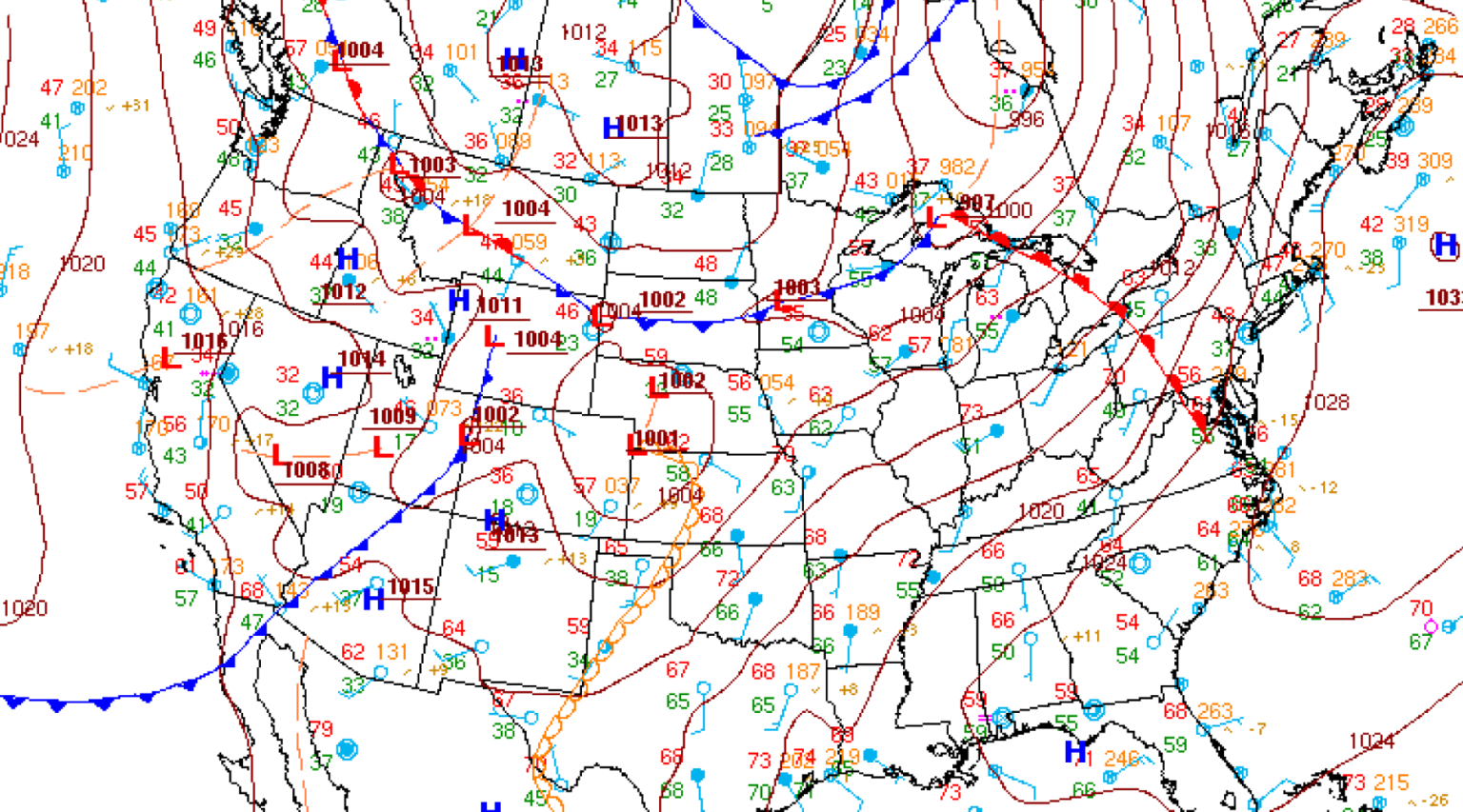
Show answer
- Isobars, which indicate lines of equal pressure.
- The numbers are the pressure (in millibars).
ACS
- PA.I.C.K2b Surface Analysis Chart, Ceiling and Visibility Chart (CVA) · 10 questions
What is the blue "H" over Arizona, and what kind of conditions are associated with it?
Show answer
- A high-pressure system, with air generally sinking, moving outward, and rotating clockwise
- It results in stable conditions such as smooth air and few clouds.
ACS
- PA.I.C.K2b Surface Analysis Chart, Ceiling and Visibility Chart (CVA) · 10 questions
- PA.I.C.K3e Weather system formation, including air masses and fronts · 9 questions
What is the red "L" over Utah, and what kind of conditions are associated with it?
Show answer
- A low-pressure system, with air generally rising, moving inward, and rotating counterclockwise
- It results in unstable conditions such as rain, wind, icing, and even thunderstorms.
ACS
- PA.I.C.K2b Surface Analysis Chart, Ceiling and Visibility Chart (CVA) · 10 questions
- PA.I.C.K3e Weather system formation, including air masses and fronts · 9 questions
What is a ridge, and what kind of conditions are associated with it?
Show answer
- An elongated area of relatively high pressure
- It brings clear skies and light winds.
ACS
- PA.I.C.K2b Surface Analysis Chart, Ceiling and Visibility Chart (CVA) · 10 questions
- PA.I.C.K3e Weather system formation, including air masses and fronts · 9 questions
What is the dashed brown line going over the Gulf of California, and what kind of conditions can you expect?
Show answer
- A trough, which is an elongated area of relatively low pressure.
- It brings gusty winds, clouds, and precipitation.
ACS
- PA.I.C.K2b Surface Analysis Chart, Ceiling and Visibility Chart (CVA) · 10 questions
- PA.I.C.K3e Weather system formation, including air masses and fronts · 9 questions
What is the blue line stretching from the Pacific up to South Dakota, and what kind of conditions are associated with it?
Show answer
- A cold front, where a cold air mass advances under and lifts a warmer air mass.
- Weather changes are abrupt and typically more severe, including thunderstorms, heavy rainfall, and a temperature drop.
ACS
- PA.I.C.K2b Surface Analysis Chart, Ceiling and Visibility Chart (CVA) · 10 questions
- PA.I.C.K3e Weather system formation, including air masses and fronts · 9 questions
What is the red line stretching from western Michigan to Virginia, and what kind of conditions are associated with it?
Show answer
- A warm front, where a warm air mass advances over a cooler air mass.
- Weather changes are slow, and may include light rain, drizzle, and a temperature rise.
ACS
- PA.I.C.K2b Surface Analysis Chart, Ceiling and Visibility Chart (CVA) · 10 questions
- PA.I.C.K3e Weather system formation, including air masses and fronts · 9 questions
What is the red and blue line over Montana, and what kind of conditions are associated with it?
Show answer
- A stationary front, where two air masses meet but neither advances significantly.
- Weather tends to persist and can produce low IFR conditions, including rain.
ACS
- PA.I.C.K2b Surface Analysis Chart, Ceiling and Visibility Chart (CVA) · 10 questions
- PA.I.C.K3e Weather system formation, including air masses and fronts · 9 questions
What is an occluded front, and what kind of conditions are associated with it?
Show answer
- Looks similar to a stationary front, but is entirely purple
- It happens when a cold front, which typically moves faster, catches up to a warm front moving in the same direction.
- When the cold front is colder than the air in front of the warm front ("cold front occlusion"), it lifts the warm air up and generates heavy rainfall.
- When the cold front is warmer than the air in front of the warm front ("warm front occlusion"), it slides in between the warm and colder air and generates gradual weather changes, including prolonged periods of rain.
ACS
- PA.I.C.K2b Surface Analysis Chart, Ceiling and Visibility Chart (CVA) · 10 questions
- PA.I.C.K3e Weather system formation, including air masses and fronts · 9 questions
What are prognostic charts, and what do they show you?
Show answer
Short-Range Surface Prog Charts are the forecast counterpart to a surface analysis chart: same kind of picture, but of conditions expected rather than observed.
- Produced by the Weather Prediction Center for the CONUS and coastal waters, covering a multiday period.
- They plot surface pressure systems, fronts, and precipitation, combining WPC forecasts of fronts, isobars, and highs and lows with the National Digital Forecast Database.
- The period is divided into selected valid times, and each chart is a snapshot of what is expected at its own valid time, not a summary of the span.
- Precipitation is shown by type and probability: rain green, snow blue, mixed purple, freezing rain red, each in a light shade for chance (25% to under 55%) and a dark shade for likely (55% or more). Thunderstorms are red diagonal hatching.
Sources
ACS
- PA.I.C.R2b Aviation weather reports and forecasts · 3 questions
Getting a Briefing and Making the Call
What are the types of preflight weather briefings, and what's in a standard one?
Show answer
- Standard - The full picture, for when you haven't looked at anything yet. It covers adverse conditions, VFR flight not recommended when applicable, the synopsis, current conditions, enroute and destination forecasts, winds aloft, NOTAMs, and ATC delays.
- Abbreviated - An update to a briefing or data you already have. Tell the briefer what you've already seen and when you saw it.
- Outlook - For a departure 6 or more hours away. Forecast information only.
All three are also available in flight via Flight Service. You can also get a compliant briefing by self-briefing with qualified sources (e.g., ForeFlight) because § 91.103 is about having the information, not about how you got it.
Sources
ACS
- PA.I.C.K1 Sources of weather data (e.g., National Weather Service, Flight Service) for flight planning purposes. · 2 questions
What are the limitations of the weather displayed in the cockpit?
Show answer
Datalink weather is old by the time you see it, and it is for strategic decisions, not for picking a way through a storm.
- Every product has latency. NEXRAD imagery may be 15 to 20 minutes older than the time on the display, so check the product time and use it knowing it shows where the weather was.
- Strategic, not tactical. Use it for route selection to avoid a weather area entirely, typically 20 minutes or more ahead. Do not use it as the sole means of negotiating a path through a thunderstorm area, typically under 3 minutes ahead.
- It does not replace a preflight briefing, or ATC and Flight Service in flight.
- A clear radar display does not mean clear weather. Radar does not detect clouds or fog.
- Onboard radar attenuates. An airplane's 3 cm radar loses energy in heavy precipitation, so it typically shows only the leading edge of extreme echoes.
Sources
ACS
- PA.I.C.K4 Flight deck instrument displays of digital weather and aeronautical information.
- PA.I.C.R2a Installed onboard weather equipment
- PA.I.C.R2c Inflight weather resources
What will you do if the weather deteriorates below VFR in flight?
Show answer
Act early, while there are still options. The hazard is continuing VFR into deteriorating conditions, which remains a leading cause of fatal general aviation accidents.
- Make the decision before the margin is gone. A 180° turn puts you back into air you have just proved was flyable.
- Divert to a suitable airport while you still have the ceiling and visibility to get there.
- Use ATC. Request flight following, radar vectors, or declare an emergency if needed. An emergency declaration costs paperwork at worst.
- Climb or descend only if that puts you clearly in better conditions, and never into cloud.
Set the limits on the ground, as a personal minimum with a hard number for ceiling and visibility. Deciding in flight, with a destination in mind and fuel burning, is the condition under which the decision is made badly.
If you end up in it anyway, it is an emergency. Anytime you cannot hold the airplane's attitude by reference to the natural horizon you are in IMC, whatever the prevailing weather, and the AFH says to accept it as a genuine emergency. Three steps, in order:
- Recognize and accept it, and act immediately.
- Keep control of the airplane. Wings level on the attitude indicator. If you must turn, use the smallest practical bank and in no case more than 10°, turning a few degrees at a time and returning to level if the heading change is large. To descend, reduce power in increments of 100 rpm or 1 inHg, keep the rate of descent at or below 500 fpm, and hold the pitch no lower than one bar width below level.
- Get help to put the airplane safely on the ground.
Sources
ACS
- PA.I.C.R1a Circumstances that would make diversion prudent
- PA.I.C.R1b Personal weather minimums
- PA.VIII.E.K3 Procedures available to safely regain visual meteorological conditions (VMC) after flight into inadvertent instrument meteorological conditions or unintended instrument meteorological conditions (IIMC)/(UIMC).
- PA.VIII.F.R1 When to seek assistance or declare an emergency in a deteriorating situation.
Cross-Country Planning and Navigation
Preflight Planning
What information do you need to have prior to any flight?
Show answer
- NOTAMs
- Weather reports and forecasts
- Known ATC delays
- Runway lengths
- Alternatives available
- Fuel requirements
- Takeoff and landing distances
ACS
- PA.I.D.R3 Environment (e.g., weather, airports, airspace, terrain, obstacles).
How do you plan the route and pick a cruising altitude for a VFR cross-country?
Show answer
Chart the course first, then compute from it: plot the course on a sectional, pick checkpoints, measure distances, get the weather, and work out headings, time, and fuel.
Choosing an altitude balances several things against each other:
- Terrain and obstacles, with enough margin to clear them and to be received by the facilities you plan to use.
- Glide distance. Higher gives you more choices if the engine quits, which matters most over inhospitable ground.
- § 91.159 VFR cruising altitudes, which apply in level cruise more than 3,000 ft above the surface and are set by magnetic course.
- Wind. The winds aloft forecast can make a 2,000 ft difference worth several knots of groundspeed either way.
- Weather and cloud clearance, since the altitude has to keep you legal under § 91.155 as well as clear of terrain.
What to compute, and these are the ACS's own list: time, climb and descent rates, course, distance, heading, true airspeed, and groundspeed; estimated time of arrival including the conversion to UTC; and fuel requirements including reserve. Work the fuel consumption rate against the estimated time so refueling points are part of the plan rather than a surprise.
Two currency traps. A sectional can be up to 6 months old, and the effective date is printed on the front. Where the back of the chart and the Chart Supplement disagree, the Chart Supplement is newer and wins.
Then the airplane. Weight and balance from the latest data in the approved AFM, and takeoff and landing distances for the fields you are actually using, which § 91.103 requires for any flight.
Sources
ACS
- PA.I.D.K2 Altitude selection accounting for terrain and obstacles, glide distance of airplane, VFR cruising altitudes, and effect of wind. · 3 questions
- PA.I.D.K3a Time, climb and descent rates, course, distance, heading, true airspeed, and groundspeed
- PA.II.B.K3 Requirements for current and appropriate navigation data. · 3 questions
When do you need a VFR flight plan, and how do you file, activate, and close one?
Show answer
Within the continental U.S. a VFR flight plan is not normally required, but it is strongly recommended: it is what causes somebody to look for you.
When one is required:
- Into an ADIZ: a DVFR flight plan, except for DoD and law enforcement flights.
- VFR to an international destination: a filed and activated flight plan.
- The Washington DC Special Flight Rules Area carries additional requirements of its own.
Filing. With Flight Service or an equivalent service, on FAA Form 7233-4. File a separate plan for each leg of a stopover flight, and list surveillance equipment, because ATC radar history helps locate a downed aircraft.
Activating is on you, by radio or other electronic means.
- U.S. towers do not routinely activate VFR flight plans. Talking to the tower is not activating anything.
- An assumed departure time activates it automatically. Depart late without updating it and search and rescue works from the assumed time.
Closing is entirely on you, and this is where it differs from IFR.
- Landing at a towered airport does not close a VFR flight plan. Control towers do not close VFR or DVFR flight plans, because they have no way to know a given VFR aircraft is on one.
- An IFR flight plan to a towered airport is closed automatically on landing. Carrying that habit across is the trap.
- Close with the nearest FSS. If none is available, ask any ATC facility to relay the cancellation.
- Fail to report or cancel within 30 minutes after your ETA and search and rescue procedures start.
Position reports are not required, but periodic calls to Flight Service are good practice.
Sources
ACS
- PA.I.D.K5 Procedures for filing, activating, and closing a VFR flight plan.
What can Flight Service do for you on a VFR flight, and how do you reach them?
Show answer
Flight Service Stations are air traffic facilities. What they do:
- Pilot briefings
- Flight plan processing: activating and closing yours, and starting a search if you do not
- En route flight advisories
- Search and rescue services
- Assistance to lost aircraft and aircraft in emergency situations
- Relaying ATC clearances
- Processing NOTAMs
- Broadcasting aviation weather and aeronautical information
On the ground: 1-800-WX-BRIEF in the CONUS, Hawaii, and Puerto Rico, 1-833-AK-BRIEF in Alaska, or 1800wxbrief.com.
In the air you find the frequency on the sectional, and there are two places to look:
- A heavy line box around a NAVAID box marks a Flight Service Station. The frequencies it works are printed above the box.
- A thin line box is a Remote Communications Outlet (RCO), an FSS radio providing voice communications away from the station itself. Frequencies above a thin line box are remoted to the NAVAID site.
- A thin line box with no frequencies means no FSS frequencies are available there.
Reading the frequencies:
- They transmit and receive unless followed by a letter.
- R means receive only: the station listens on that frequency but answers over the NAVAID's voice channel, so you transmit on the printed frequency and listen on the VOR.
- T means transmit only.
- The FSS name under the box is who you are calling. Use it on the radio: "Princeton Radio, Skyhawk..."
The sectional is not the complete list. Other FSS frequencies may be usable depending on altitude and terrain, and the Chart Supplement has the full set. In Alaska, 121.5, 122.2 and 243.0 are available at many FSSs and are not printed above the boxes.
The specialist is a certified Pilot Weather Briefer but is not authorized to make original forecasts. They translate and interpret available weather into what to expect at departure, en route, and destination. The briefing is complete when you have a clear picture, so ask about anything you do not follow.
Sources
ACS
- PA.I.C.K1 Sources of weather data (e.g., National Weather Service, Flight Service) for flight planning purposes. · 2 questions
- PA.III.A.K1 How to obtain appropriate radio frequencies.
- PA.VIII.F.K3 Air traffic control facilities and services.
What is a NOTAM, and can you provide some examples?
Show answer
- Notices to Airmen are time-sensitive notices issued by aviation authorities to alert pilots of essential information, hazards, or changes that could affect flight safety.
- Examples include runway or taxiway closures, NAVAIDs out of service, obstacles, temporary flight restrictions (TFRs), and parachute jumping.
ACS
- PA.II.D.K1 Current airport aeronautical references and information resources such as the Chart Supplement, airport diagram, and Notices to Air Missions (NOTAMs). · 3 questions
Where can you find NOTAMs?
Show answer
The FAA NOTAM Search, as well as EFB apps such as ForeFlight
ACS
- PA.II.D.K1 Current airport aeronautical references and information resources such as the Chart Supplement, airport diagram, and Notices to Air Missions (NOTAMs). · 3 questions
Can you fly with an EFB instead of paper charts, and what are the risks?
Show answer
Yes, under part 91, with no formal operational approval, if you follow AC 91-78A. Using an EFB in flight in place of paper is the decision of the operator and the PIC.
The EFB may replace paper when:
- It does not replace any system or equipment part 91 requires, such as a navigation, communication, or surveillance system.
- It shows only information functionally equivalent to the paper it replaces.
- The charts and data used for navigation or performance planning are current, up to date, and valid, as verified by the pilot.
- It complies with § 91.21 and does not interfere with equipment required for flight.
Risks:
- System failure or shutdown in flight.
- Workload: inputs become more demanding in flight. Cross-check data entry and computed results.
- Display and lighting: at night, set its brightness so it does not impair night vision.
- An unsecured device: stow or secure it for takeoff and landing.
- Datalink weather on it is not live. Check the product time, since latency may limit how you can use it.
Sources
ACS
- PA.I.D.K1a Use of an electronic flight bag (EFB), if used
- PA.I.D.R7 Use of an electronic flight bag (EFB), if used.
- PA.II.B.K3 Requirements for current and appropriate navigation data. · 3 questions
- PA.II.B.R1 Use of systems or equipment, including automation and portable electronic devices.
- PA.VI.B.R5 Use of an electronic flight bag (EFB), if used.
Navigation Methods
What is the difference between pilotage and dead reckoning?
Show answer
- Pilotage is navigation by reference to landmarks or checkpoints. It works on any course with adequate checkpoints.
- Dead reckoning is navigation solely by computation from time, airspeed, distance, and direction, adjusted for wind to produce a heading and a groundspeed.
They are used together. Dead reckoning gives you the heading to fly and the time to each checkpoint; pilotage confirms it and corrects it as the checkpoints come up. The PHAK's exception is flights over water, where there are no checkpoints to pilot by, so dead reckoning is not paired with pilotage. Radio navigation is still available.
Choosing checkpoints well is most of what makes pilotage work:
- Pick prominent features common to the area: roads, rivers, railroads, lakes, power lines.
- Prefer features that bracket the course on each side, which shows a drift before it becomes a position error.
ACS
- PA.VI.A.K1 Pilotage and dead reckoning.
- PA.VI.A.K4c Checkpoints
How do you get from true course to compass heading?
Show answer
Three corrections, each for one thing:
- True course measured off the chart, then apply the wind correction angle to get true heading. Wind from the right is added, from the left subtracted.
- Apply variation to get magnetic heading.
- Apply deviation from the compass correction card to get compass heading.
Which way to apply variation: "east is least, subtract. West is best, add."
The PHAK's worked example: a true course of 090 with a wind correction angle of 14° from the left gives a true heading of 076. Variation and then deviation are applied to that to reach the compass heading.
ACS
- PA.VI.A.K5a Determining heading, speed, and course · 2 questions
- PA.VI.A.K5b Wind correction angle · 2 questions
What is the difference between variation and deviation?
Show answer
- Variation is the angle between true north and magnetic north, a property of where you are on the Earth. It is read off the chart from the isogonic lines, the broken magenta lines connecting points of equal variation.
- Deviation is the error in your airplane's compass caused by magnetic influences within the aircraft: electrical circuits, radios, lights, tools, the engine, magnetized metal parts. It is read off the compass correction card.
Deviation is different for each airplane, and it may vary by heading in the same airplane, which is why the card lists several headings.
The line connecting points of zero variation is the agonic line. Isogonic lines change slightly over time, which is one reason chart currency matters.
ACS
- PA.VI.A.K2 Magnetic compass errors. · 2 questions
What does the wind triangle give you, and what happens with a direct crosswind?
Show answer
It solves for the two things you cannot read off a chart: the heading to fly and the groundspeed you will make.
The three sides of the triangle pair up like this:
- Air vector: true heading and true airspeed, where the airplane is pointed and how fast it moves through the air.
- Ground vector: true course and groundspeed, where it actually tracks and how fast it moves over the ground.
- Wind vector: wind direction and velocity.
True course, TAS, and the wind are the knowns; true heading and groundspeed are what the triangle gives you. The PHAK's worked case is an 080° heading at 120 kt airspeed producing a 090° course at 110 kt groundspeed.
- Airspeed and wind are independent. The airplane does not feel the wind; a pilot in a 70 knot gale is unaware of it unless the ground is observed.
- A tailwind adds to groundspeed, a headwind subtracts. 120 knots TAS with a 20 knot tailwind is 140 over the ground, and 100 against it.
- A crosswind drifts you off course, so it requires a wind correction angle into the wind to hold the course line.
A direct crosswind still costs groundspeed. Crabbing leaves your airspeed vector off the course line, so only the remaining component advances you: 100 knots TAS with a direct 30 knot crosswind makes about 95 over the ground.
The same geometry means a round trip in steady wind always takes longer than in calm air.
ACS
- PA.VI.A.K5a Determining heading, speed, and course · 2 questions
- PA.VI.A.K5b Wind correction angle · 2 questions
Radio Navigation
How does a VOR work?
Show answer
A reference phase signal broadcasts in all directions, and a variable phase signal rotates 360°. Your VOR receiver compares the timing differences and determines a bearing.
ACS
- PA.VI.B.K1 Ground-based navigation (identification, orientation, course determination, equipment, tests, regulations, interference, appropriate use of navigation data, and signal integrity). · 2 questions
How does GPS work?
Show answer
- A constellation of satellites in medium Earth orbit, with enough satellites visible for the receiver to calculate position
- Each satellite sends a signal containing its position and the highly accurate time the signal was sent.
- Your GPS receiver uses those signals to calculate distance from each satellite, producing a sphere of possible positions.
- Additional satellite signals narrow the position solution and help correct receiver clock error.
Sources
- FAA AIM Section 1-2 - Performance-Based Navigation (PBN) and Area Navigation (RNAV)
- FAA AIM ¶ 1-2-3 - Use of Suitable Area Navigation (RNAV) Systems on Conventional Procedures and Routes
- FAA AC 90-108 Chg. 1 - Use of Suitable RNAV Systems on Conventional Routes and Procedures
- FAA AIM ¶ 1-2-2 - Required Navigation Performance (RNP)
- FAA Instrument Procedures Handbook, Chapter 5 - Global Positioning System
ACS
- PA.VI.B.K2 Satellite-based navigation (e.g., equipment, regulations, authorized use of databases, and Receiver Autonomous Integrity Monitoring (RAIM)). · 2 questions
What do you need to watch when you navigate VFR by GPS?
Show answer
It depends on the receiver. VFR use covers everything from a fully integrated IFR/VFR installation to a handheld, and some limits belong only to VFR-only receivers.
Any GPS used VFR:
- Database currency. No rule requires a current database for VFR, but do not use an outdated moving map in or near critical airspace. Verify waypoints against current charts or the Chart Supplement.
- Do not rely on it alone. Cross-check with pilotage, dead reckoning, and other navigation, and distrust the GPS when they disagree.
- Program it on the ground. Load VFR waypoints before takeoff, exercise caution when programming routes once airborne, and keep your eyes outside.
VFR panel-mount and handheld receivers add:
- No RAIM alerting. They cannot warn you that satellites were lost or that the position is wrong. IFR equipment classes have RAIM or an equivalent.
- No accuracy standard. No design standard of accuracy or integrity applies to a VFR receiver.
- Antenna location. A suction-cup antenna inside the cabin rarely sees all the satellites, so you can lose the signal, and without RAIM you may get a wrong position with no warning.
- They are not authorized for IFR navigation or approaches.
ACS
- PA.II.B.K3 Requirements for current and appropriate navigation data. · 3 questions
- PA.VI.B.K2 Satellite-based navigation (e.g., equipment, regulations, authorized use of databases, and Receiver Autonomous Integrity Monitoring (RAIM)). · 2 questions
- PA.VI.B.R1 Management of automated navigation and autoflight systems.
- PA.VI.B.R3 Limitations of the navigation system in use. · 3 questions
How far out is a VOR signal reliable?
Show answer
Legacy:
- Terminal (T):
- 1,000-12,000 ft - 25 NM
- Low (L):
- 1,000-18,000 ft - 40 NM
- High (H):
- 1,000-14,500 ft - 40 NM
- 14,500-18,000 ft - 100 NM
- 18,000-45,000 ft - 130 NM
- 45,000-60,000 ft - 100 NM
Minimum Operational Network (MON):
- Low (VL):
- 1,000-5,000 ft - 40 NM
- 5,000-18,000 ft - 70 NM
- High (VH):
- 1,000-5,000 ft - 40 NM
- 5,000-14,500 ft - 70 NM
- 14,500-18,000 ft - 100 NM
- 18,000-45,000 ft - 130 NM
- 45,000-60,000 ft - 100 NM
ACS
- PA.VI.B.K1 Ground-based navigation (identification, orientation, course determination, equipment, tests, regulations, interference, appropriate use of navigation data, and signal integrity). · 2 questions
- PA.VI.B.R3 Limitations of the navigation system in use. · 3 questions
- Terminal (T):
If you are picking up a reliable VOR signal further than the published service volume, can you use it for navigation?
Show answer
Yes, but you cannot plan your flight to count on it if using the VOR for navigation. Also, be very wary of loss of signal.
ACS
- PA.VI.B.R3 Limitations of the navigation system in use. · 3 questions
- PA.VI.B.R4 Loss of a navigation signal.
What radar services can you get as a VFR pilot, and what do they do and not do for you?
Show answer
Basic radar service is available from every commissioned radar facility, to any VFR aircraft that can communicate with it and is within radar coverage:
- Safety alerts
- Traffic advisories
- Limited radar vectoring, workload permitting
- Sequencing where procedures or a letter of agreement exist
Traffic advisories tell you where to look, not that you are separated. The controller calls a target whose position and track may put it near you, so you can see and avoid it. ATC's surveillance radar gives no altitude on a target unless that aircraft has Mode C and the facility can display it.
Vectors do not relieve you of anything. Accepting radar navigational assistance is not authorization to violate a regulation, and in many cases the controller cannot tell whether their instruction will put you into instrument conditions. If a vector would take you into cloud, say so.
Where more is offered:
- TRSA: participating VFR aircraft are separated from IFR and other participating VFR aircraft by 500 ft vertical, visual separation, or target resolution. You must hold an assigned altitude, and ATC may assign one that does not conform to § 91.159.
- Class C: separation between VFR and IFR is standard, not optional.
- Class B: everyone is separated.
You still see and avoid. § 91.113(b) applies whatever service you are receiving.
Sources
ACS
- PA.I.D.R5 Limitations of air traffic control (ATC) services.
- PA.III.A.K7 Radar assistance.
- PA.VI.B.K3 Radar assistance to visual flight rules (VFR) aircraft (e.g., operations, equipment, available services, traffic advisories).
What do transponder Modes A, C, and S send?
Show answer
- Mode A, also written Mode 3/A, replies with the four-digit code you set, which identifies you on radar.
- Mode C is Mode A with altitude reporting: pressure altitude in 100 ft increments, sent to the radar and to TCAS and ADS-B In users.
- Mode S can also report altitude, and carries the aircraft's unique ICAO aircraft address, also called its Mode S code.
- The Traffic Information Service (TIS) uplinks nearby traffic to the cockpit using the Mode S transponder.
- On the ground, you should have altitude reporting on any time you are on the airport movement area.
- IDENT only when ATC asks.
- "Stop altitude squawk" means turn off automatic altitude reporting. ATC uses it when the transmitted altitude may be wrong. An incorrect altimeter setting does not change what the transponder sends, but it does put you at the wrong true altitude.
Sources
- FAA Aeronautical Information Manual 4-1 - Services Available to Pilots
- 14 CFR § 91.215 - ATC transponder and altitude reporting equipment and use
- FAA Aeronautical Information Manual 5-6 - National Security and Interception Procedures
- FAA Instrument Flying Handbook, Chapter 5 - Flight Instruments (traffic information systems)
ACS
- PA.III.A.K4 Appropriate use of transponder(s). · 2 questions
- PA.VI.B.K4 Transponder (Mode(s) A, C, and S) and Automatic Dependent Surveillance-Broadcast (ADS-B). · 3 questions
When the Plan Changes
Walk me through a VFR diversion.
Show answer
It starts on the ground. Before any cross-country, check the charts for airports or suitable landing areas along or near the route, and for navaids you could use to divert.
In flight, precision is not the priority:
- If time permits, start the diversion over a prominent ground feature. In an emergency, turn toward the alternate promptly: finishing the plotting, measuring, and computing first may only make the emergency worse.
- Measure the course with a straightedge against the compass rose around a VOR, or approximate it from a nearby radial or a paralleling airway. Plotting on the chart is rarely practical and seldom necessary, since an alternate is usually not far off course. The trap: a VOR radial or a printed airway is a magnetic heading outbound from the station, so to get the course to the station you may need its reciprocal.
- Use rules of thumb for time, speed, and distance. Attention is already divided between flying, computing, and scanning.
- Confirm the fuel on board covers the new leg plus reserve.
- Advise ATC or flight service, and amend or close the flight plan.
For the diversion altitude, consider cloud heights, winds, terrain, and radio reception.
ACS
- PA.VI.C.K1 Selecting an alternate destination.
- PA.VI.C.R5 Using available resources (e.g., automation, ATC, and flight deck planning aids).
What will you do if you become lost on a VFR cross-country?
Show answer
The PHAK's order, and the first step is not what most people guess:
- Climb, if a town or city cannot be seen, mindful of traffic and weather. Altitude increases radio and navigation reception range and radar coverage.
- Identify a landmark. Near a town it may be possible to read the name off a water tower.
- Plot a position from two or more navaids if you have a VOR or ADF, or read present position and the nearest airport off a GPS.
- Communicate with any available facility, using the frequencies shown on the sectional. A controller may offer radar vectors.
- Direction finding assistance is available from some facilities. The controller has you hold the transmit button down a few seconds and release, over several headings, which lets them plot you and vector you to a landing site.
- If the situation becomes threatening, transmit on 121.5 MHz and squawk 7700.
Getting lost is most dangerous when low on fuel, so work the list early rather than after the reserve is gone.
ACS
- PA.VI.D.K1 Methods to determine position.
- PA.VI.D.K2 Assistance available if lost (e.g., radar services, communication procedures).
- PA.VI.D.R4 When to seek assistance or declare an emergency in a deteriorating situation.
Airspace
The Classes
Walk me through the airspace classes and what defines each one.
Show answer
Class Vertical limits To enter A 18,000 ft MSL to FL600 IFR only, clearance required B Surface to 10,000 ft MSL Clearance, two-way radio, transponder, ADS-B, private certificate or student endorsement C Surface to 4,000 ft above the field Two-way radio established, transponder, ADS-B D Surface to 2,500 ft above the field Two-way radio established E Floor varies, up to but not including 18,000 ft MSL No clearance or radio; equipment depends on altitude and location G Surface to the base of the overlying Class E Nothing from the class itself Shapes and purpose:
- B is individually tailored, a surface area plus two or more layers, the upside-down wedding cake. Every cleared aircraft receives separation services.
- C is usually a 5 NM radius surface area with a 10 NM outer circle from 1,200 ft to 4,000 ft above the field, at airports with a tower and radar approach control.
- D exists where there is an operating control tower. Where instrument procedures are published, it is normally designed to contain them.
- E is the controlled airspace that is none of the above, with floors commonly at 700 or 1,200 ft AGL and 14,500 ft MSL where nothing lower is designated.
- G is uncontrolled. ATC has no authority or responsibility there.
Equipment rules reach into E and G. In the 48 contiguous states and DC, a Mode C transponder is required in all airspace at and above 10,000 ft MSL and ADS-B Out in Class E there, both excluding airspace at and below 2,500 ft AGL. Both are also required above a Class B or C ceiling up to 10,000 ft MSL and inside the 30 NM Mode C veil, much of which is E or G. Airplanes never certificated with an engine-driven electrical system, originally or since, such as a J-3 Cub without one installed, are exempt at and above 10,000 ft, and in the veil outside and below any Class B or C. ADS-B Out is also required in Class E over the Gulf of Mexico at and above 3,000 ft MSL.
Sources
ACS
- PA.I.E.K1 Airspace classes and associated requirements and limitations. · 11 questions
What do you need to enter Class B airspace?
Show answer
- An ATC clearance from the facility having jurisdiction, before entering. "Radar contact" is not a clearance. The words you need are "cleared into the Class B."
- A two-way radio capable of communicating with ATC on assigned frequencies.
- An operable Mode C transponder and ADS-B Out.
- At least a private pilot certificate. A student pilot may operate there with the § 61.94 or § 61.95 training and endorsement. The appendix D, section 4 restriction is narrower than it is often stated: at those airports no person may take off or land unless the PIC holds at least a private certificate. An endorsed student may still transit the Class B above them.
Speed below the Class B floor or in a VFR corridor through it is limited to 200 knots. Inside Class B the limit is the general 250 knots below 10,000 ft.
ACS
- PA.I.E.K1 Airspace classes and associated requirements and limitations. · 11 questions
What do you need to enter Class C airspace?
Show answer
- § 91.130 requires you to establish two-way radio communications with the facility providing air traffic services prior to entering, and thereafter maintain them while in the airspace.
- Calling and getting no answer is not establishing communication. You stay out until the controller answers you with your tailnumber.
- The AIM is explicit that this is a low bar: "(callsign) standby" means communications have been established and you may enter. If workload prevents immediate service, the controller will instead tell you to remain outside.
- Mode C transponder and ADS-B Out.
- No specific certificate is required, and a student pilot needs no special endorsement.
No clearance is required, which is the difference from Class B. Once two-way communications and radar contact are established, ATC separates VFR aircraft from IFR aircraft within the Class C and the outer area, using visual separation or 500 ft vertical. It also sequences all VFR aircraft to the primary airport and gives traffic advisories and safety alerts between VFR aircraft.
Within 4 NM of the primary airport at or below 2,500 ft AGL, the speed limit is 200 knots unless otherwise authorized or required by ATC.
Sources
ACS
- PA.I.E.K1 Airspace classes and associated requirements and limitations. · 11 questions
What do you need to enter Class D airspace?
Show answer
- Establish communication before entering and maintain it while in the airspace. As in Class C, "(callsign) standby" means communications have been established and you may enter; if the controller is too busy, they will tell you to remain outside.
- No specific certificate and no endorsement.
- Class D itself requires no transponder and no ADS-B. That is not the same as none being required where you are.
- A Class D inside the 30 NM Mode C veil picks up both: the veil is § 91.215(b)(2) for the transponder and § 91.225(d)(2) for ADS-B, and both are keyed to the same appendix D, section 1 airports.
- A Class D within 10 NM of an appendix D, section 2 airport picks up the transponder only. § 91.215(b)(5)(ii) names that ring; § 91.225(d) does not list it, so no ADS-B requirement follows from it.
- Being beneath a Class B or C shelf picks up neither. Both regulations attach the requirement to the airspace above a B or C ceiling, not below its floor.
- At any airport with an operating control tower, you need a clearance to take off, to land, or to operate on a runway or taxiway.
Within 4 NM of the primary airport at or below 2,500 ft AGL, the speed limit is 200 knots unless otherwise authorized or required by ATC.
When the tower closes, the airspace reverts: either the Class E surface area rules, or Class E from 700 ft AGL with Class G below it.
Sources
ACS
- PA.I.E.K1 Airspace classes and associated requirements and limitations. · 11 questions
What is Class E airspace, and where does it begin?
Show answer
The controlled airspace that is not Class A, B, C, or D. Its purpose is to provide enough controlled airspace to safely control and separate aircraft during IFR operations.
Where the floor sits:
- 1,200 ft AGL in many areas, the common default.
- 700 ft AGL or the surface in many others, typically where there is an instrument approach.
- Some Class E begins at an MSL altitude depicted on the chart.
How a sectional shows it, per the Chart Users' Guide:
- A magenta vignette marks a floor of 700 ft AGL.
- A blue vignette marks a floor other than 700 ft that laterally abuts Class G.
- A magenta dashed line marks Class E surface airspace.
Class E extends up to but not including 18,000 ft MSL, and all airspace above FL600 is also Class E.
No clearance and no communication are required to fly VFR in it, and the weather minimum steps to 5 SM at and above 10,000 ft MSL.
A Mode C transponder and ADS-B Out can still be required in Class E, but the requirement comes from where you are, not from the class: above 10,000 ft MSL, above a Class B or C ceiling, or inside the Mode C veil.
Sources
- FAA Pilot's Handbook of Aeronautical Knowledge, Chapter 15 - Airspace
- 14 CFR § 91.215 - ATC transponder and altitude reporting equipment and use
- 14 CFR § 91.225 - Automatic Dependent Surveillance-Broadcast (ADS-B) Out equipment and use
- FAA Aeronautical Chart Users' Guide - VFR Terms and Symbols (Class E vignette)
- 14 CFR § 91.155 - Basic VFR weather minimums
ACS
- PA.I.E.K1 Airspace classes and associated requirements and limitations. · 11 questions
- PA.I.E.K2 Chart symbols.
What is Class G airspace, and how high does it go?
Show answer
Uncontrolled airspace: the portion not designated Class A, B, C, D, or E. It runs from the surface up to the base of the overlying Class E, so the top is wherever Class E starts.
Working upward, that base is:
- 700 ft AGL, shown by a magenta vignette, typically around an airport with an instrument approach.
- 1,200 ft AGL in many areas, the common default.
- 14,500 ft MSL where no lower Class E floor is designated. Note MSL, not AGL.
Above 14,500 ft MSL it is Class E, with one exception: airspace less than 1,500 ft above the terrain stays Class G. Over 14,000 ft terrain in the mountain west, Class G continues above 14,500 ft MSL.
ATC has no authority or responsibility to control traffic in Class G, and nothing is required to enter: no clearance, no equipment, no communication. The VFR weather minimums still apply, and they are the most complex in the § 91.155 table because they split by altitude and by day or night.
Sources
ACS
- PA.I.E.K1 Airspace classes and associated requirements and limitations. · 11 questions
VFR Weather Minimums
What are the basic VFR weather minimums?
Show answer
The § 91.155 table, for aircraft other than helicopters. 152 is shorthand for 500 ft below, 1,000 ft above, 2,000 ft horizontal.
Airspace Flight visibility Distance from clouds Class A Not applicable Not applicable Class B 3 SM Clear of clouds Class C 3 SM 152 Class D 3 SM 152 Class E, below 10,000 ft MSL 3 SM 152 Class E, at or above 10,000 ft MSL 5 SM 1,000 below, 1,000 above, 1 SM horizontal Class G, 1,200 ft or less AGL (regardless of MSL altitude), day 1 SM Clear of clouds Class G, 1,200 ft or less AGL (regardless of MSL altitude), night 3 SM 152 Class G, above 1,200 ft AGL and below 10,000 ft MSL, day 1 SM 152 Class G, above 1,200 ft AGL and below 10,000 ft MSL, night 3 SM 152 Class G, above 1,200 ft AGL and at or above 10,000 ft MSL 5 SM 1,000 below, 1,000 above, 1 SM horizontal One pattern makes the table easier to hold: at and above 10,000 ft MSL the clearances change shape to 1,000 above, 1,000 below and a full statute mile horizontally.
A narrow exception: at night in Class G below 1,200 ft AGL, within half a mile of the runway in an airport traffic pattern, an airplane may operate clear of clouds with at least 1 SM.
Two more rules in the same section, and neither is in the table:
- § 91.155(c): you may not operate beneath the ceiling under VFR inside the lateral boundaries of controlled airspace designated to the surface for an airport when the ceiling is less than 1,000 ft.
- § 91.155(d): you may not take off, land, or enter the traffic pattern under VFR within the surface areas of Class B, C, D, or E unless ground visibility at that airport is at least 3 SM, or, where ground visibility is not reported, flight visibility is at least 3 SM.
Both are excepted by special VFR.
ACS
- PA.I.E.K1 Airspace classes and associated requirements and limitations. · 11 questions
Why is Class B only clear of clouds when Class C and D need 500 and 1,000 ft?
Show answer
Because everyone in Class B is separated by ATC. A clearance is required for all aircraft, and the PHAK states that all aircraft that are so cleared receive separation services within the airspace.
- The regulation gives no reason, but the usual reading follows from that: with no unknown traffic to see and avoid, the cloud clearance need only keep you out of the cloud itself, so clear of clouds is enough.
- In Class C and D, VFR traffic is not separated from other VFR traffic. You remain responsible for seeing and avoiding, so the 500 below, 1,000 above and 2,000 horizontal buys the distance to spot an airplane emerging from a cloud.
Sources
ACS
- PA.I.E.K1 Airspace classes and associated requirements and limitations. · 11 questions
What is special VFR? When would you use it? How do you request it? Are there any rules you must follow while in special VFR?
Show answer
What it is
Special VFR (SVFR) is an ATC clearance that allows a VFR aircraft to operate within controlled airspace designated to the surface for an airport when the weather is below basic VFR minimums. For airplanes, SVFR generally requires at least 1 statute mile visibility and clear of clouds.
When you'd use it
You might use SVFR to enter, leave, or operate within a surface area when the weather is below normal VFR minimums, but conditions are still good enough to safely remain clear of clouds with the required visibility. For example, an airport might have a low cloud layer that makes the field technically IFR, while visibility below the layer is adequate for a short VFR departure or arrival.
How to request it
To request it, you can call tower and say "Tower, Archer 3096B, request Special VFR departure to the west".
Rules to follow
For airplanes, you need at least 1 SM visibility and must remain clear of clouds. At night, the pilot must be instrument rated and the airplane must be IFR equipped. SVFR is traffic permitting, applies only within the surface area, and is prohibited for fixed-wing aircraft at certain airports.
ACS
- PA.I.E.K4 Special visual flight rules (VFR) requirements.
Altitudes and Speed Limits
What VFR cruising altitudes apply, and when?
Show answer
They apply in level cruising flight more than 3,000 ft above the surface, except while holding in a pattern of 2 minutes or less, while turning, or where otherwise authorized by ATC. Below 18,000 ft MSL:
- Magnetic course 0° through 179°: odd thousands plus 500. 3,500, 5,500, 7,500.
- Magnetic course 180° through 359°: even thousands plus 500. 4,500, 6,500, 8,500.
Course, not heading. A wind correction does not change which rule applies.
At or below 3,000 ft AGL the rule does not bind, so you may cruise at any altitude subject to § 91.119. The ATC exception is not academic either: controllers routinely assign VFR altitudes that do not conform to § 91.159 on a Class B transition.
ACS
- PA.I.D.K2 Altitude selection accounting for terrain and obstacles, glide distance of airplane, VFR cruising altitudes, and effect of wind. · 3 questions
What are the minimum safe altitudes?
Show answer
From § 91.119, except when necessary for takeoff or landing:
- Anywhere: an altitude allowing an emergency landing without undue hazard to persons or property if a power unit fails.
- Over congested areas of a city, town, or settlement, or an open air assembly: 1,000 ft above the highest obstacle within a horizontal radius of 2,000 ft of the aircraft.
- Other than congested areas: 500 ft AGL.
- Over open water or sparsely populated areas: no altitude floor, but you may not operate closer than 500 ft to any person, vessel, vehicle, or structure.
The "anywhere" rule binds on top of the others, not instead of them. Meeting the 500 ft figure in paragraph (c) is no defense if a power failure at that altitude and over that ground would put the airplane into something, because paragraph (a) is about undue hazard to persons or property on the surface.
ACS
- PA.I.D.K2 Altitude selection accounting for terrain and obstacles, glide distance of airplane, VFR cruising altitudes, and effect of wind. · 3 questions
What speed limits apply, and where?
Show answer
Three limits from § 91.117:
- 250 knots indicated below 10,000 ft MSL, unless otherwise authorized by the Administrator.
- 200 knots at or below 2,500 ft above the surface within 4 NM of the primary airport of Class C or Class D airspace, unless otherwise authorized or required by ATC. Controllers do assign speeds there.
- 200 knots in the airspace underlying Class B, or in a VFR corridor through it. This limit has no ATC exception.
The 200 knot limit does not apply inside Class B itself. There you comply with the 250 knot rule.
If the minimum safe airspeed for any particular operation is greater than the limit, you may fly at that minimum speed.
Sources
ACS
- PA.I.E.K1 Airspace classes and associated requirements and limitations. · 11 questions
Right-of-Way and Security
What are the right-of-way rules?
Show answer
The duty to see and avoid comes first. § 91.113(b): when weather permits, vigilance to see and avoid other aircraft is maintained whether you are IFR or VFR. Where a rule gives another aircraft the right of way, you give way and may not pass over, under, or ahead of it unless well clear.
- In distress: right of way over all other air traffic.
- Converging, same category and about the same altitude: the aircraft to the other's right has the right of way.
- Head-on or nearly so: each pilot alters course to the right. Nobody has the right of way.
- Overtaking: the aircraft being overtaken has it. The overtaking aircraft alters course to the right to pass well clear.
- Landing: aircraft on final approach or landing have it over aircraft in flight or on the surface. With two or more approaching to land, the lower aircraft has it.
Converging aircraft of different categories run least maneuverable first:
Balloon, then glider, then airship, then powered parachute, weight-shift-control, airplane and rotorcraft. An aircraft towing or refueling another has the right of way over all other engine-driven aircraft.
Two anti-abuse clauses sit in the rule itself. A landing aircraft may not use its priority to force an aircraft that has already landed off the runway, and a lower aircraft on approach may not use its priority to cut in front of or overtake another on final.
ACS
- PA.III.B.K3 Right-of-way rules. · 2 questions
What do you do if you are intercepted?
Show answer
Air Defense Sectors monitor traffic with the FAA and can order an intercept in the interest of national security. An interceptor may be trying to identify, track, inspect, divert or establish communications with your aircraft.
Before it happens: maintain a listening watch on the guard frequencies, 121.5 or 243.0 MHz. All aircraft in U.S. national airspace are highly encouraged to, and if you are intercepted it is on you to establish contact.
How it unfolds. Interceptors approach from behind, usually in pairs though sometimes singly, then close to a distance sufficient for positive identification.
The ICAO signals, which are the part to know cold:
Interceptor does Means You respond Rocks its wings from slightly above, ahead, and normally to your left, then a slow level turn, normally left, onto a heading. At night, the same plus irregularly flashing navigation lights You have been intercepted. Follow me. Rock your wings and follow. At night, flash your navigation lights irregularly as well An abrupt break-away: a climbing turn of 90° or more without crossing your flight path You may proceed If you cannot keep pace, the interceptor is expected to fly race-track patterns, rocking its wings each time it passes you.
Terrain or weather may put the interceptor on your right instead, with the turn to the right.
ACS
- PA.I.D.K6 Inflight intercept procedures.
Special Use Airspace
What are the types of special use airspace?
Show answer
- Prohibited area - Flight is prohibited, period. Established for security or national welfare reasons, e.g., P-56 over the White House.
- Restricted area - Hazardous activity such as artillery fire, gunnery, or missile testing. You need permission from the controlling agency unless it's inactive and released.
- Warning area - The same kind of activity as a restricted area, but starting 3 NM off the coast over domestic or international waters. It's advisory in nature, because the airspace can't be prohibited.
- Military Operations Area (MOA) - Separates military training from IFR traffic. VFR traffic isn't prohibited, but exercise real caution.
- Alert area - High volume of pilot training or unusual aerial activity. Everybody in there is equally responsible for seeing and avoiding.
- Controlled firing area - Activity stops when an aircraft approaches, which is why these aren't charted.
- National security area - Flight avoidance is requested, and can be made mandatory by NOTAM.
Sources
ACS
- PA.I.E.K3 Special use airspace (SUA), special flight rules areas (SFRA), temporary flight restrictions (TFR), and other airspace areas.
Performance, Weight and Balance
Altitude and Air Density
What is the difference between pressure altitude and density altitude?
Show answer
- Pressure altitude is the height above the standard datum plane, the theoretical level where pressure is 29.92 inHg and air weighs 14.7 psi. Set the altimeter to 29.92 and what it reads is pressure altitude.
- Density altitude is pressure altitude corrected for nonstandard temperature. It is the altitude in the standard atmosphere corresponding to the actual air density.
Density altitude is the one that governs performance, because the airplane responds to air density, not to elevation:
- Lower density altitude means denser air and better performance.
- Higher density altitude means thinner air and worse performance.
Conditions producing a high density altitude: high elevation, low atmospheric pressure, high temperature, high humidity, or any combination. The reverse gives a low density altitude.
ACS
- PA.I.F.K2a Atmospheric conditions · 2 questions
Takeoff and Landing
What affects takeoff and landing distance, and by how much?
Show answer
Takeoff distance is set by the lift-off speed and the rate of acceleration to it, so anything changing either one changes the distance. The PHAK's figures show how badly it scales.
Weight has a threefold effect: a higher lift-off speed, a greater mass to accelerate, and more retarding force from drag and ground friction. A 10% increase in gross weight gives:
- A 5% increase in takeoff velocity
- At least a 9% decrease in rate of acceleration
- At least a 21% increase in takeoff distance
Wind, and note the asymmetry:
- A headwind of 10% of takeoff airspeed reduces the distance about 19%.
- A tailwind of 10% increases it about 21%.
- A headwind of 50% of takeoff speed cuts the distance to about 25% of the zero-wind figure.
The effect of wind on landing distance is identical.
Density altitude drives both. Pressure altitude and temperature together define it, and it is the first of the four inputs the PHAK uses to predict either distance: density altitude, gross weight, wind, and runway slope and condition. Landing distance alone grows about 3.5% for each 1,000 ft of altitude.
So a tailwind hurts more than the same headwind helps. The weight penalty differs by phase: on takeoff it is roughly double the percentage you added, while landing distance varies in direct proportion to gross weight, so 10% more weight is about 10% more landing distance. Neither is intuitive, and both are the margin you thought you had.
ACS
- PA.I.F.K2a Atmospheric conditions · 2 questions
- PA.I.F.K2f Weight and balance · 3 questions
- PA.IV.A.K1 Effects of atmospheric conditions, including wind, on takeoff and climb performance.
- PA.IV.B.K2 Effects of atmospheric conditions, including wind, on approach and landing performance.
How do you work out the crosswind component, and what is the maximum demonstrated crosswind?
Show answer
Off the chart in the POH. Take the angle between the runway heading and the wind direction, follow that radial out to the arc for the wind speed, then from that intersection draw a line straight down for the crosswind component and straight across for the headwind component.
Worked the PHAK's way: runway 17, wind 140 at 25 kt. Runway 17 points 170°, the wind is from 140°, so the wind angle is 30°. Follow the 30° line to the 25 kt arc: the crosswind component is 13 kt and the headwind component is 22 kt.
The arithmetic behind the chart is just the angle: crosswind is the wind speed times the sine of the wind angle, so 30° is half of it. That gives 12.5 kt here, close enough to confirm you read the chart correctly, but the chart is the answer.
Maximum demonstrated crosswind component is what a pilot of average skill achieved in a 90° crosswind during certification, tested at velocities up to 0.2 VS0. An airplane stalling at 45 kt must be capable of landing in a 9 kt 90° crosswind. Your airplane's figure is in the AFM/POH.
It records what was demonstrated, not a structural limit. The AFH still lists exceeding it as a common error, and your own limit on the day may be lower than the book's.
Sources
ACS
- PA.I.F.K1 Elements related to performance and limitations by explaining the use of charts, tables, and data to determine performance.
- PA.I.F.R2 Airplane limitations. · 4 questions
What is ground effect, and how does it affect takeoff and landing?
Show answer
Start with induced drag. A lifting wing has higher pressure underneath than on top, so air spills around the tips from below to above. That rolling flow becomes the wingtip vortices, which angle the air downward behind the wing. That downwash is the wing doing the work of making lift, and induced drag is the price of it.
Within about a wingspan of the surface, the ground gets in the way of that downward flow. The vortices cannot fully develop, there is less downwash, and so there is less induced drag.
What you feel:
- The wing makes the same lift at a lower angle of attack, which is the floating in the flare.
- Induced drag dominates at low speed, so thrust required drops noticeably down low.
The takeoff trap: you can lift off below normal flying speed, climb out of ground effect, meet the full induced drag again and settle back onto the runway. Ground effect also raises the pressure at the static port, so the airspeed and altimeter read low while it happens.
ACS
- PA.I.F.K3 Aerodynamics. · 3 questions
- PA.IV.C.K4 Ground effect. · 2 questions
Limitations and Load
What is the difference between VX and VY, and when do you use each?
Show answer
Both are climb speeds. They answer different questions.
Gives you Use it for VX Maximum angle of climb: the most altitude per unit of distance over the ground Clearing an obstacle. Taking off from a short field surrounded by trees or wires VY Maximum rate of climb: the most altitude per unit of time Getting to altitude quickly, which is the normal takeoff and en route climb Why they differ. Angle of climb comes from excess thrust, and in a propeller airplane the maximum occurs at a speed below L/DMAX, frequently just above stall. Rate of climb comes from excess power, which peaks at a higher speed. So VX is the slower of the two.
Maximum rate is not always enough. Max ROC may fail to clear an obstacle that max AOC would clear, which is the entire reason both exist.
On a normal takeoff the airplane is pitched to accelerate to VY, and takeoff power is held to at least 500 ft above the surrounding terrain or obstacles. That combination gives the most altitude in the least time, which is altitude you can maneuver from if the engine quits.
On a short field you climb at VX until the obstacle is cleared, then lower the nose to VY and retract flaps.
One caution: VY is slow enough that an engine failure demands quick response to avoid a stall, so a cruise climb at a lower pitch is often the better choice once clear.
Sources
ACS
- PA.IV.A.K2 Best angle of climb speed (VX) and best rate of climb speed (VY). · 2 questions
What is the region of reversed command, and why does pitch control airspeed and power control altitude there?
Show answer
Normal command is the intuition you build in cruise: holding altitude, a higher airspeed needs more power and a lower airspeed needs less. Most flying happens here: climb, cruise, and maneuvering.
Reversed command is the opposite relationship: holding altitude, a higher airspeed needs less power and a lower airspeed needs more. It covers the speeds between the best endurance speed, the lowest point on the power required curve, and the stall.
Why it flips. The power required curve is U-shaped. Below its lowest point, slowing down increases the power needed to hold altitude, because induced drag is climbing faster than parasite drag is falling. Needing more power as you slow is contrary to normal command, which is where the name comes from.
Be precise about what it does not mean. It does not mean a power reduction produces a lower airspeed. It is a statement about the power required to hold altitude at a given speed.
Why the controls appear to swap. Down here you have little excess power, so the throttle is what buys or costs you altitude, and pitch is what sets the speed. Two cases make it concrete:
- A low-airspeed, high-pitch power approach to a short field. If an unacceptable sink rate develops, power may reduce or stop it. Lowering the nose alone, without power, gives a rapid sink rate and loss of altitude, and without power the airplane would probably stall or be unable to flare.
- A soft-field climb out of ground effect before reaching normal climb pitch and airspeed. The airplane can enter the region at a dangerously low altitude where even full power will not climb or hold altitude, and the only recourse is to lower the nose and accept the altitude loss.
Hence the emphasis on precise airspeed control at low speeds.
ACS
- PA.I.F.K3 Aerodynamics. · 3 questions
- PA.VII.A.K1 Aerodynamics associated with slow flight in various airplane configurations, including the relationship between angle of attack, airspeed, load factor, power setting, airplane weight and center of gravity, airplane attitude, and yaw effects. · 2 questions
What is maneuvering speed, and why does it change with weight?
Show answer
VA is the maximum speed at which the positive design load limit can be imposed, either by a gust or by full one-sided deflection of one control surface, without causing structural damage.
Operating at or below VA does not protect against multiple full control inputs in one axis, or full control inputs in more than one axis at the same time.
At or below VA the airplane reaches the critical angle of attack first, and the stall unloads the wing before the load limit is exceeded. Above VA it reaches the load limit at less than the critical AOA, so no stall intervenes.
VA decreases as weight decreases. A lighter airplane stalls at a lower speed, so the protective stall has to arrive sooner.
Some airplanes publish VO instead, a historical operating limitation applicable to certain airplanes only: the maximum speed where, at any given weight, you may apply full control excursion without exceeding the design limit load factor.
Sources
ACS
- PA.I.F.R2 Airplane limitations. · 4 questions
- PA.V.A.K2c Maneuvering speed, including the impact of weight changes · 2 questions
How does bank angle affect load factor and stall speed?
Show answer
Load factor is the ratio of the load the wing carries to the weight of the airplane. In a level turn it is the vector sum of gravity and centrifugal force, so it depends only on bank angle, not on weight or airspeed.
Bank Load factor Stall speed increase 30° 1.15 G about 7% 45° 1.41 G about 19% 60° 2.0 G about 41% Stall speed increases in proportion to the square root of the load factor, which is where the third column comes from. The curve is nearly flat to 45° and then climbs steeply. Going from 60° to 80° costs far more than going from 0° to 60°.
Certificated limit load factors:
- Normal: 3.8 to -1.52
- Utility, mild acrobatics including spins: 4.4 to -1.76
- Acrobatic: 6.0 to -3.0
A 50 percent safety factor is added to those limits, and the normal-category limit is reduced for aircraft over 4,000 lb gross.
Stall speed rises because holding altitude in a bank needs a higher AOA. Let the AOA go excessive at any point in the turn and the airplane stalls, well above the wings-level speed.
ACS
- PA.I.F.R2 Airplane limitations. · 4 questions
- PA.V.A.K2d Load factor and accelerated stalls · 2 questions
Why do weight and balance matter, and what does moving the CG actually do?
Show answer
Most airplanes are designed with the wing's center of lift behind the CG, which makes them nose heavy, so the horizontal stabilizer carries a downward force that holds the tail down and keeps the nose from pitching down. It is a lever: lift up at the CL, weight down at the CG ahead of it, a smaller download at the tail behind it.
Moving the CG forward lengthens the weight's arm, so the tail must push down harder to balance it. The wing now has to support weight plus that tail download, which is why a forward CG behaves like a heavier airplane:
- Higher stall speed, because more lift is needed
- More induced drag, so slower cruise
- Higher control forces, and eventually not enough elevator to flare
Moving the CG aft shortens that arm, so less download is needed, the wing carries less, and the airplane cruises faster. You pay in stability. Tail heavy loading reduces longitudinal stability and the ability to recover from stalls and spins, and makes control forces very light, so it is easy to overstress the airplane. Aft of the allowable range it can mean extreme control difficulty and violent stall characteristics.
Overweight is the separate limit. It compromises structural integrity and adversely affects performance, and the stability of many certificated airplanes is completely unsatisfactory above gross weight.
Baggage counts too. Unsecured or improperly loaded baggage can move the CG, which is why the pilot supervises loading and securing it.
Sources
ACS
- PA.I.F.K2e Loading [e.g., center of gravity (CG)] · 2 questions
- PA.I.F.K2f Weight and balance · 3 questions
The CG is out of limits. How do you work out how much weight to move?
Show answer
Shifting weight leaves the total weight unchanged and changes only the moments, so one proportion solves it:
weight shifted ÷ total weight = change in CG ÷ distance the weight is moved
- Moving weight aft increases total moment and moves the CG aft. Moving it forward does the opposite.
- Solve for the weight to move when you know the CG change you need, or for the CG change when you know the weight.
The PHAK's example: a 7,800 lb airplane has its CG at 81.5 in, with an aft limit of 80.5 in. Cargo moves from the aft compartment at station 150 to the forward one at station 30, a distance of 120 in, and the CG must move 1.0 in:
- weight to move = 7,800 lb × 1.0 in ÷ 120 in = 65 lb
Moving 65 lb puts the CG exactly at the aft limit.
Sources
ACS
- PA.I.F.K2e Loading [e.g., center of gravity (CG)] · 2 questions
- PA.I.F.K2f Weight and balance · 3 questions
Aircraft Systems
The Engine
Walk me through the four-stroke cycle.
Show answer
Four separate strokes of the piston convert chemical energy into mechanical energy, in this order:
- Intake. The piston starts down, the intake valve opens, and the fuel-air mixture is drawn into the cylinder.
- Compression. The intake valve closes and the piston moves back up, compressing the mixture to get far more power out of it once ignited.
- Power. The mixture is ignited, pressure rises sharply, and the piston is forced down. This is the only stroke producing power.
- Exhaust. The exhaust valve opens and the rising piston purges the burned gases.
Even at fairly low engine speed the full cycle happens several hundred times each minute in every cylinder.
Only one stroke in four produces power, so the other three are driven by the crankshaft's momentum and by the other cylinders. Each cylinder is on a different stroke, and continuous rotation depends on the precise timing of the power strokes, which is why losing a cylinder costs smoothness as well as power.
ACS
- PA.I.G.K1c Powerplant and propeller · 7 questions
Why does a piston engine have two magnetos, and what is the mag check looking for?
Show answer
Two magnetos, separate wires, and two spark plugs in each cylinder. Each magneto fires one plug per cylinder and operates independently, for two reasons:
- Redundancy. If a magneto or a plug fails, the engine runs normally with a slight power decrease.
- Performance. Two plugs improve combustion and give slightly higher power output, so it is not purely a backup.
The mag check. Switch arrangements vary, the check does not: running on both, isolate one magneto, note the indications, return to both to recover, then isolate the other.
- A small RPM drop is normal. With one plug firing instead of two, a single flame front has to cross the whole chamber, so the mixture burns more slowly.
- EGT rises, for the same reason. The slower burn is still finishing later in the cycle, so hotter gas reaches the exhaust valve.
- No drop at all is a finding. It suggests a magneto is not being grounded by the switch, meaning the engine can fire with the ignition off.
- The permissible drop is in the AFM or POH, not a universal number.
- If the engine quits on one magneto, or a drop exceeds the limit, do not fly. Fouled plugs and broken or shorted wires are the usual causes.
Sources
ACS
- PA.I.G.K1c Powerplant and propeller · 7 questions
- PA.II.F.K1a Reasons for checking each item · 2 questions
- PA.II.F.K1b Detecting malfunctions · 2 questions
Why do you lean the mixture, and what happens if you do not?
Show answer
Engines are calibrated at sea level pressure, where FULL RICH gives the correct ratio. As you climb, the density of the air entering the engine falls while the density of the fuel does not, so the mixture becomes progressively richer on its own. This applies to carbureted and fuel-injected engines alike.
An over-rich mixture gives engine roughness and an appreciable loss of power.
The roughness is fouled plugs, not the mixture itself: a rich mixture lowers the temperature inside the cylinder, which inhibits complete combustion, which leaves carbon building up on the spark plugs.
So leaning is not only about fuel economy. It protects the plugs and recovers power you lose by climbing.
Leaning too far has its own cost. An excessively lean mixture at high power is one of the PHAK's listed causes of detonation, along with rough running, overheating, and power loss, so enrich for takeoff, climb, and any high power setting.
The PHAK's guidance is to monitor engine temperature and enrich as needed, and it notes an EGT gauge gives better mixture control and fuel economy on fuel-injected engines. The specific procedure varies, so the AFM or POH governs.
Sources
ACS
- PA.I.G.K1c Powerplant and propeller · 7 questions
What is the difference between detonation and preignition?
Show answer
Both are abnormal combustion, and they differ in when the mixture burns.
Detonation is an uncontrolled, explosive ignition of the mixture inside the cylinder. It is characterized by high cylinder head temperatures and is most likely at high power settings. Severe cases fail the piston, cylinder, or valves; milder ones cause overheating, roughness, or power loss.
Common causes:
- A fuel grade lower than the manufacturer specifies
- High manifold pressure with low RPM
- High power with an excessively lean mixture
- Extended ground operations or steep climbs, where cylinder cooling is reduced
Preignition is the mixture igniting before the normal ignition event, usually from a hot spot in the combustion chamber: a carbon deposit on a plug, a cracked plug insulator, or other damage heating a part enough to light the charge. It also causes power loss and high operating temperature, and it damages the engine the same way detonation does: the expanding gases exert excessive pressure on the piston while it is still on its compression stroke.
You often cannot tell the two apart in the airplane. They frequently occur simultaneously and one may cause the other, and since both produce high engine temperature with a loss of performance, distinguishing them in flight is often not possible.
Avoiding detonation is mostly cooling and mixture discipline: correct fuel grade, cowl flaps, if fitted, open on the ground, an enriched mixture and a shallow climb angle during takeoff and initial climb, and monitoring the engine instruments.
ACS
- PA.I.G.K1c Powerplant and propeller · 7 questions
- PA.I.G.K2 Indications of and procedures for managing system abnormalities or failures. · 5 questions
What causes carburetor icing, when do you expect it, and how do you know you have it?
Show answer
Fuel vaporizing and air pressure dropping in the venturi both cool the carburetor sharply: a temperature drop of as much as 60 to 70 °F. If water vapor condenses while the carburetor is at or below freezing, ice forms at the throttle valve and venturi throat, restricting fuel-air flow and reducing power. Enough of it stops the engine.
When to expect it:
- Most likely below 70 °F (21 °C) with relative humidity above 80%.
- But possible in outside air as warm as 100 °F (38 °C) and humidity as low as 50%, because of the size of that temperature drop.
How you notice it depends on the propeller:
- Fixed-pitch: a decrease in RPM, possibly followed by engine roughness.
- Constant-speed: a decrease in manifold pressure with no RPM change, because the governor adjusts pitch to compensate.
Carburetor heat is also the test. Apply it and watch the same gauge: if ice is present the indication drops further and then gradually recovers as the ice melts. If it drops and simply holds steady, there was no ice.
It is most dangerous at reduced power in a descent, where ice can build unnoticed until you add power and find it.
If you find it, use full heat. Partial heat, or heat left on for too short a time, can make the situation worse. Expect a further power loss and rough running for 30 seconds to several minutes as melted ice passes through the engine, and leave the heat full hot until normal power returns. It costs up to 15% power and enriches the mixture, so it is not used when full power is required. Prevention is the better use of it, and it doubles as an alternate air source if the intake filter clogs.
ACS
- PA.I.G.K1c Powerplant and propeller · 7 questions
- PA.I.G.K2 Indications of and procedures for managing system abnormalities or failures. · 5 questions
- PA.IX.C.K1 Causes of partial or complete power loss related to the specific type of powerplant(s).
What are the advantages and disadvantages of fuel injection over a carburetor?
Show answer
A fuel injection system delivers fuel directly into the cylinders or just ahead of the intake valve, rather than mixing it in a venturi upstream.
Advantages:
- Reduction in evaporative icing, since there is no venturi temperature drop to freeze
- Better fuel flow and better fuel distribution between cylinders
- Faster throttle response
- Precise control of mixture
- Easier cold weather starts
Disadvantages:
- Difficulty starting a hot engine
- Vapor lock during ground operations on hot days
- Problems restarting an engine that quit from fuel starvation
Note what is not on the advantage list: impact icing is still possible. Ice forming on the outside of the aircraft can block the air intake on either system, which is why an injected airplane still has an alternate air source, usually automatic with a manual backup.
So injection makes an engine less susceptible to carburetor icing. It does not remove induction icing.
ACS
- PA.I.G.K1c Powerplant and propeller · 7 questions
Fuel, Oil and Cooling
What are the two types of fuel system, and why does a low-wing airplane need pumps?
Show answer
The system has to deliver clean fuel to the engine under all conditions of power, altitude, and attitude, and in every approved maneuver.
Gravity feed. On a high-wing airplane the tanks sit in the wings, above the engine, so gravity alone moves the fuel. No pump is required.
Fuel pump system. On a low-wing airplane the wing tanks sit below the engine, so gravity cannot do it. These aircraft carry two pumps:
- An engine-driven main pump
- An electrically driven auxiliary, also called the boost pump, controlled from the flight deck
The auxiliary exists for starting and in the event the engine pump fails. That is the redundancy, and it is the reason the boost pump appears on checklists for takeoff and landing on low-wing types: those are the phases where an engine pump failure leaves you least time.
A fuel primer is fitted to both kinds of system, drawing fuel and delivering it directly to the cylinders for starting.
ACS
- PA.I.G.K1e Fuel, oil, and hydraulic · 4 questions
What does the oil system do, and what is the difference between wet and dry sump?
Show answer
Oil does five jobs, and only one of them is lubrication:
- Lubricates the engine's moving parts
- Cools the engine by reducing friction
- Removes heat from the cylinders
- Seals between the cylinder walls and pistons
- Carries away contaminants
A significant share of engine cooling runs through the oil, which is why oil temperature is an engine health indication and not just a lubrication check.
Wet sump: the oil sits in a sump that is an integral part of the engine. This is what most training airplanes use.
Dry sump: the oil is held in a separate tank and circulated through the engine by pumps.
The main component of a wet-sump system is the oil pump, which draws oil from the sump and routes it through the engine, then through a filter and cooler before returning.
ACS
- PA.I.G.K1e Fuel, oil, and hydraulic · 4 questions
Electrical
What makes up the electrical system, and what does the ammeter tell you?
Show answer
Most aircraft run a 14 or 28 volt DC system. The components:
- Alternator or generator, engine driven
- Battery
- Master/battery switch and alternator switch
- Bus bar, fuses, and circuit breakers
- Voltage regulator
- Ammeter or loadmeter
- The associated wiring
The alternator supplies current to the system and maintains the battery's charge. The battery starts the engine and provides a limited supply if the alternator fails.
That word limited is what the system comes down to for a pilot. Once the alternator quits, everything is running off a battery with a finite endurance, so the response is to shed load and land.
An ammeter shows current flowing to or from the battery: a positive reading means it is charging, a negative reading means the battery is carrying the load and the alternator is not. A loadmeter instead shows the total load being drawn from the alternator.
The two full-scale readings are each a specific failure. Full-scale minus indicates a malfunction of the alternator or generator; full-scale positive indicates a malfunction of the voltage regulator. Either way the AFM/POH has the action. Not every airplane has an ammeter: some use a warning light that illuminates to show a discharge.
ACS
- PA.I.G.K1f Electrical · 2 questions
- PA.I.G.K2 Indications of and procedures for managing system abnormalities or failures. · 5 questions
- PA.IX.C.K2a Electrical malfunction · 2 questions
How does an alternator make electricity, and how do you turn it off if a belt is driving it?
Show answer
It is engine driven, usually by a belt, so it spins whenever the engine runs.
Making the electricity. The spinning rotor is an electromagnet, not a permanent magnet. A small field current through its windings is what makes it a magnet. Spinning that magnet past the stationary windings induces alternating current, and diodes inside the alternator rectify it to DC.
Where the field current comes from. The battery and bus, through the alternator field circuit: whatever switch the airplane uses to control the alternator, plus its circuit breaker. Arrangements vary between types. The voltage regulator sets output by varying it: more field current, stronger magnet, more output. Output is held above battery voltage so the battery charges, roughly 14 volts for a 12 volt battery.
Turning it off. The switch cannot stop the alternator turning, because the belt is still driving it off a running engine. It removes the field current, so the rotor stops being a magnet and there is nothing to induce against. The alternator keeps spinning and produces nothing.
That is how you isolate a failed or overvoltage alternator in flight. The entire load is then on the battery, so shed everything nonessential.
Sources
ACS
- PA.I.G.K1f Electrical · 2 questions
- PA.I.G.K2 Indications of and procedures for managing system abnormalities or failures. · 5 questions
Flight Controls and Landing Gear
What do the primary flight controls do, and how does each one work?
Show answer
The ailerons, the elevator or stabilator, and the rudder. Each changes the airflow and pressure over its surface, which changes lift and drag and moves the airplane about one axis.
Control Axis Motion How it works Ailerons Longitudinal Roll Move opposite each other. The down aileron adds camber and lift, the up aileron removes it Elevator or stabilator Lateral Pitch Aft control deflects the trailing edge up, pushing the tail down and pitching the nose up about the CG Rudder Vertical Yaw Deflecting it creates a sideward force on the tail. Left pedal moves the rudder left and yaws the nose left - Adverse yaw: the down aileron makes more lift and more drag, so the airplane yaws away from the turn. Rudder counters it. It takes the most rudder at low airspeed, high angle of attack, and large aileron deflections.
- A stabilator is a one-piece horizontal tail that pivots as a unit. It is very sensitive, so an antiservo tab that moves in the same direction adds control force and trims it.
- Controls feel soft and sluggish at low airspeed and firmer, with faster response, at high airspeed. Rudder effectiveness rises with speed and with propeller slipstream over the tail.
- Design limits such as control stops keep you from overcontrolling and overstressing the airplane in normal maneuvering.
ACS
- PA.I.G.K1a Primary flight controls
What do flaps do, and what are the four common types?
Show answer
Flaps are trailing-edge high-lift devices that increase both lift and induced drag at any given angle of attack. They let you land slowly while still cruising fast.
Type What it does Plain Simplest. Increases camber, so a significant increase in lift coefficient, but also a large increase in drag Split Deflects from the lower surface. Slightly more lift than plain, and more drag from the turbulent wake Slotted The most popular today. A duct carries high energy air from the lower surface onto the flap's upper surface, accelerating the boundary layer and delaying separation, so the lift coefficient increases significantly more than plain or split Fowler A slotted flap that slides back on tracks rather than hinging down, so it increases wing area as well as camber Fully extended, plain and split flaps produce high drag with little additional lift, so the last notch steepens the approach rather than adding lift.
A Fowler's first portion of travel increases drag very little but lift a great deal, adding area and camber. As extension continues it deflects downward and the drag arrives.
Flap extension may cause a nose-up or nose-down pitching moment depending on the type, which you compensate for, usually with trim.
ACS
- PA.I.G.K1b Secondary flight controls
What are the advantages of tricycle gear, and how do the brakes work?
Show answer
Gear with the third wheel at the nose is tricycle; with it at the rear it is conventional, or tailwheel.
The PHAK gives three advantages for tricycle gear:
- It allows more forceful braking during high-speed landings without nosing over.
- It gives better forward visibility during takeoff, landing, and taxi.
- It tends to prevent ground looping, because the CG is forward of the main wheels, which keeps the airplane moving in a straight line rather than swerving.
Brakes are on the main wheels only, applied by hand control or by foot pedals, toe or heel.
Foot pedals operate independently, which gives differential braking: braking one main wheel more than the other to help turn. On the ground this supplements nosewheel or tailwheel steering, and it is what lets you make a tight turn or hold a crosswind-affected taxi line.
Nosewheels are either steerable, linked to the rudders by cables or rods, or castering, free to swivel. A castering nosewheel is steered entirely by differential braking.
ACS
- PA.I.G.K1d Landing gear
Propellers
How does a constant-speed propeller work, and what does the governor do?
Show answer
A constant-speed propeller holds a selected RPM by changing blade angle, so the engine stays at the RPM you set as airspeed and power change. The propeller governor is what does the work.
- Inside the governor, engine-driven flyweights are opposed by an adjustable speeder spring. The propeller control changes spring tension, which is how you select an RPM.
- The flyweights position a pilot valve that meters engine oil to or from a piston in the propeller hub.
- On speed - Flyweights and spring balanced, pilot valve centered, blade angle steady.
- Overspeed - RPM above the setting, flyweights move out, the governor increases blade angle (coarser) to add load and slow the engine back down.
- Underspeed - RPM below the setting, flyweights move in, the governor decreases blade angle (finer) to unload the engine so it accelerates.
Which way oil moves the blades
- On almost all single-engine airplanes, the propeller is oil-pressure-to-increase-pitch: governor oil drives the blades toward high pitch / low RPM, and a spring plus the blades' natural centrifugal twisting moment drives them back toward low pitch / high RPM.
- The consequence is the failure mode: lose governor oil pressure in a single and the propeller goes to low pitch, high RPM - the setting that gives you full power for a go-around. You may see the engine overspeed in a descent, but you are not left without thrust.
- Most light twins use the opposite arrangement, oil-pressure-to-decrease-pitch with counterweights, so a loss of oil pressure moves the propeller toward feather. That reversal is deliberate: on a twin, a failed engine that drifts toward feather beats one windmilling flat at maximum drag.
Flying it
- Throttle controls manifold pressure, propeller control sets RPM. Read manifold pressure on the MP gauge and RPM on the tachometer.
- Increasing power, go prop forward then throttle up. Reducing power, go throttle back then prop back. The point is to avoid unapproved high-manifold-pressure/low-RPM combinations - such settings are fine when the AFM/POH power charts specifically approve them.
- At low blade angles the governor may hit its low-pitch stop, and below that the propeller behaves like a fixed-pitch one - which is why RPM rises with airspeed on takeoff roll and in a dive at full-forward prop.
- A controllable-pitch propeller is one of the three items in the complex definition under § 61.31(e), along with retractable gear and flaps.
Sources
ACS
- PA.I.G.K1c Powerplant and propeller · 7 questions
What are the left-turning tendencies, and when is each strongest?
Show answer
Four effects of a propeller turning clockwise as seen from the pilot's seat, as on most U.S. engines. Together they are what pilots call "torque."
Tendency What causes it Strongest when Torque reaction The engine and propeller turn one way, so the airplane tries to roll the other, to the left. On the ground it loads the left main gear, adding drag that yaws the airplane left. Takeoff roll, growing with horsepower, propeller size, and rpm Spiraling slipstream The corkscrewing slipstream strikes the vertical fin and yaws the airplane about its vertical axis. It also rolls the airplane right, partly offsetting torque. High power and low airspeed: takeoff, power-on stalls. It weakens as the spiral stretches out with speed. Gyroscopic precession A force on the spinning propeller acts 90° ahead in the direction of rotation. Pitching down yaws the nose left. Raising the tail on a tailwheel takeoff roll, especially abruptly P-factor At a high AOA the descending right blade takes a bigger bite, moving the center of thrust right and yawing the nose left. High AOA. It falls to zero when the propeller shaft is aligned with the airflow. - Manufacturers set the compensation for torque at cruise. Aileron trim tabs adjust for other speeds, and on the ground you hold the left yaw with rudder.
- Which element dominates changes with the phase of flight and with the airframe, engine, and propeller combination.
Sources
ACS
- PA.I.F.K3 Aerodynamics. · 3 questions
- PA.IV.C.K6 Left turning tendencies.
Flight Instruments
What instruments does the pitot-static system drive, and what do they use?
Show answer
The system combines static pressure with the dynamic pressure of the aircraft moving through the air, and drives three instruments:
Instrument Uses Airspeed indicator Both pitot and static Altimeter Static only Vertical speed indicator Static only That split explains the failure consequences. A blocked pitot tube affects only the airspeed indicator. A blocked static port affects all three, because two of them have no other source.
On preflight, confirm the pitot cover is removed and check both the pitot and static openings. Blockages come from moisture and ice, dirt, or insects, which is why a tube left uncovered on the ramp is a real risk rather than a theoretical one.
Some airplanes have an alternate static source, normally inside the flight deck. The venturi effect of air flowing around the fuselage makes flight deck pressure lower than outside, so selecting it gives:
- The altimeter a slightly higher altitude than actual
- The airspeed indicator an airspeed greater than actual
- The VSI a momentary climb, then it stabilizes if altitude is held
ACS
- PA.I.G.K1h Pitot-static, vacuum/pressure, and associated flight instruments · 3 questions
What happens to the instruments if the pitot tube or static port blocks?
Show answer
Three cases, each behaving differently.
Pitot blocked, drain hole clear. Ram air cannot enter and the air already in the system vents out the drain, dropping to ambient pressure. The airspeed indicator senses no difference between ram and static, so airspeed falls to zero. Not quite instantly, but very quickly.
Pitot opening and drain hole both blocked. Pressure is trapped. The airspeed indicator does not respond to actual speed changes at all, but it does respond to altitude changes, behaving like an altimeter: climb and it reads higher, descend and it reads lower.
Static blocked, pitot clear. The airspeed indicator keeps working but is inaccurate, because the trapped static pressure is only correct for the altitude where the blockage occurred:
- Above that altitude, the trapped pressure is too high, so the airspeed indicator reads lower than actual.
- Below it, the trapped pressure is too low, so the airspeed indicator reads higher than actual.
A blocked static also freezes the altimeter and flatlines the VSI.
What you do about it:
- Pitot heat, where fitted, for flight in visible moisture. The AFM/POH gives the procedure.
- For a blocked static, open the alternate static source if the airplane has one. It draws from the flight deck, where pressure is lower than outside, so the altimeter reads slightly high, the airspeed indicator reads high, and the VSI shows a momentary climb before settling. The AFM/POH gives the corrections.
- With no alternate source fitted, break the glass face of the VSI. It is the least important of the three static instruments, and breaking it lets flight deck pressure into the system.
ACS
- PA.I.G.K2 Indications of and procedures for managing system abnormalities or failures. · 5 questions
- PA.IX.C.K2c Pitot-static system malfunction
Which instruments are gyroscopic in non-TAA airplanes, and how are they powered?
Show answer
Three: the attitude indicator, the heading indicator, and the turn coordinator.
They rely on two properties of a spinning rotor:
- Rigidity in space: a gyro stays fixed relative to space unless an outside force acts on it. This is what the attitude and heading indicators use as their reference.
- Precession: a force applied to a spinning gyro takes effect 90° later in the direction of rotation. This is what makes the turn coordinator work.
Power comes from two sources, and the split is deliberate:
- Vacuum or pressure driven, typically the attitude indicator and heading indicator
- Electrically driven, typically the turn coordinator
Splitting them is the redundancy. A vacuum pump failure takes the attitude and heading indicators but leaves the electric turn coordinator, so you still have a bank reference. That is why the turn coordinator is the instrument to trust after a vacuum failure, and why identifying which of your instruments is on which source is a preflight question rather than an inflight one.
ACS
- PA.I.G.K1h Pitot-static, vacuum/pressure, and associated flight instruments · 3 questions
- PA.IX.C.K2b Vacuum/pressure and associated flight instrument malfunctions
What happens to the magnetic compass when you accelerate, and why? What about when you're turning to the north - what magnetic compass error do you have to anticipate, and what causes it?
Show answer
- ANDS (Accelerate North, Decelerate South): On east/west headings, acceleration causes a false turn toward north and deceleration toward south because the compass is weighted on its south-seeking end to counter magnetic dip. Inertia makes that weighted end lag or swing forward, rotating the compass card.
- UNOS (Undershoot North, Overshoot South): When turning toward north, the compass lags, so undershoot north. When turning toward south, it leads, so overshoot south. This happens because the compass hangs pendulously below its pivot, and banking lets magnetic dip tilt and rotate the compass assembly, producing the turning error.
Sources
Supplements
ACS
- PA.VI.A.K2 Magnetic compass errors. · 2 questions
What do the colored markings on the airspeed indicator mean?
Show answer
Required on FAA-certificated aircraft of 12,500 lb or less manufactured after 1945, so you can read a limitation at a glance.
Marking Means Limits White arc Flap operating range. Approaches and landings are usually flown inside it Bottom VS0, full-flap stall speed. Top VFE, maximum flaps extended Green arc Normal operating range, where most flying happens Bottom VS1, clean stall speed. Top VNO, maximum structural cruising speed Yellow arc Caution range. Smooth air only, and then only with caution Between VNO and VNE Red line VNE, never exceed. Operating above it is prohibited and may cause damage or structural failure The two stall speeds are the ones to keep apart. VS0 is the stall speed in the landing configuration; in small airplanes, power-off, gear and flaps down, at maximum landing weight. VS1 is the stall speed in a specified configuration; for most airplanes, power-off and clean, gear and flaps up, at maximum takeoff weight.
Not every limitation is on the dial. VA, VLO, VLE, VX and VY appear only on placards and in the AFM/POH. VA changes with weight: lower when the airplane is lightly loaded.
If the needle is in the yellow arc and moving toward the red line, the response is to reduce airspeed.
ACS
- PA.I.F.R2 Airplane limitations. · 4 questions
- PA.I.G.K1h Pitot-static, vacuum/pressure, and associated flight instruments · 3 questions
Human Factors and Decision Making
Oxygen and the Body at Altitude
What are the types of hypoxia, and what causes each?
Show answer
- Hypoxic - Not enough oxygen pressure available for oxygen to cross into the bloodstream. This is the altitude type.
- Hypemic - The blood can't carry the oxygen. Carbon monoxide poisoning, anemia, blood loss, or a recent blood donation.
- Stagnant - The blood isn't moving well. Heart problems, G loading, or cold restricting circulation to the extremities.
- Histotoxic - The cells can't use the oxygen they're given. Alcohol or drugs.
Symptoms to catch early include euphoria or belligerence, degraded judgment, headache, tunnel vision, and cyanosis in the fingernails and lips. Night vision starts degrading as low as 5,000 ft, and performance can seriously deteriorate within 15 minutes at 15,000 ft. The fix is oxygen and a descent. Since the symptoms overlap with hyperventilation, treat for hypoxia first when you're not sure.
Sources
ACS
- PA.I.H.K1a Hypoxia · 2 questions
How do you tell hyperventilation from hypoxia, and what do you do about it?
Show answer
- Hyperventilation is blowing off too much carbon dioxide by breathing too fast, usually from stress, anxiety, or task saturation.
- The symptoms overlap badly with hypoxia: lightheadedness, tingling, visual disturbance, and eventually unconsciousness.
- Because you can't reliably tell them apart in the moment, if you're at altitude assume hypoxia first. Go to oxygen and descend.
- If that doesn't resolve it, treat the hyperventilation: consciously slow your breathing rate, talk out loud, or breathe into a bag to bring carbon dioxide levels back up.
Sources
ACS
- PA.I.H.K1a Hypoxia · 2 questions
- PA.I.H.K1b Hyperventilation
When do you need supplemental oxygen in an unpressurized airplane?
Show answer
- Above 12,500 ft MSL up to and including 14,000 ft MSL - The required minimum flight crew must use oxygen for the portion of the flight at those altitudes lasting more than 30 minutes.
- Above 14,000 ft MSL - The required minimum flight crew must use it the entire time at those altitudes.
- Above 15,000 ft MSL - Each occupant must be provided with supplemental oxygen. They aren't required to use it.
These are cabin pressure altitudes, and they're legal minimums rather than physiological ones. At night, or if you smoke or aren't at your best, consider oxygen well below 12,500 ft. Night vision begins degrading around 5,000 ft.
Sources
ACS
- PA.I.G.K1l Oxygen system
What causes an ear block, and why is descent worse than climb?
Show answer
Gas trapped in body cavities expands and contracts with pressure change. If it cannot escape, pressure builds and you get pain and a temporary loss of hearing.
The middle ear equalizes through the Eustachian tube, which runs to the back of the throat. It is normally closed and opens during chewing, yawning, or swallowing.
- Climbing, middle ear pressure exceeds the pressure in the external ear canal and the eardrum bulges outward. You notice it as alternating sensations of fullness and clearing.
- Descending, the reverse: external pressure rises while the middle ear is still at the lower pressure from altitude, bulging the eardrum inward. The resulting partial vacuum constricts the walls of the Eustachian tube, which is why a block almost always happens on the way down.
Clearing a descent block: pinch the nostrils shut, close the mouth and lips, and blow slowly and gently into the mouth and nose. That forces air up the Eustachian tube into the middle ear.
A cold, an ear infection, or a sore throat may make equalizing impossible, and flying in that condition can be extremely painful as well as damaging to the eardrums. For minor congestion, nose drops or nasal sprays may reduce the risk, but check with an AME before using any medication.
Sinus block is the same mechanism. The sinuses equalize through small openings into the nasal passages, and a cold, sinusitis, or a nasal allergy can congest an opening enough to plug it.
- It also occurs most frequently during descent, and a slow descent rate reduces the pain.
- It hits the frontal sinuses above each eyebrow or the maxillary sinuses in each upper cheek. A maxillary block can also make the upper teeth ache.
- Avoid it by not flying with an upper respiratory infection or nasal allergic condition. If it does not clear shortly after landing, see a physician.
ACS
- PA.I.H.K1c Middle ear and sinus problems
How long must you wait to fly after scuba diving?
Show answer
It depends on the dive and on how high you intend to go. Nitrogen absorbed at depth comes out of solution as you climb, and evolved gas can create a serious inflight emergency.
Flying to altitudes up to 8,000 ft:
- At least 12 hours after a dive that did not require a controlled ascent (nondecompression stop diving).
- At least 24 hours after a dive that did require a controlled ascent (decompression stop diving).
Flying above 8,000 ft: at least 24 hours after any dive.
These are actual flight altitudes above MSL, not cabin altitudes. The PHAK sets it that way deliberately, to account for the aircraft depressurizing in flight.
Decompression sickness shows up as joint pain, a dry constant cough, itching around the ears, face, and neck, a crawling sensation on the skin, or mottled skin with pitting edema.
ACS
- PA.I.H.K1l Dissolved nitrogen in the bloodstream after scuba dives
Fitness to Fly
What is the IMSAFE checklist?
Show answer
A self-assessment of physical and mental readiness before flying.
- Illness: am I sick?
- Medication: am I taking anything that might affect judgment or make me drowsy?
- Stress: am I under psychological pressure from the job, money, health, or family? Stress causes concentration and performance problems.
- Alcohol: have I been drinking within 8 hours? Within 24?
- Fatigue: am I tired and not adequately rested?
- Emotion: am I emotionally upset?
Two points the PHAK makes that get skipped:
- Stress is not on the FAA's grounding list. The regulations name medical conditions that require grounding, and stress is not among them, so this one is entirely on your judgment.
- As little as one ounce of liquor, one bottle of beer, or four ounces of wine can impair flying skills, and alcohol also makes you more susceptible to disorientation and hypoxia.
ACS
- PA.II.A.K1 Pilot self-assessment. · 2 questions
- PA.II.A.R1 Pilot. · 2 questions
What are the rules on alcohol and flying?
Show answer
Four separate prohibitions on acting or attempting to act as a crewmember of a civil aircraft. Breaking any one of them is enough.
- Within 8 hours after consuming any alcoholic beverage.
- While under the influence of alcohol.
- While using any drug that affects your faculties contrary to safety.
- With an alcohol concentration of 0.04 or greater.
Eight hours is a floor, not a clearance. You can be well past it and still be impaired, and the "under the influence" prohibition has no time limit attached.
Except in an emergency, you also may not allow a person who appears to be intoxicated, or who demonstrates by manner or physical indications that they are under the influence of drugs, to be carried in the aircraft. A medical patient under proper care is excepted.
A crewmember must also, on the request of an authorized law enforcement officer investigating a suspected violation, submit to a blood or breath test. Where the FAA has reasonable basis to believe you violated the 8-hour, under-the-influence, or 0.04 prohibition, you must on request release the results of any test taken within 4 hours after acting or attempting to act as a crewmember.
ACS
- PA.I.H.K2 Regulations regarding use of alcohol and drugs. · 3 questions
How do you decide whether a medication grounds you?
Show answer
The rule is about effect, not about a list. § 91.17 prohibits flying while using any drug that affects your faculties in any way contrary to safety.
- Many common over-the-counter drugs are disqualifying, sedating antihistamines being the usual example.
- The underlying condition can be as disqualifying as the medicine. If you are ill enough to need it, that is its own answer.
- For any new medication, OTC or prescribed, wait at least 48 hours after the first dose before flying, to find out whether it gives you side effects that would make flying unsafe.
- After taking any medication with potentially adverse side effects, wait at least five maximal dosing intervals. A dosing interval of 5 to 6 hours means waiting 30 hours.
- Observing the interval does not eliminate the risk, because everyone metabolizes medication differently. When in doubt, consult an AME before flying.
Sources
ACS
- PA.I.H.K2 Regulations regarding use of alcohol and drugs. · 3 questions
- PA.I.H.K3 Effects of alcohol, drugs, and over-the-counter medications.
What are the types of fatigue, and why is it dangerous?
Show answer
Fatigue is frequently associated with pilot error. It degrades attention and concentration, impairs coordination, and decreases the ability to communicate, all of which hit decision-making directly.
Fatigue also splits by source: physical fatigue comes from sleep loss, exercise, or physical work, while mental fatigue comes from stress and prolonged cognitive work.
- Acute fatigue is short term and normal: the tiredness after strenuous effort, excitement, or lost sleep. Rest after exertion and 8 hours of sound sleep ordinarily cures it.
- Chronic fatigue extends over a long period and usually has psychological roots, though an underlying disease is sometimes responsible. Continuous high stress produces it. It is not relieved by proper diet and adequate rest, and usually requires treatment by a physician.
- Skill fatigue is a special type of acute fatigue with two specific effects:
- Timing disruption: the task looks normal but each component is slightly off, so the operation is performed as separate pieces rather than one integrated activity.
- Disruption of the perceptual field: attention concentrates on the center of vision and neglects the periphery.
If you are acutely fatigued, stay on the ground. Once it reaches the flight deck no amount of training or experience overcomes it, and adequate rest is the only thing that prevents it.
ACS
- PA.I.H.K1h Fatigue
What is stress, and what are the two kinds?
Show answer
The body's response to physical and psychological demands. It releases hormones such as adrenaline and raises metabolism, so blood sugar, heart rate, respiration, blood pressure, and perspiration all increase.
A stressor is the element causing it. They come in three kinds:
- Physical: noise or vibration.
- Physiological: fatigue.
- Psychological: difficult work or personal situations.
Acute stress is an immediate perceived threat and triggers the fight-or-flight response, whether the threat is real or imagined. A healthy person normally copes with it.
Chronic stress is an intolerable burden that exceeds the individual's ability to cope and causes performance to fall sharply. Ongoing acute stress can develop into it.
Stress is on the IMSAFE checklist, and while the regulations list medical conditions that require grounding, stress is not among them. That does not leave it to taste. A pilot at the chronic level is not safe and should not exercise airman privileges, and anyone who suspects chronic stress should consult a physician.
Sources
ACS
- PA.I.H.K1g Stress
What causes dehydration in flight, and how would you notice it?
Show answer
A critical loss of water from the body. The causes are ordinary cockpit conditions:
- Hot flight decks and flight lines, wind, and humidity
- Diuretic drinks: coffee, tea, alcohol, and caffeinated soft drinks
Signs are headache, fatigue, cramps, sleepiness, and dizziness.
The one to watch for is that the first noticeable effect is fatigue, which then makes top physical and mental performance difficult or impossible. So dehydration presents as the thing you would blame on a short night, and you treat the wrong cause.
Long flights in hot summer temperatures or at high altitude raise susceptibility. The prevention is unglamorous: drink two to four quarts of water every 24 hours, carry an ample supply and use it at frequent intervals whether thirsty or not, and go easy on the coffee before a long leg.
Heatstroke is the body losing the ability to control its own temperature. It may announce itself through the symptoms of dehydration, but it has also been known to be recognized only upon complete collapse.
ACS
- PA.I.H.K1i Dehydration and nutrition
What causes motion sickness, and what do you do if a student gets airsick?
Show answer
The brain receiving conflicting messages about the state of the body. Anxiety and stress, common at the start of flight training, contribute to it.
Symptoms are general discomfort, nausea, dizziness, paleness, sweating and vomiting.
It commonly appears during initial flights and generally goes away within the first few lessons. Experiencing airsickness is no reflection on anyone's ability as a pilot.
Preventing it, which is mostly a scheduling problem:
- Tell the instructor, so the lessons can be built around it.
- Avoid turbulent conditions until more comfortable in the aircraft.
- Start with shorter flights and work up to longer periods.
If symptoms appear during a lesson: open the fresh air vents, focus on objects outside the airplane, and avoid unnecessary head movements.
Medications such as Dramamine prevent airsickness in passengers, but are not recommended while flying because they cause drowsiness and other problems.
ACS
- PA.I.H.K1e Motion sickness
How does carbon monoxide poisoning happen in an airplane, and what do you do about it?
Show answer
CO is a colorless and odorless gas produced by every internal combustion engine. It attaches to hemoglobin about 200 times more easily than oxygen, so it blocks oxygen from reaching the cells. The result is hypemic hypoxia.
Heater and defrost vents may provide CO a passageway into the cabin, particularly where the exhaust system has a leak or is damaged. So it arrives when you turn the heat on, in winter, with the windows shut.
- Symptoms: headache, blurred vision, dizziness, drowsiness, loss of muscle power.
- If you smell exhaust or notice those symptoms: turn off the heater, open fresh air vents and windows, and use supplemental oxygen if available.
Two further points:
- A strong exhaust odor means you should assume CO is present, but CO can be present in dangerous amounts with no odor at all. Disposable CO detectors are inexpensive and widely available, and change color in its presence.
- The body needs up to 48 hours to clear it, so this is not something you sleep off before tomorrow's flight. Severe enough poisoning is fatal.
ACS
- PA.I.H.K1f Carbon monoxide poisoning
Vision and Illusions
How does night vision work, and how do you scan for traffic at night?
Show answer
Two receptor types, with opposite strengths.
- Cones sit concentrated at the fovea, the center of the visual field. They detect fine detail and color and need high light levels.
- Rods sit away from the fovea and provide the major portion of night vision. They detect movement and work in dim light, but cannot discern color.
Once fully dark adapted, the rods are about 10,000 times more sensitive to light than the cones.
The consequence: the fovea has almost no rods at all, so at night the center of your visual field is the least sensitive part. Looking straight at a dim object is how you fail to see it.
- Use off-center viewing: look about 10° to the side of what you want to see. Do not hold it there. An object viewed off-center for longer than 2 to 3 seconds disappears, because the rods reach a photochemical equilibrium and stop responding until the scene changes. Scan in short steps and pause no longer than that on each.
- Protect adaptation. The rods take about 30 minutes to adapt fully to darkness, and a bright light can completely destroy that adaptation, leaving you to serve the 30 minutes again.
ACS
- PA.XI.A.K1 Physiological aspects of vision related to night flying.
- PA.XI.A.K5 Night orientation, navigation, chart reading techniques and methods for maintaining night vision effectiveness. · 3 questions
What is spatial disorientation, what causes it, and how can you avoid it?
Show answer
Spatial disorientation is an incorrect perception of the aircraft’s attitude, position, or motion relative to the Earth. It occurs when visual, vestibular (inner ear), and proprioceptive ("seat-of-the-pants") senses provide misleading or conflicting information, especially when reliable outside visual references are absent. Prevent/correct it by trusting the flight instruments rather than bodily sensations when visual references are unreliable. Maintain instrument proficiency, anticipate conditions that can cause illusions, and avoid unnecessary abrupt head movements during prolonged turns.
ACS
- PA.I.H.K1d Spatial disorientation
What visual illusions can lead to landing errors, especially at night?
Show answer
- Runway width - A narrow runway makes you feel high, so you fly low. A wide runway makes you feel low.
- Runway or terrain slope - An upsloping runway or rising terrain makes you feel high. Downsloping does the opposite.
- Featureless terrain (black hole) - Approaching over dark water or unlit terrain with no visual cues makes you feel high, and pilots fly dangerously low approaches as a result.
- Haze - Makes the runway look farther away and makes you feel higher, so you descend early. Unusually clear air does the reverse.
- Rain on the windscreen - The horizon appears lower than it is, giving an illusion of greater height, so you fly low.
- Bright runway and approach lights - Especially with few lights around them, they make the runway seem closer, so you fly a higher approach.
- False horizon - Sloping cloud tops, a dark night with scattered ground lights and stars, or shoreline lights mistaken for stars in the sky.
- Fog - Flying into fog can create the illusion of pitching up, and a pilot who does not recognize it steepens the approach, often abruptly.
- Autokinesis - Stare at a single light against a dark background long enough and it appears to move.
Defenses:
- Before an unfamiliar airport, check the airport diagram and Chart Supplement for runway slope, terrain, and lighting.
- Refer to the altimeter often on every approach, day and night.
- Overfly an unfamiliar airport to look it over first, if you can.
- Use the VASI or PAPI, or an electronic glideslope, whenever one is available. On a nonprecision instrument approach, use the VDP.
- Expect the risk to rise when an emergency or other distraction pulls you away from your usual procedures.
Sources
Supplements
ACS
- PA.I.H.K1k Optical illusions
- PA.XI.A.K8 Visual illusions at night. · 2 questions
- PA.XI.A.R3 Effect of visual illusions and night adaptation during all phases of night flying. · 3 questions
Aeronautical Decision Making
What are the five hazardous attitudes, and how do you use the antidotes?
Show answer
They are a three-step technique, not slogans. Recognize the thought as hazardous, label it as hazardous, then state the antidote. The PHAK says to memorize the antidotes so they surface automatically, which is why each is a short counter-statement rather than an explanation.
Attitude Thought Antidote Anti-authority "Don't tell me." Follow the rules. They are usually right. Impulsivity "Do it quickly." Not so fast. Think first. Invulnerability "It won't happen to me." It could happen to me. Macho "I can do it." Taking chances is foolish. Resignation "What's the use?" I'm not helpless. I can make a difference. Resignation can look like going along with an unreasonable request just to be a nice guy.
Macho is thought of as a male characteristic, but women are equally susceptible. Under anti-authority, the PHAK allows that it is always your prerogative to question authority where you believe it is in error.
ACS
- PA.I.H.R2 Hazardous attitudes.
What is the PAVE checklist?
Show answer
A way to perceive hazards by dividing the risks of a flight into four categories. It is the Perceive step of the 3P model, which is for use during all phases of flight, not preflight alone:
- Pilot in command: experience, currency, and the IMSAFE answers.
- Aircraft: airworthiness, equipment, fuel, performance for the runway and the density altitude.
- enVironment: weather, terrain, airspace, day or night, the airports available.
- External pressures: the reason the flight has to happen, and who is waiting.
Having identified the risks, you decide whether they can be managed safely. If not, cancel. If you continue, develop strategies to mitigate each one.
One way to control the risks is to set personal minimums for items in each risk category, limits unique to your own experience and proficiency. For external pressures specifically the named control is a set of personal standard operating procedures.
External pressure is the category to watch because it is the one that can cause a pilot to ignore all the others.
ACS
- PA.I.H.K4 Aeronautical Decision-Making (ADM) to include using Crew Resource Management (CRM) or Single-Pilot Resource Management (SRM), as appropriate. · 3 questions
- PA.II.A.R1 Pilot. · 2 questions
- PA.II.A.R2 Aircraft.
- PA.II.A.R3 Environment (e.g., weather, airports, airspace, terrain, obstacles).
- PA.II.A.R4 External pressures.
What is the DECIDE model?
Show answer
A six-step continuous loop for working a problem in flight:
- Detect that a change has occurred, or that an expected change did not.
- Estimate the need to counter or react to the change.
- Choose the outcome desired.
- Identify solutions to get you there.
- Do the necessary action.
- Evaluate the effect of the action.
Evaluate feeds back into detect, so a decision is checked against what actually happened rather than assumed to have worked.
There is no single right answer in ADM. You analyze each situation against your experience, your personal minimums, and your current readiness.
ACS
- PA.I.H.K4 Aeronautical Decision-Making (ADM) to include using Crew Resource Management (CRM) or Single-Pilot Resource Management (SRM), as appropriate. · 3 questions
What is single-pilot resource management, and how does it relate to CRM?
Show answer
Crew resource management (CRM) is how a crew manages its resources. Single-pilot resource management (SRM) applies the same principles to one pilot: managing all the resources, on board and from outside, available before and during the flight to ensure a successful outcome.
SRM integrates four skills:
- Situational awareness: an accurate picture of the factors affecting the flight, from the airplane, outside support, the environment, and the pilot.
- Human resource management: using people, equipment, and information. The people include weather briefers, line and maintenance personnel, and ATC.
- Task management: your capacity is limited, and distraction and fixation crowd out more important tasks. Do routine tasks early so you are not overloaded later.
- Aeronautical decision-making.
Without a second pilot, the autopilot and ATC fill some of the crew's role.
Passengers are one of the differences from CRM. The pilot of a single-engine airplane sits within arm's reach of them, and their need to make a meeting or a connection enters the decision.
Sources
ACS
- PA.I.H.K4 Aeronautical Decision-Making (ADM) to include using Crew Resource Management (CRM) or Single-Pilot Resource Management (SRM), as appropriate. · 3 questions
You are about to fly an airplane, or an avionics suite, you have not flown before. How do you manage the risk?
Show answer
Treat unfamiliarity with the airplane or its systems as a hazard with high risk potential. It adds to workload and can cost you situational awareness.
-
Know the airplane, not just the panel. Ask whether you are familiar with and current in it. Its AFM performance figures come from a new airplane flown by a professional test pilot.
-
Learn it before you fly it. Read and understand the manuals for the installed electronic flight systems, including the autopilot.
-
Understand the system conceptually, not as a memorized sequence of knobs and keystrokes. Knowing how it is organized helps you find information and solve problems you have not seen before.
-
Use simulation software and training on the specific system, then practice to build experience.
-
Pick an easy day. Good weather is a much better time to fly an unfamiliar airplane for the first time than low IFR.
-
Be able to fly it to standards without the automation. Fly turns, climbs, and descents using minimal information from the PFD.
-
Expect surprises. It is generally impossible to understand every behavior of a complex avionics system.
The trap is expecting the airplane or avionics to make up for inexperience. Poor decision-making seems to afflict new advanced avionics pilots at a higher rate than general aviation as a whole, and most of their accidents trace to inexperience and a chain of poor decisions, not the airplane.
ACS
- PA.I.A.R2 Flying unfamiliar aircraft or operating with unfamiliar flight display systems and avionics.
-
How do you manage an autopilot without letting it fly you?
Show answer
Automation removes you from the process of flying, which reduces situational awareness and invites complacency.
- Know at all times which modes are engaged and which are armed, and confirm that an armed mode, such as altitude capture or course tracking, actually engages when it should.
- Call out each change after you arm or select a mode.
- Watch for mode changes you did not command. On some systems, changing the navigation source while tracking a course drops the autopilot to wing-level roll mode.
- Keep monitoring. People are poor monitors of reliable systems, and the more reliable the system, the poorer the monitoring.
- Choose the level of automation that fits the task. Reprogramming heads-down during a late change can cost more than hand-flying it.
- Disconnect it first in a stall or upset. Left engaged, it can make control or trim changes you do not notice, and a sudden self-disconnect can leave the airplane trimmed out of coordination.
- Hand-fly regularly to keep stick-and-rudder skills.
Sources
- FAA Pilot's Handbook of Aeronautical Knowledge, Chapter 2 - Aeronautical Decision-Making (automation)
- FAA Airplane Flying Handbook, Chapter 2 - Ground Operations (automation and workload)
- FAA Airplane Flying Handbook, Chapter 5 - Maintaining Aircraft Control: Upset Prevention and Recovery Training
- FAA AC 61-67C - Stall and Spin Awareness Training
ACS
- PA.I.G.R3 Monitoring and management of automated systems.
Airport Operations
Markings and Signs
What are the runway marking types, and what does a displaced threshold look like?
Show answer
Three types, by the approach the runway supports: visual, nonprecision instrument, and precision instrument. Each adds elements to the one before, so a precision runway carries touchdown zone markings and side stripes that a visual runway does not.
Marking colors are the fastest way to read pavement:
- Runway markings are white.
- Taxiway markings, closed or hazardous areas, and holding positions are yellow, even when a holding position is painted on a runway.
Around a displaced threshold:
- A threshold bar, 10 ft wide across the full runway width, marks where the runway available for landing begins.
- A demarcation bar, 3 ft and yellow, separates a displaced threshold from a blast pad, stopway, or taxiway ahead of it. Yellow because it is not on the runway.
- Chevrons, also yellow, mark pavement aligned with the runway that is unusable for landing, takeoff, and taxi.
- White arrows run along the centerline from the beginning of the runway to the displaced threshold, ending in white arrowheads across the full width just before the threshold bar.
Pavement before a displaced threshold is available for takeoff in either direction, for landing from the opposite direction, and for taxi. Chevroned pavement cannot be used for anything.
ACS
- PA.II.D.K3 Airport markings, signs, and lights. · 5 questions
How are runway numbers determined?
Show answer
From the magnetic azimuth of the runway centerline, measured clockwise from magnetic north, as seen from the approach direction.
The number is the whole number nearest one tenth of that azimuth. A runway aligned 183° magnetic is 18, and one aligned 076 is 8.
Parallel runways add a letter:
- Two parallels: L and R.
- Three parallels: L, C, and R.
Two consequences:
- The number is magnetic, not true, so it reflects variation at that airport.
- Magnetic north drifts, so runways get renumbered. A chart or a memory a few years old can disagree with the paint, which is why the number on the pavement governs.
ACS
- PA.II.D.K3 Airport markings, signs, and lights. · 5 questions
What are the six types of airport signs, how do you tell them apart by color, and what are the two boundary signs?
Show answer
Color tells you whether a sign is an instruction or information.
Sign Colors Means Mandatory instruction Red background, white inscription An entrance to a runway or critical area, or an area you are prohibited from entering Location Black background, yellow inscription, yellow border The taxiway or runway you are on Direction Yellow background, black inscription Taxiways leading out of this intersection, each with an arrow Destination Yellow background, black inscription A taxi route to a destination on the airport, always with an arrow Information Yellow background, black inscription Areas not visible from the tower, frequencies, noise abatement Runway distance remaining Black background, white numeral Thousands of feet of landing runway remaining Runway boundary Yellow background, black inscription Faces the runway you are exiting; past it you are clear of the runway ILS critical area boundary Yellow background, black inscription Faces the critical area you are exiting; past it you are clear of it Red means stop. At a towered airport, do not cross a runway holding position without an ATC clearance; at a nontowered one, ensure adequate separation first. Never enter a No Entry area. Black tells you where you are and yellow where you can go, with one exception: the two boundary signs are yellow and tell you what you have just left.
ACS
- PA.II.D.K3 Airport markings, signs, and lights. · 5 questions
What is a segmented circle, and what does each part tell you?
Show answer
A visual indicator system at airports without an operating control tower, giving traffic pattern information. It is sited for maximum visibility from the air and the ground.
- The segmented circle provides the centralized location for the other elements.
- A wind direction indicator: a wind cone, wind sock, or wind tee. The large end points into the wind, as does the large end or cross bar of a wind tee.
- A landing direction indicator: a tetrahedron, whose small end points in the direction of landing.
- Landing strip indicators, installed in pairs, showing the alignment of the landing strips.
- Traffic pattern indicators, paired with the landing strip indicators, showing the direction of turns only where it varies from normal left traffic.
Two traps. A tetrahedron is not a wind indicator, and the AIM cautions against using it as one. And a traffic pattern indicator marks an exception: its absence means left traffic, not that the pattern is unmarked.
ACS
- PA.II.D.K4 Visual indicators for wind.
- PA.III.B.K2 Traffic pattern selection for the current conditions.
Lighting
What do airport beacon colors tell you, and what does a beacon on during the day mean?
Show answer
The color combination identifies the kind of airport:
- White and green: lighted land airport. Green alone means the same thing, and is used only alongside a white-and-green display.
- White and yellow: lighted water airport. Yellow alone likewise.
- Green, yellow, and white: lighted heliport.
- Military: alternating white and green like a civil field, but distinguished by dual-peaked, two quick white flashes between the green ones.
In Class B, C, D, and E surface areas, a beacon operating during daylight often indicates the ground visibility is less than 3 miles and/or the ceiling is less than 1,000 ft. An ATC clearance is then required for landing, takeoff, and flight in the traffic pattern.
Do not read the beacon as a weather report. At some towered fields ATC switches it on and off; at many airports a photoelectric cell or a time clock runs it and ATC cannot control it at all. There is no regulatory requirement for daylight operation, and the preflight planning § 91.103 requires is still yours.
ACS
- PA.XI.A.K2 Lighting systems identifying airports, runways, taxiways and obstructions, as well as pilot controlled lighting. · 6 questions
What are the runway lights and what do their colors tell you?
Show answer
Light Color Edge lights White. On an instrument runway, yellow replaces white over the last 2,000 ft or half the runway length, whichever is less, forming a caution zone for landings End lights Green outward from the runway end, marking the threshold to a landing aircraft, and red toward the runway, marking the end to a departing one. The same fixtures, read from opposite sides Centerline lights (RCLS) White until the last 3,000 ft, then alternating red and white for 2,000 ft, then all red for the last 1,000 ft Touchdown zone lights (TDZL) Steady white bars either side of the centerline, starting 100 ft beyond the threshold REILs A pair of synchronized flashing lights at the approach end, for rapid identification of a runway surrounded by other lighting Sources
Supplements
ACS
- PA.XI.A.K2 Lighting systems identifying airports, runways, taxiways and obstructions, as well as pilot controlled lighting. · 6 questions
How do you identify a taxiway at night, and what do the lead-off lights mean?
Show answer
- Edge lights are blue. That is the identifier: blue means taxiway.
- Centerline lights, where fitted, are steady green.
- Lead-off lights are alternating green and yellow, beginning with green at the runway centerline. They guide you off the runway and the color coding is a warning that you are still within the runway environment or the ILS critical area, whichever is more restrictive. You are not clear until the alternating pattern ends.
- Lead-on lights entering a runway use the same alternating pattern, for the same reason.
- Clearance bars at a holding position are three in-pavement steady yellow lights.
Sources
Supplements
ACS
- PA.II.D.K3 Airport markings, signs, and lights. · 5 questions
- PA.XI.A.K2 Lighting systems identifying airports, runways, taxiways and obstructions, as well as pilot controlled lighting. · 6 questions
How do you know if an airport has pilot-controlled lighting? How do you use it? When should you use it?
Show answer
Pilot-controlled lighting is indicated with an "(L)" symbol on VFR sectional and IFR enroute charts. To use it, tune to the CTAF/UNICOM frequency and key the mic 3 times for low-intensity lighting, 5 times for medium-intensity lighting, and 7 times for high-intensity lighting. The lighting will remain on for 15 minutes. You should use it when it's dark out prior to approach to landing. While on an instrument approach, you should turn it on during your final approach segment so you can see the runway at nighttime after breaking out of IMC.
Supplements
ACS
- PA.XI.A.K2 Lighting systems identifying airports, runways, taxiways and obstructions, as well as pilot controlled lighting. · 6 questions
How do you read a VASI and a PAPI?
Show answer
Both work on color differentiation between red and white. Each unit projects a beam with a white segment in the upper part and a red segment in the lower part, so a unit reads white from above and red from below.
From that, a 2-bar VASI:
- Red over white: on glidepath. The far bar reads red, the near bar white.
- White over white: too high, above both beams.
- Red over red: too low, below both. "Red over red, you're dead."
A PAPI is a single row of two or four units. With four, read left to right: two red and two white is on path, more white is high, more red is low.
The paired numbers:
- VASI: safe obstruction clearance within ±10° of the extended centerline, to 4 NM. Visible 3 to 5 miles by day, 20 miles or more at night.
- PAPI: ±10°, to 3.4 NM. Visible about 5 miles by day, 20 miles at night.
A 2-bar VASI glidepath is normally 3°, but may be as high as 4.5° for obstacle clearance.
Sources
ACS
- PA.XI.A.K2 Lighting systems identifying airports, runways, taxiways and obstructions, as well as pilot controlled lighting. · 6 questions
What are Runway Status Lights, and what do you do when they are red?
Show answer
RWSL is a fully automated system that uses surveillance data to show when it is unsafe to enter, cross, take off from, or land on a runway. It is not a clearance and does not replace one.
Lights Where Red means Runway Entrance Lights (REL) In the taxiway centerline, from the hold line to the runway High-speed traffic on the runway, or an aircraft on final within the activation area Takeoff Hold Lights (THL) Two rows along the runway centerline ahead of an aircraft in position The runway is occupied or about to be occupied, so it is unsafe to take off - Red REL: stop at the hold line or remain stopped. Contact ATC if your clearance conflicts with the lights.
- Red THL: stop safely if feasible, or remain stopped, and contact ATC if your clearance conflicts.
- If stopping is impractical for safety, such as already on the runway or well into the takeoff roll, use your best judgment knowing the lights mean it is unsafe, and tell ATC as soon as you can.
- Lights going out is not a clearance. All takeoff clearances still come from ATC.
- Keep the transponder or ADS-B on from leaving the parking area until shutdown at the gate. The lights work from that surveillance data.
Sources
ACS
- PA.III.A.K9 Runway Status Lighting Systems.
Traffic Patterns and Operations
What altitude is the traffic pattern, and how do you enter one at a non-towered airport?
Show answer
Pattern altitude is recommended, not regulatory, and the Chart Supplement overrides it:
- Propeller-driven aircraft: 1,000 ft AGL.
- Large and turbine-powered: not less than 1,500 ft AGL, or 500 ft above the established pattern altitude.
- Helicopters: about 500 ft AGL, closer in, and possibly on the opposite side.
Turns are left unless a traffic pattern indicator or the Chart Supplement says otherwise. Sectional and terminal area charts mark right traffic as RP with the runway number in the airport data block.
Entry is always at pattern altitude, and which entry depends on the side you arrive from:
- From the downwind side, the preferred method: approach on a course 45° to the downwind leg and join at midfield.
- From the upwind side: cross over midfield at least 500 ft above pattern altitude, then about 2 NM clear of the pattern scan for traffic, descend to pattern altitude, and turn back to enter at 45° to the downwind at midfield.
- An alternate from the upwind side is a midfield crosswind entry at pattern altitude, but not when the pattern is busy. Give way to aircraft on the 45° entry and to anyone already established on downwind.
Radio practice at a non-towered field:
- Inbound, monitor and communicate on the CTAF from 10 miles to landing.
- Departing, monitor from start-up through taxi and until 10 miles out.
- With no tower, FSS, or UNICOM, use MULTICOM 122.9.
- "Traffic in the area, please advise" is not a recognized phrase and the AIM says it should not be used under any condition.
The FAA discourages VFR straight-ins because of the mid-air risk. If you fly one, self-announce 8 to 10 miles out, and know you have no priority over pattern traffic.
Sources
ACS
- PA.III.A.K2 Proper radio communication procedures and air traffic control (ATC) phraseology.
- PA.III.B.K1 Towered and nontowered airport operations.
What is LAHSO, and should you accept one?
Show answer
Land and Hold Short Operations: landing and holding short of an intersecting runway, an intersecting taxiway, or another designated point on the runway.
- Accept only if you as PIC determine the aircraft can safely land and stop within the Available Landing Distance.
- ALD and runway slope are published in the Chart Supplement and the Terminal Procedures Publications, and controllers provide ALD on request.
- Student pilots, and pilots not familiar with LAHSO, should not participate.
- The PIC has final authority to accept or decline, and the AIM says pilots are expected to decline if they determine it would compromise safety. Decline promptly, ideally before the clearance is issued.
- You should only be given one with a ceiling of at least 1,000 ft and 3 SM visibility.
- Read the clearance back in full, including the words "HOLD SHORT OF (runway, taxiway or point)".
- Accepting does not preclude a rejected landing. If you go around after accepting, keep safe separation from other aircraft and vehicles and tell the controller promptly.
Declining costs nothing: say "unable" and you get a normal landing clearance.
Accepting commits you to stopping in a distance you have not computed, which is why the AIM wants the ALD and slope figures in hand before the clearance arrives.
ACS
- PA.IV.B.R3b Land and hold short operations (LAHSO)
- PA.IV.N.R9 Managing a go-around/rejected landing after accepting a LAHSO clearance.
What is a runway incursion, and how do you avoid one?
Show answer
Any occurrence in the airport runway environment involving an aircraft, vehicle, person, or object on the ground that creates a collision hazard or results in a loss of required separation with an aircraft taking off, intending to take off, landing, or intending to land. The two "intending to" clauses are what bring an aircraft holding in position, or one on short final, inside the definition.
What prevents it:
- Read back every hold short instruction with your call sign. A clearance to taxi is not a clearance to cross a runway.
- Stop at the holding position marking: four yellow lines, two solid and two dashed. The solid lines are always on the side where you must hold.
- Know where you are. A black sign with yellow lettering names the taxiway you are on; a red sign with white lettering means a runway entrance ahead.
- Have the airport diagram out and track your progress on it, including at your home field.
- Sterile cockpit while taxiing. No checklists, no programming, no unrelated conversation.
- Scan the full length of the runway and the final approaches before crossing or entering any runway, even with a clearance.
If you lose track of your position, stop and ask.
Sources
ACS
- PA.II.D.K6c Entering or crossing runways · 2 questions
- PA.II.D.R1 Activities and distractions.
- PA.II.D.R4 Runway incursion.
Lost Communications
You lose the radio on a VFR flight. What do you do?
Show answer
- Squawk 7600. You may not be in radar coverage.
- Whether it is an emergency is your call. If it is, § 91.3(b) lets you deviate from any rule of part 91 to the extent required, in an in-flight emergency requiring immediate action.
- Check the equipment. Confirm the audio panel has the right transmitter and receiver selected and the volume up. Losing the electrical system takes the radios and the transponder with it.
- Try to reestablish contact on the previous frequency, with Flight Service, or on 121.5 MHz.
- Receiver out, landing at a towered airport: stay outside or above the Class D until you know the direction and flow of traffic, tell the tower your type, position, altitude, and intention to land, then enter the pattern, report your position, and watch for light signals.
- Transmitter out: stay outside or above the Class D until you know the traffic flow, monitor the tower frequency, enter the pattern, and watch for light signals. Acknowledge transmissions by rocking the wings by day and blinking the landing light at night.
- Both out: stay outside the Class D until you have the traffic flow, then enter the pattern and watch for light signals.
- Afterward: have the radio repaired before the next flight. If you cannot, phone ATC and request a VFR departure without two-way radio.
Planned no-radio flights are different. A VFR departure without a radio can be requested from ATC by telephone, but busy airports do not accept planned no-radio arrivals.
Sources
- FAA Aeronautical Information Manual 6-4 - Two-way Radio Communications Failure
- 14 CFR § 91.3 - Responsibility and authority of the pilot in command
- FAA Pilot's Handbook of Aeronautical Knowledge, Chapter 14 - Airport Operations (lost communication procedures)
- FAA Instrument Flying Handbook, Chapter 2 - The Air Traffic Control System (audio panel)
- FAA Airplane Flying Handbook, Chapter 18 - Emergency Procedures
ACS
- PA.III.A.K5 Lost communication procedures.
- PA.III.A.K6 Equipment issues that could cause loss of communication.
- PA.III.A.R2 Deciding if and when to declare an emergency. · 2 questions
Your radio fails on arrival at a towered airport. What do the light gun signals mean?
Show answer
Signal Aircraft in Flight Aircraft on the Ground Steady green Cleared to land Cleared for takeoff Flashing green Return for landing, followed by a steady green at the proper time Cleared to taxi Steady red Give way to other aircraft and continue circling Stop Flashing red Airport unsafe, do not land Taxi clear of the runway in use Flashing white Not applicable Return to the starting point on the airport Alternating red and green Exercise extreme caution Exercise extreme caution Acknowledge by moving the ailerons or rudder during the day, and by blinking the landing or navigation lights at night.
Between sunset and sunrise, to get the tower's attention, turn on a landing light and taxi clear of the active runway so the light is visible to them.
The signals carry only approval or disapproval of what you are about to do. Nothing explanatory can be sent except the alternating red and green general warning, and the tower may not be looking at you when it matters.
ACS
- PA.III.A.K3 ATC light signal recognition.
Wake Turbulence
What makes wake turbulence worse?
Show answer
Heavy, clean, and slow. The generating aircraft's weight, speed, wingspan, and wing shape all govern vortex strength. Strength rises with its operating weight and falls as its speed increases, and a dirty configuration hastens wake decay.
Conditions that make it worse:
- A light quartering tailwind, which the AIM says requires maximum caution. It can move the vortices forward into the touchdown zone rather than clear of it.
- Smooth air, since atmospheric turbulence is what breaks a wake up.
- Low altitude, where even a momentary encounter could be catastrophic.
Whether you can out-roll an encounter depends primarily on your own wingspan and counter-control responsiveness, which is why a trainer is far more vulnerable than the airplane that made the wake.
ACS
- PA.III.B.R3 Windshear and wake turbulence. · 2 questions
How do you avoid wake turbulence landing behind a larger aircraft?
Show answer
The vortices sink several hundred feet per minute and weaken with time and distance, and within 100 to 200 ft of the ground they move laterally across it at 2 or 3 knots. Every procedure below follows from those two facts.
Landing behind a larger arriving aircraft:
- Same runway: stay at or above its final approach path, note its touchdown point, and land beyond it.
- Parallel runway closer than 2,500 ft: consider drift to your runway, and still stay at or above its path.
- Crossing runway: cross above its flight path.
Landing behind a larger departing aircraft:
- Same runway: note its rotation point and land well prior to it.
- Crossing runway: note its rotation point. If it rotated past the intersection, continue the approach and land prior to the intersection. If it rotated before the intersection, stay out from under its flight path and abandon the approach unless a landing is ensured well before the intersection.
- After a larger aircraft's low approach, missed approach, or touch-and-go, allow at least 2 minutes before your own takeoff or landing. The vortices settle and move laterally near the ground, so the hazard lies along the runway and in your flight path.
The rule underneath all of it: stay above the other airplane's path, and touch down short of its rotation point or beyond its touchdown point. The AIM's emphasis is to avoid the area below and behind the generating aircraft.
A common encounter is accepting a visual approach behind landing traffic. Accepting a clearance to visually follow a preceding aircraft makes you responsible for your own separation and wake turbulence avoidance.
ACS
- PA.III.B.R3 Windshear and wake turbulence. · 2 questions
- PA.IV.B.R2d Wake turbulence
Maneuvers and Flight Standards
Slow Flight and Stalls
What is slow flight, and what are you supposed to learn from it?
Show answer
Flight at a speed where any further increase in AOA, increase in load factor, or reduction in power would trigger the stall warning, without the warning sounding. That is about 5 to 10 kt above the 1G stall speed for the configuration, no lower than 1,500 ft AGL in a single. It is typically performed and evaluated in the landing configuration, and other configurations may be evaluated too. The private and commercial ACS Task objectives both name cruise configuration, and each has you fly the maneuvers configured as specified by the evaluator, so be ready for any of them.
What it teaches:
- Controls get sloppy. Less airflow over the surfaces means larger inputs for the same response, and a slower reaction to them.
- You need right rudder. High power at low speed may produce a strong left yaw, and the closer you are to the stall the more rudder it takes.
- The controls swap jobs. You are in the region of reversed command, where holding altitude takes more power as you slow, so pitch sets the airspeed and power sets the flightpath.
- Speed decays on its own. Below L/DMAX the airplane has speed instability: after a gust slows you, the airspeed may continue to decrease unless you reduce AOA or add power.
To find the target speed: slow to the stall warning in the configuration you want, lower the nose slightly to silence it, add power to hold altitude, and note the airspeed.
Checkride standards, flown without a stall warning:
Checkride Altitude Heading Airspeed Bank Private ±100 ft ±10° +10/-0 kt ±10° Commercial ±50 ft ±10° +5/-0 kt ±5° Sources
ACS
- PA.VII.A.K1 Aerodynamics associated with slow flight in various airplane configurations, including the relationship between angle of attack, airspeed, load factor, power setting, airplane weight and center of gravity, airplane attitude, and yaw effects. · 2 questions
What is a stall, and at what airspeed does it happen?
Show answer
A stall is the disruption of smooth airflow over the wing, and it happens when the angle of attack exceeds the wing's critical AOA. AOA is the angle between the wing's chord line and the relative wind.
At what airspeed? Any of them. You can exceed the critical AOA at any airspeed, in any attitude, and at any power setting. The published stall speed is not a property of the wing, it is the speed at which a specific set of conditions happens to produce the critical AOA.
That number is valid only when all four of these hold:
- In unaccelerated 1G flight
- In coordinated flight, ball centered
- At one weight, typically maximum gross
- At one CG, typically the forward limit
Break any of them and the airplane stalls somewhere else on the dial.
Most trainers are built to stall from the wing roots outward, often with washout, a twist that gives the tips a lower AOA. That keeps the ailerons working into the stall. It does not make them safe to use: picking up a dropping wing with aileron increases that wing's AOA and can stall it further. Reduce AOA first, then roll.
ACS
- PA.VII.B.K1 Aerodynamics associated with stalls in various airplane configurations, including the relationship between angle of attack, airspeed, load factor, power setting, airplane weight and center of gravity, airplane attitude, and yaw effects.
- PA.VII.B.K2 Stall characteristics as they relate to airplane design, and recognition impending stall and full stall indications using sight, sound, or feel. · 2 questions
What are the limits of a stall warning device?
Show answer
It is one cue among several, and it can be absent, fail, or arrive with little margin.
- Not every airplane has one. Most vintage airplanes, and many light-sport and experimental airplanes, have no stall warning device. Certification allows the required warning to come from pre-stall buffet instead.
- Many devices warn only 4 to 8 kt before the stall.
- It can fail, so the natural cues have to catch the stall.
- Contamination changes the wing. Mud, insect residue, or ice on the leading edge can significantly alter its aerodynamics. In some icing conditions it can stall with little or none of the usual cues.
- Airspeed is not the cue either. The published stall speed holds only at 1 G, in coordinated flight, at one weight and one CG.
- An AOA indicator adds a visual margin to the critical AOA, but it supplements the natural stall cues; it does not replace them.
The natural cues are feel (lighter control pressures and slower response), sound (changing airflow noise), kinesthesia, aerodynamic buffet, loss of roll authority, and an inability to arrest a descent. Vision is not foolproof, because the airplane can stall in any attitude.
Sources
- FAA Airplane Flying Handbook, Chapter 5 - Maintaining Aircraft Control (stall recognition, angle of attack indicators)
- FAA AC 61-67C - Stall and Spin Awareness Training (wing contamination, stall recognition)
- FAA Commercial Pilot - Airplane ACS (FAA-S-ACS-7), Area of Operation VII - Slow Flight and Stalls
ACS
- PA.VII.A.R2 Range and limitations of stall warning indicators (e.g., aircraft buffet, stall horn, etc.).
- PA.VII.B.K2 Stall characteristics as they relate to airplane design, and recognition impending stall and full stall indications using sight, sound, or feel. · 2 questions
What is the difference between a power-off and a power-on stall, and what does each one simulate?
Show answer
They are the same aerodynamic event set up to rehearse two different accidents.
Power-off stall. Flown in the landing configuration at idle, from a normal approach attitude and speed. It simulates a stall on approach to landing, or one caused by trying to stretch a glide after an engine failure. Flown from a shallow banked turn, it simulates the stall in the turn from base to final.
Power-on stall. Flown in the takeoff or climb configuration, at takeoff power or the recommended climb power. For takeoff stall practice the AFH calls for maximum power, though some airplanes use less to avoid an excessively high pitch attitude. The ACS sets no less than 65% power, as assigned by the evaluator on the private test, though in some high-performance airplanes it may have to be reduced below that to keep the pitch attitude under 30° nose up. Entered by slowing to lift-off speed before advancing the throttle so you do not sit nose-high for long. It simulates a stall just after takeoff, in a climbing turn, during a go-around, or while trying to clear an obstacle. Practiced from straight climbs and 15° to 20° banked climbing turns.
The cues differ too. The buffet and shaking of a power-on stall are much more obvious. In a power-off 1G stall the predominant cue may be the elevator control position, full up against the stops, and a high rate of descent, which is a quieter arrival at the same place.
Sources
ACS
- PA.VII.B.K3 Factors and situations that can lead to a power-off stall and actions that can be taken to prevent it.
- PA.VII.C.K3 Factors and situations that can lead to a power-on stall and actions that can be taken to prevent it.
Walk me through a stall recovery.
Show answer
The AFH gives a six-step template. A trainer with no autopilot and no speedbrakes uses four of them:
- Reduce the angle of attack. Push forward until the stall warning stops. Nothing else works until this is done.
- Roll wings level, which points the lift vector where it can help, and use rudder to cancel yaw so the stall does not become a spin.
- Add power as needed. On a propeller airplane this also increases airflow over the wing. It reduces the altitude you lose; it does not end the stall.
- Return to the desired flightpath, smoothly, without pulling into a secondary stall, and watch your height above the terrain.
ACS
- PA.VII.B.K4 Fundamentals of stall recovery.
- PA.VII.B.R4 Stall recovery procedure.
What causes a spin, and how do you recover from one?
Show answer
A spin is a stalled condition plus yaw, descending in a helical path beyond the critical AOA. A stall alone will not spin you; yaw at the stall will.
The rotation sustains itself because the wings sit at different angles of attack. Yaw lowers one wing and raises the other, so the down-going wing meets the air at a higher AOA: more deeply stalled, making less lift and more drag than the rising wing. That imbalance keeps rolling and yawing the airplane. The AFH puts the general case as "at least one of the wings is stalled," since spin modes vary with design, loading, and control inputs.
The yaw need not come from your feet: adverse yaw, P-factor, torque, slipstream, and wake turbulence all qualify. A stall in a slip or skid spins in the direction of rudder application.
Four phases: entry, where the elements for the spin are supplied; incipient, from the stall and start of rotation until the spin is fully developed, typically two to four turns, with aerodynamic and inertial forces not yet in balance; developed, where rotation rate, airspeed, and vertical speed have stabilized in equilibrium on a nearly vertical flightpath; and recovery, when rotation ceases and the AOA goes below critical.
Follow the POH first. Absent that, the PARE method:
- Power to idle. Power flattens the spin and speeds the rotation.
- Ailerons neutral. Either direction can worsen it.
- Rudder full opposite, briskly, until rotation stops.
- Elevator forward, immediately after the rudder, without waiting for rotation to stop.
Once rotation stops, neutralize the rudder and ease out of the dive, staying careful to avoid a secondary stall and the G limit. Budget 1,000 ft for the first turn, half that for each one after.
A spiral is not a spin. The airplane autorotates but is not stalled, so airspeed builds fast toward the structural limit. Recovery is five steps and the order matters:
- Power to idle, to slow the rate of acceleration.
- Some forward elevator to unload to about +1G, before rolling. Rolling while loaded is a rolling pullout, which exceeds the design limit more easily and can cause structural damage or failure.
- Roll to wings level with coordinated aileron and rudder, nose-low though it is, and finish the roll before step four.
- Gently raise the nose to level flight. The airplane may be at or beyond VNE, so the inputs are slow.
- Climb power once the speed has stabilized at VY.
Failing to close the throttle first, and pulling out without rolling level, are the first two errors the AFH names.
Sources
ACS
- PA.VII.D.K1 Aerodynamics associated with spins in various airplane configurations, including the relationship between angle of attack, airspeed, load factor, power setting, airplane weight and center of gravity, airplane attitude, and yaw effects.
- PA.VII.D.K2 What causes a spin and how to identify the entry, incipient, and developed phases of a spin.
- PA.VII.D.K3 Spin recovery procedure.
- PA.VII.D.R3 Spin recovery procedure.
- PA.VIII.E.K2 Procedures for recovery from unusual attitudes in flight. · 2 questions
What is an elevator trim stall, and how do you prevent one?
Show answer
A stall during a go-around, when full power is added with the airplane still trimmed nose-up for the approach and the pilot does not hold positive control.
- Where it happens: a go-around from a normal or simulated forced-landing approach, or right after takeoff with the trim still set for an idle-power glide.
- What the airplane does: propwash over the tail and the nose-up trim make the nose rise sharply and turn left, and pitch climbs above the normal climb attitude.
- Prevention: add power smoothly, hold forward pressure against the strong trim force, keep a safe pitch attitude, and retrim promptly.
- Recovery at the first sign of a stall: forward elevator pressure to reduce the AOA and eliminate the warning, then back to the normal climb attitude, trim off the heavy pressures, and complete the go-around.
- Taken to a full stall, recovery needs a significant nose-down attitude and a significant loss of altitude, which is why it has to be caught before it develops in a real go-around.
It is a demonstration maneuver, and only flight instructor applicants may be asked to perform it on a practical test.
Sources
ACS
- PA.IV.N.R3 Power application. · 2 questions
- PA.VII.C.R5 Secondary stalls, accelerated stalls, elevator trim stalls, and cross-control stalls.
Performance Maneuvers
How do bank angle and airspeed change your rate and radius of turn?
Show answer
The horizontal component of lift turns the airplane, and it grows with bank.
- More bank, same airspeed: higher rate of turn and smaller radius.
- More airspeed, same bank: lower rate of turn and larger radius. Doubling the speed quadruples the radius.
- To hold a rate as speed rises, increase the bank.
- The formulas use true airspeed in knots: rate (°/second) = 1,091 × tan(bank) ÷ TAS, and radius (ft) = TAS² ÷ (11.26 × tan(bank)).
The PHAK's own examples at 30° of bank:
TAS Rate of turn Radius Time for 360° 120 kt 5.25°/second 2,215 ft 68.6 seconds 240 kt 2.62°/second 8,861 ft about 137 seconds Holding 5.25°/second at 240 kt takes about 49° of bank.
Bank also costs vertical lift, so holding altitude in the turn takes more AOA and power.
Sources
ACS
- PA.V.A.K2e Rate and radius of turn
- PA.V.B.K3 Effects of bank angle and groundspeed on rate and radius of turn. · 2 questions
What happens aerodynamically in a steep turn, and what are the checkride standards?
Show answer
A steep turn is a 360° or 720° turn at 45° to 60° of bank.
- The wing works harder to hold altitude. Bank tilts lift, but its vertical component still carries the whole weight, so you increase AOA and add power to pay for the extra induced drag. Hence the heavy back pressure.
- Load factor rises with bank: 2.0 in a level 60° turn, and stall speed rises with it. A standard category airplane is built to 3.8, which a level turn at 75° exceeds.
- Fly it at or below VA or VO, where the airplane stalls before it can be overstressed.
The overbanking tendency comes from the outside wing traveling faster and making more lift:
Turn Bank With ailerons neutral Shallow about 20° or less Lateral stability slowly levels the wings, so hold aileron into the bank Medium about 20° to 45° Holds a constant bank Steep about 45° or more Keeps rolling into the turn unless you hold opposite aileron Checkride standards. Private and commercial both enter at the manufacturer's recommended speed, or at no more than VA if none is published, and hold entry altitude ±100 ft, airspeed ±10 kt, bank ±5°, rolling out on the entry heading ±10°.
Checkride Bank Turns Private approximately 45° 360°, then the opposite direction if the evaluator specifies Commercial approximately 50° 360° in each direction On an initial single-engine commercial test the evaluator picks either steep turns or the steep spiral.
Sources
- FAA Airplane Flying Handbook, Chapter 3 - Basic Flight Maneuvers (overbanking tendency)
- FAA Airplane Flying Handbook, Chapter 10 - Performance Maneuvers (steep turns)
- FAA Private Pilot - Airplane ACS (FAA-S-ACS-6), Task V.A - Steep Turns
- FAA Commercial Pilot - Airplane ACS (FAA-S-ACS-7), Task V.A - Steep Turns
ACS
- PA.V.A.K1 How to conduct a proper steep turn.
- PA.V.A.K2b Overbanking tendencies
- PA.V.A.K2c Maneuvering speed, including the impact of weight changes · 2 questions
- PA.V.A.K2d Load factor and accelerated stalls · 2 questions
Why does bank angle change through a turn around a point?
Show answer
Because the bank angle has to be proportional to groundspeed to hold a constant radius over the ground, and the wind changes your groundspeed all the way around.
- For a given airspeed, your turn radius through the air depends only on bank. But wind moves the air mass, so the same bank traces a different path over the ground.
- Faster groundspeed means less time to get around, so you need a steeper bank to increase the rate of turn and keep the radius.
- Slower groundspeed means more time, so a shallower bank.
That puts the steepest bank downwind and the shallowest upwind, changing continuously in between. It is also why you enter from downwind: you establish the steepest bank the maneuver will need at the start, and if it is too steep you are too close and should move out.
Fly these between 600 and 1,000 ft AGL, keep the bank under 45° because of the stall speed increase, clear the area with two 90° clearing turns, and stay 500 ft above and 2,000 ft horizontally from any obstruction.
ACS
- PA.V.B.K2 Effects of wind on ground track and relation to a ground reference.
- PA.V.B.K3 Effects of bank angle and groundspeed on rate and radius of turn. · 2 questions
Flight by Reference to Instruments
How do you scan the instruments, and what goes wrong with a scan?
Show answer
Group the instruments by what they do, not by where they sit:
- Control instruments show immediate attitude and power changes: the attitude indicator, and the manifold pressure gauge and tachometer. These are what you set.
- Performance instruments show what the airplane is actually achieving: airspeed, altimeter, VSI, plus heading indicator and slip/skid. These are what you check.
- Navigation instruments show position relative to a facility or fix: GPS, VOR, localizer, and glideslope.
The method is set, trim, cross-check:
- Establish an attitude and power setting on the control instruments that should produce the performance you want.
- Trim until the control pressures are neutralized. Hands-off flight is what frees you to attend to anything else.
- Cross-check the performance instruments to see whether that attitude and power is actually delivering it. If there is a deviation, determine its magnitude and direction before correcting.
The cross-check involves both seeing and interpreting. Looking at an instrument is not reading it.
Three scan errors to know by name, all of which the ACS lists as risks:
- Fixation: staring at one instrument. It usually happens for a reason, and the results are poor.
- Omission: leaving an instrument out. Standby instruments and the magnetic compass get dropped most.
- Emphasis: elevating one instrument above the others until you rely on it alone. Common in early training and easily becomes a habit.
ACS
- PA.VIII.A.K1d Proper instrument cross-check techniques
- PA.VIII.A.R5 Fixation and omission.
- PA.VIII.A.R8 Trimming the aircraft.
Explain how to recover from unusual attitudes, and why it differs when in a climb vs a descent.
Show answer
- When in a climb, go full power while lowering the nose, the roll wings level.
- Lowering the nose may require strong nose down pressure.
- When in a descent, pull the power out while rolling wings level, then slowly pitch up.
- Rolling wings level while in a descent is necessary to unload the wing so that it does not stall at a higher airspeed during recovery.
Supplements
ACS
- PA.VIII.E.K2 Procedures for recovery from unusual attitudes in flight. · 2 questions
- When in a climb, go full power while lowering the nose, the roll wings level.
Takeoffs and Landings
Walk me through a normal takeoff and climb.
Show answer
Three phases: takeoff roll, lift-off, and initial climb.
- Takeoff roll accelerates the airplane from a standstill to a speed that gives enough lift to fly.
- Lift-off is the wings taking the weight, normally from your rotating the nose up to increase the angle of attack.
- Initial climb begins once it leaves the surface and a climb pitch attitude is set, and ends at a safe maneuvering altitude or when the en route climb is established.
After lift-off:
- Pitch to roughly the attitude that lets it accelerate to VY. Some back pressure may be needed to hold it; relaxing too early can let the airplane settle back onto the runway.
- Once a positive rate of climb is established, retract flaps and gear.
- Hold takeoff power to at least 500 ft above surrounding terrain and obstacles. VY plus takeoff power gives the most altitude in the least time, and altitude is what you maneuver from if the engine quits.
- Then set climb power and trim off the control pressures.
Fly the attitude, not the airspeed indicator. Make the pitch change against the natural horizon, hold it, then glance at the airspeed to verify. The airplane has inertia, so the speed takes a moment to settle: over-correcting against a lagging needle is how the chase starts.
Track the extended centerline so you do not drift into obstructions or into a parallel runway's traffic. Two points in line ahead of the runway make a usable reference.
Expect different performance solo: lighter means airborne sooner, a steeper climb, a different pitch picture, and more sensitive controls.
ACS
- PA.IV.A.K2 Best angle of climb speed (VX) and best rate of climb speed (VY). · 2 questions
- PA.IV.A.K3 Appropriate airplane configuration.
Walk me through a normal approach and landing.
Show answer
Final approach. After the base-to-final turn, align the longitudinal axis with the runway centerline and keep it there. Set the final flap setting, adjust pitch, and re-trim once the attitude and airspeed stabilize.
- Approach speed is the manufacturer's figure, or 1.3 VS0 if there is none.
- Aim to land in the center of the first third of the runway.
- Fly a partial-power approach. If you are high, lower the nose and reduce power to hold the speed. If low, add power and raise the nose. That is the reason for carrying power rather than gliding it in.
Never stretch the approach with pitch alone. Raising the nose without adding power sharply increases angle of attack and decays airspeed, which produces an excessive sink rate or a low-altitude stall. Either, or both.
Round out and touchdown, normally with the engine at idle:
- Airspeed decays through the round out so the airplane touches on the main gear at or just above stalling speed.
- Attain the landing attitude with whatever back pressure it takes as the airplane settles.
- A technique for a smooth touchdown is to hold the wheels a few inches off the ground as long as possible with the elevator while the power comes smoothly to idle.
- Do not fly it onto the runway, and never with excessive speed.
The descent angle is a force balance. Lift, drag, thrust, and weight: if the net force is zero the angle stays constant in steady wind. You cannot control the wind, only correct for it with pitch and power.
Sources
ACS
- PA.IV.B.K1 A stabilized approach, including energy management concepts. · 2 questions
- PA.IV.B.R5 Low altitude maneuvering, including stall, spin, or controlled flight into terrain (CFIT).
What is a stabilized approach, and how do you tell you are on one?
Show answer
A constant-angle glidepath toward a predetermined point on the runway, flown at a constant airspeed and in a constant configuration. The aiming point is where the airplane would strike the ground if you never flared.
Two visual cues tell you it is working:
- The aiming point does not move. It stays fixed in the windscreen. Everything short of it appears to move one way, everything beyond it the other way, and the distance between the aiming point and the horizon stays constant.
- The runway keeps its shape. Perspective makes the runway a trapezoid, narrower at the far end. On a stabilized approach that trapezoid just grows, without changing shape. If it looks shorter and wider, the approach has gone shallow.
The aiming point is not where you touch down. The flare arrests the descent, so touchdown is farther along, and judging that float is part of predicting where you will land.
If the perceived aiming point drifts down away from the horizon, the real one is farther down the runway. If it moves up toward the horizon, the real one is closer.
ACS
- PA.IV.B.K1 A stabilized approach, including energy management concepts. · 2 questions
How does a short-field takeoff and landing differ from a normal one?
Show answer
The goal is the shortest ground roll and the steepest climb on departure, and the shortest stopping distance on arrival. Use the AFM/POH's power, flap, and speed numbers.
Takeoff
- Start at the very beginning of the usable surface, flaps already set if the manufacturer calls for them.
- Brakes and power: the ACS has you apply brakes while setting power and confirm takeoff power before releasing them. Holding brakes to full rpm has not been shown to shorten the run in every light single.
- Apply power smoothly and continuously and accelerate on the main wheels in a low-drag attitude.
- Rotate at VX and hold it until obstacles are cleared, or to at least 50 ft if there are none. Then lower the nose to VY.
- Leave the gear and flaps alone until clear of obstacles and established at VY. Eyes outside.
Pulling it off early does not help: below VX the climb is flat, and the airplane may settle back on.
Landing
- A stabilized approach is essential. Fly a wider pattern with a longer final if conditions allow, so the descent angle settles early.
- Start final at least 500 ft above the touchdown area and use full flaps at the right point.
- With no manufacturer's recommended approach speed, use not more than 1.3 VS0, adding no more than half the gust factor in gusty air.
- Touch down at the minimum controllable airspeed with little or no float.
- Hold the positive pitch attitude after touchdown, as long as the elevators remain effective and if the manufacturer recommends it, for aerodynamic braking, and do not have brake pressure in at touchdown: early braking drops the nose and costs you that aerodynamic braking.
- Once the nose-wheel is down, apply maximum braking. Hold the yoke full back while braking smoothly, since the airplane leans forward under heavy braking. Brakes get more effective as speed and lift decay, and locking a wheel makes them dramatically worse.
Checkride standards. The speed tolerance applies to VX or the obstacle clearance speed, VY, and the approach speed with the gust factor applied.
Checkride Speeds Touchdown Private +10/-5 kt Within 200 ft beyond or on the specified point Commercial ±5 kt Within 100 ft beyond or on the specified point Sources
- FAA Airplane Flying Handbook, Chapter 6 - Takeoffs and Departure Climbs
- FAA Airplane Flying Handbook, Chapter 9 - Approaches and Landings
- FAA Private Pilot - Airplane ACS (FAA-S-ACS-6), Tasks IV.E and IV.F - Short-Field Takeoff and Landing
- FAA Commercial Pilot - Airplane ACS (FAA-S-ACS-7), Tasks IV.E and IV.F - Short-Field Takeoff and Landing
ACS
- PA.IV.E.K2 Best angle of climb speed (VX) and best rate of climb speed (VY).
- PA.IV.E.K3 Appropriate airplane configuration.
- PA.IV.F.K1 A stabilized approach, including energy management concepts.
How do you take off from and land on a soft field?
Show answer
The technique is about what is carrying the weight. Soft or rough surfaces slow your acceleration and can damage the gear, so you move the load onto the wings as early as possible and keep it there as long as possible.
Takeoff
- Flaps down before you start, if the manufacturer recommends it, and keep rolling while lining up. Stopping in mud or snow can bog you down.
- Apply full power with enough back pressure to get the nose-wheel light and hold a nose-high attitude. The wings progressively relieve the wheels as speed builds, and the airplane flies itself off.
- It leaves the ground below a safe climb speed, on ground effect alone. Lower the nose and stay in ground effect until at least VX, or it will settle back on even at full power.
Landing
- Carry power through the level-off and touchdown, flying 1 to 2 ft off the surface in ground effect while the speed bleeds away.
- Touch down at the lowest possible speed, nose-high, then hold back pressure to keep the nose-wheel off, using elevator and power to control how fast the weight transfers to the wheels.
- Lower the nose-wheel gently once committed. A slight addition of power usually helps ease it down.
- Avoid the brakes. They are not needed, and they load the nose gear enough to dig the nose-wheel in. The surface itself slows you. On a very soft field you may need to add power to keep moving rather than get stuck.
Sources
ACS
- PA.IV.C.K4 Ground effect. · 2 questions
- PA.IV.C.K5 Importance of weight transfer from wheels to wings.
- PA.IV.D.R2e Landing surface/condition
What are the two methods of flying a crosswind approach, and which do you use?
Show answer
The crab method and the wing-low, or sideslip, method. The AFH recommends the wing-low method in most cases, allows a combination of the two, and says pilots should learn both.
- Crab. Turn into the wind far enough that the airplane tracks the centerline, wings level, in coordinated flight. Comfortable to hold on final, but the crab has to come out immediately before touchdown, which takes judgment and precise timing.
- Wing-low. Lower the upwind wing to stop the drift and hold opposite rudder to keep the nose straight down the runway. The airplane is already aligned, so there is nothing to undo at the last moment. You touch down on the upwind main wheel first.
A common approach is to crab on final and transition to wing-low before the flare.
On the takeoff roll, hold full aileron into the wind from the start and keep that control position as the airplane accelerates, easing it off only as the ailerons become effective and you feel the pressure build. Use rudder to hold the centerline: the airplane weathervanes into the wind on the ground, so the correction is usually downwind rudder. Lifting off with too much aileron still in produces a steep bank into the wind.
Crosswind landings are harder than crosswind takeoffs, because on landing the airplane is slowing down and the controls are losing authority, while on takeoff it is accelerating and gaining it. The aileron you hold into the wind has to increase through the rollout for the same reason.
The maximum demonstrated crosswind component is the velocity at which the airplane was shown during certification to be satisfactorily controllable in a 90° crosswind with no exceptional degree of skill or alertness, tested up to 0.2 VS0. It is placarded in airplanes certificated after May 3, 1962. The AFH lists attempting a landing beyond it as a common error.
Sources
ACS
- PA.IV.A.R2a Crosswind
- PA.IV.B.K3 Wind correction techniques on approach and landing. · 2 questions
- PA.IV.B.R2a Crosswind
What is the difference between a forward slip and a sideslip?
Show answer
Both are deliberate cross-controlling, aileron one way and rudder the other. They differ in what stays fixed.
Forward slip keeps the flightpath the same and points the nose off to the side. You lower a wing and use opposite rudder to yaw the nose away, so the airplane keeps tracking where it was going. Its job is to lose altitude without gaining airspeed: the bank cuts the vertical component of lift and the sideways presentation adds a lot of drag. Steeper bank, steeper descent. Power comes to idle and elevator holds the speed.
Sideslip keeps the longitudinal axis parallel to the flightpath and moves the airplane sideways toward the low wing. That is the wing-low crosswind landing: it holds you on the centerline with the nose straight down the runway.
- In a crosswind, lower the upwind wing so the airplane is banked into the wind. Slipping into the wind is what keeps you on the original flightpath, and the AFH lists slipping in the same direction as the crosswind as a common error.
- The practical slip limit is full rudder. Any more bank turns the airplane.
- The airspeed indicator may read badly in a slip, depending on where the static source sits. Use attitude, sound, and feel.
- A slipping stall is relatively benign, mostly just rolling level. A skidding stall is the one that spins.
- Two different limitations, for two different reasons. Limits by duration or by fuel quantity exist to preclude fuel starvation, since uncoordinated flight forces fuel to one side of a tank. Limitations on slips with flaps extended are aerodynamic. Check the AFM/POH.
ACS
- PA.IV.B.K3 Wind correction techniques on approach and landing. · 2 questions
- PA.IV.M.K1 Concepts of energy management during a forward slip approach.
- PA.IV.M.K3 Wind correction techniques during forward slip.
- PA.IV.M.K4 When and why a forward slip approach is used during an approach.
- PA.IV.M.R7 Forward slip operations, including fuel flowage, tail stalls with flaps, and airspeed control.
How do you fly a go-around, and what makes one dangerous?
Show answer
A go-around is a normal maneuver, not an admission that the approach was botched. Any approach may end in one.
Three cardinal principles, in order: power, attitude, configuration.
- Power. The instant you decide, apply full or maximum allowable takeoff power smoothly and without hesitation, and hold it until flying speed and control are back. Carburetor heat off, if applicable.
- Attitude. You were trimmed nose-up for a slow approach, and the sudden power makes the nose rise and yaw left. Expect to need considerable forward pressure and right rudder. An airplane cannot climb below minimum power-required speed, so do not pitch up to climb before you have the speed; sometimes you lower the nose first.
- Configuration. Only after the descent is stopped and the climb attitude is set, retract flaps partially, in increments, as the manufacturer directs. Dumping them all at once can drop you onto the runway.
The maneuver is not inherently dangerous. It becomes dangerous only when delayed unduly or executed improperly. Delay has two named causes: landing expectancy, believing it will work out, and pride, treating the go-around as a failure. Improper execution is the error list: power applied late, power applied abruptly, the wrong pitch attitude, and climbing out of ground effect prematurely. A go-around started late and close to the ground is the critical one.
ACS
- PA.IV.N.R1 Delayed recognition of the need for a go-around/rejected landing.
- PA.IV.N.R2 Delayed performance of a go-around at low altitude.
- PA.IV.N.R3 Power application. · 2 questions
- PA.IV.N.R4 Configuring the airplane.
Emergency Operations
Engine Failure
What is best glide speed, and what affects how far you can glide?
Show answer
Best glide covers the greatest forward distance for a given loss of altitude in still air, and it is the speed at which the airplane reaches its highest lift-to-drag ratio. Fly faster or slower and drag increases, so the glide ratio gets worse either way.
Glide ratio is distance traveled against altitude lost: 10,000 ft forward while descending 1,000 ft is 10 to 1.
- Weight does not change the distance, as long as you fly the right speed, because L/D is what sets the distance. A heavier airplane needs a higher airspeed for the same glide ratio, so it reaches the same touchdown point sooner.
- Wind does change it. A tailwind means a higher groundspeed and a longer glide, a headwind the opposite.
- Drag shortens it. Flaps, gear, and cowl flaps all steepen the glide, so clean up what you can.
Minimum sink is a different speed. It loses altitude at the lowest rate, maximizing time aloft rather than distance, and it sits a few knots below best glide. It is usually unpublished. Use it when time matters more than distance, as in a ditching.
Never try to stretch a glide with back pressure. You land short, and you may stall.
ACS
- PA.IX.B.K2a Importance of best glide speed and its relationship to distance
- PA.IX.B.K2b Difference between best glide speed and minimum sink speed
- PA.IX.B.K2c Effects of wind on glide distance
The engine quits in cruise. What do you do?
Show answer
Follow ABCD:
- Airspeed: best glide and trim. If you are above best glide, let the speed bleed off; if at or below it, lower the nose immediately. Trim so the airplane holds the speed without you.
- Best field. Your choices are set by the route you planned, your height above the ground, and any excess airspeed you can trade for distance. From high up, choose the general area first: terrain looks very different from altitude. Discard a plan for an obviously better one if you see it, but as a rule do not change your mind more than once.
- Checklist. Fuel selector, mixture, carburetor heat or alternate air, boost pump, magnetos, primer.
- Declare and squawk. Squawk 7700, and call on the frequency in use or 121.5 with a MAYDAY.
If you cannot restart it, shutting the engine and fuel off just before touchdown reduces the fire hazard: fuel selector off, mixture to cutoff, ignition off. Do not turn the battery master off until you no longer need electrical power for vital systems. Positive control of the airplane on the final part of the approach takes priority over configuration and checklist tasks alike. Unlatch the doors and tighten the seatbelts if the AFM/POH calls for it.
Sources
ACS
- PA.IX.B.K1 Immediate action items and emergency procedures. · 4 questions
- PA.IX.B.R1 Altitude, wind, terrain, obstructions, gliding distance, and available landing distance considerations. · 3 questions
- PA.IX.B.R2 Following or changing the planned flightpath to the selected landing area.
The engine fails on climbout. Do you turn back to the runway?
Show answer
Lower the nose and establish the glide first. That is the one action that is right in every case.
Then, almost always, land straight ahead or make a slight turn. That gives you time to set a landing attitude, and, assuming the takeoff was into a headwind, the touchdown happens under control and as slowly as possible. The FAA calls it the lowest-risk option.
Turning back is "the impossible turn." The AFH works the numbers for an engine failure at 300 ft AGL:
- A 4-second reaction, then a standard rate turn: 60 seconds for 180°.
- At a 65-knot glide the turn radius is 2,100 ft, so you finish 4,200 ft to one side and need another 45° to point at the runway.
- That is 225° of turning, 75 seconds, plus the reaction time.
- Descending at 1,000 fpm you have lost 1,316 ft, putting you 1,016 ft below the runway.
So a turn back, if attempted at all, needs a steeper bank: a shallow turn eats too much time and distance.
The other costs are an accelerated stall if you do not lower the nose enough, a wingtip strike and cartwheel, and a downwind arrival carrying far more energy. The AFH calls it unacceptable risk for student and low-time pilots: never attempt it unless you know it will work in that airplane from that altitude.
ACS
- PA.IV.A.R3b Potential engine failure in takeoff/climb phase of flight · 2 questions
- PA.IV.A.R5 Low altitude maneuvering, including stall, spin, or controlled flight into terrain (CFIT).
Emergency Landings
What are the three types of emergency landing?
Show answer
- Forced landing is an immediate landing, on or off an airport, made necessary by the inability to continue flight. Engine failure is the typical case.
- Precautionary landing is a premeditated landing, on or off an airport, when further flight is possible but inadvisable. Deteriorating weather, being lost, a fuel shortage, or gradually developing engine trouble.
- Ditching is a forced or precautionary landing on water.
A precautionary landing is generally less hazardous than a forced landing: more time to pick terrain and plan the approach, and you still have power to correct an error in judgment. The trap is letting one become a forced landing by substituting wishful thinking for reason.
Three things get in the way of acting promptly:
- Reluctance to accept the emergency, which shows up as failing to lower the nose, delaying the choice of a field, and indecision generally.
- Undue concern about getting hurt. Fear is useful; panic invites the thing you are trying to avoid.
- The desire to save the airplane, which produces the turn back with too little altitude and the stretched glide. Sometimes the right call is to sacrifice the airplane so the people walk away.
ACS
- PA.IX.B.K1 Immediate action items and emergency procedures. · 4 questions
What gives you the best chance of walking away from an off-airport landing?
Show answer
Almost any terrain can be survivable if you use the airplane's structure to protect the people in it. Two ideas do the work:
- Keep the cabin intact by letting dispensable structure absorb the impact first: wings, landing gear, the bottom of the fuselage.
- Stay strapped in. If you do not decelerate with the structure around you, you hit the inside of the airplane instead, and nothing the airframe did for you matters.
Speed is the single most important variable. Double the groundspeed and you quadruple the destructive energy, so touch down at the lowest controllable airspeed using every aerodynamic device you have. A light airplane is designed for 9G forward: at 50 mph that needs about 9.4 ft of stopping distance, at 100 mph about 37.6 ft.
Soft obstacles help. Dense mature corn or grain stops an airplane almost as well as a runway arresting device, and brush and small trees cushion without destroying it.
Control attitude and sink rate. An excessive nose-low attitude digs the nose in. A steep bank raises the stall speed and risks a wingtip. A flat arrival well above 500 fpm onto a hard surface injures people without breaking the cabin.
Use flaps when time permits, for the lower stall speed. Just do not extend them so early that you give away the glide.
ACS
- PA.IX.B.K1 Immediate action items and emergency procedures. · 4 questions
- PA.IX.B.R1 Altitude, wind, terrain, obstructions, gliding distance, and available landing distance considerations. · 3 questions
Fire
You see flames from the cowling while starting. What do you do?
Show answer
Run the AFM/POH engine fire during start checklist, because the procedure is airplane-specific and the FAA handbooks give no generic procedure for it. Know your airplane's version before you need it.
What the FAA sources do give:
- Excessive throttle opening after the engine has fired is the principal cause of backfiring during starting. Open the throttle gradually while the engine is cold.
- Prime per the airplane's instructions to avoid overpriming.
- Starter limits: avoid continuous starter operation for more than 30 seconds without a cool-down of at least 30 seconds to 1 minute. Some AFM/POHs specify longer.
- The signs are smoke or flames from the cowling, or discoloration, bubbling, or melting of the cowling skin.
The passenger briefing covers the fire extinguisher's location and operation, so cover it before you crank.
Sources
- FAA Airplane Flying Handbook, Chapter 2 - Ground Operations (starting, backfiring)
- FAA Airplane Flying Handbook, Chapter 18 - Emergency Procedures (engine compartment fires)
- FAA Pilot's Handbook of Aeronautical Knowledge, Chapter 7 - Aircraft Systems (fuel primer, overpriming)
- FAA Pilot's Handbook of Aeronautical Knowledge, Chapter 2 - Aeronautical Decision-Making (passenger briefing)
- FAA Private Pilot - Airplane ACS (FAA-S-ACS-6), Task IX.C.K3 - Causes and remedies for smoke or fire onboard
- FAA Commercial Pilot - Airplane ACS (FAA-S-ACS-7), Task IX.C.K3 - Causes and remedies for smoke or fire onboard
ACS
- PA.II.C.K3 Limitations associated with starting. · 2 questions
- PA.IX.C.K3 Causes and remedies for smoke or fire onboard the aircraft. · 3 questions
You have an engine fire in flight in a single. What do you do?
Show answer
Cut off the fuel. Unless the AFM/POH says otherwise, that is the first action: mixture to idle cutoff and the fuel selector to OFF. Leave the ignition ON so the engine burns off what is left in the lines between the selector and the engine, which starves the fire. If the flames go out, do not attempt a restart.
- You may see smoke or flames at the cowling, or only discoloration, bubbling, or melting of the cowl skin. By the time you notice, the fire is usually well developed.
- Thick black smoke means an oil-fed fire, bright orange flames a fuel-fed one. Stopping the propeller stops the engine-driven pump feeding an oil fire: feather it, or with a constant-speed propeller go to minimum rpm and raise the nose until rotation stops.
- Do not reflexively kill the master. Unless the fire is electrical or a crash landing is imminent, that costs you the radio and your transponder return.
A single has no second engine, so this ends in a forced landing. Fly the emergency descent. The structure may be damaged, the airplane may explode, and a fire that looks out can rekindle when the airflow changes.
ACS
- PA.IX.C.K3 Causes and remedies for smoke or fire onboard the aircraft. · 3 questions
You smell burning insulation. What do you do?
Show answer
The smell is the first clue. An electrical fire usually announces itself as the distinct odor of burning insulation before anything is visible.
- Find the faulty circuit. Check circuit breakers, instruments, avionics, and lights.
- If you cannot isolate it and conditions permit, turn off the battery master and the alternator to remove the source. Anything already burning keeps burning.
- If you need electrical power, isolate by elimination: master OFF, every switch OFF, master back ON, then switches on one at a time, pausing after each to check for odor, smoke, or sparks. This recreates the original fault, so land as soon as possible regardless.
A cabin fire comes from careless smoking, the electrical system, or the heating system. You have two jobs at once: fight the fire and get on the ground.
- Shut down the faulty system, then use the extinguisher first and open the cabin air vents after to purge the smoke.
- If the smoke gets worse when you open the vents, close them immediately. That points to a fire in the heating system or nose baggage area, or to airflow feeding the fire.
- In an unpressurized single or light twin you can try to expel smoke through the foul weather windows, closing them immediately if the fire intensifies.
- If the smoke is severe, everyone goes on oxygen masks if available and you initiate an immediate descent.
- On some airplanes, lowering the gear or flaps makes cabin smoke worse.
ACS
- PA.IX.C.K3 Causes and remedies for smoke or fire onboard the aircraft. · 3 questions
Systems and Equipment Malfunctions
The alternator fails in flight. How long do you have, and what do you do?
Show answer
Most in-flight electrical failures are in the alternator or generator. Once it drops off line, the battery is your only source, and how long it lasts depends entirely on how much you are drawing from it.
The AFH's example is a 25 amp-hour battery:
- 5 amps for about 5 hours
- 10 amps for maybe 2 hours
- 40 amps could flatten it in 10 to 15 minutes
A battery a few years old has less than its rating because of internal resistance, and if you were slow to notice the failure, some of the charge is already gone.
- Shed nonessential loads immediately. That is what buys you time.
- Then plan to land at the nearest suitable airport. Any loss of electrical power in a small airplane is serious, day VFR included. If you intend to keep talking to ATC, the radio is one of the loads you are choosing to keep.
- Plan the arrival early. Electric gear and flap motors draw far more than anything else on the bus, and selecting them on a depleted battery can take the whole electrical system with it. Expect a no-flap landing and a manual gear extension.
ACS
- PA.IX.C.K2a Electrical malfunction · 2 questions
The flaps will not extend. How does that change the approach and landing?
Show answer
A no-flap landing in a light airplane is not especially difficult, but four things change.
- You need substantially more runway, as much as 50 percent more landing distance.
- The airplane sits nose-high in the pattern to hold altitude, having lost the drag the flaps provided. Losing altitude is now the problem, so fly a wider, longer pattern rather than diving to get down and arriving fast.
- The nose-high attitude on final hides the runway and can feel close to a stall. Unexpected, it leads to misjudging height, or to pushing the nose down and landing on the nosewheel.
- It floats. Without flaps the airplane is slightly less stable in pitch and roll at approach power. Do not force it on at high speed, and do not over-flare: without flaps that can strike the tail.
If only one flap extends, you get a split flap: a pronounced roll toward the wing with less deflection, held off with opposite aileron and a lot of opposite rudder. Fly it faster than normal, do not flare excessively, and do not accept a crosswind from the side of the extended flap: you may need all that roll authority already.
ACS
- PA.IX.C.K2e Landing gear or flap malfunction
A cabin door pops open after liftoff. What do you do?
Show answer
Fly the airplane. A cabin door that opens in flight seldom compromises the airplane's ability to fly. There may be some roll or yaw, and there will be a loud noise and possibly buffeting, but the handling effects are easily overcome.
- Do not rush to land. Climb to pattern altitude, fly a normal pattern, make a normal landing, and close the door on the ground.
- Do not unfasten your belt or harness to reach the door. Leave it alone.
- Most doors do not stay wide open. They bang open and settle partly closed. A slip toward the door opens it wider; a slip away from it pushes it closed.
- Complete the whole landing checklist. Nothing about the door suspends it.
Accidents here are almost never caused by the door. They are caused by the pilot's distraction, or by rushing: steep turns at low altitude trying to get down quickly.
ACS
- PA.IX.C.K5 Inadvertent door or window opening.
- PA.IX.C.R2 Distractions, task prioritization, loss of situational awareness, or disorientation.
Your PFD or MFD fails in flight. What happens, and what do you do?
Show answer
On many glass panels the remaining screen goes to reversionary mode: a composite display that combines the PFD with the engine indications and drops the moving map.
- Without the map you may not know the airplane's position, the nearest airport, or where other traffic is.
- Follow the flight on a chart and know the nearest airport before anything fails. A database used in place of the Chart Supplement can go with the display or electrical power.
- If the attitude and air data themselves fail (AHRS and ADC), the PFD has nothing to show, and the only references left are the standby instruments: typically airspeed, attitude, altimeter, and magnetic compass.
- Failure indications are not standardized. The primary and backup displays may respond differently to the same fault, and both may behave differently from conventional instruments.
- The backups may share the failure. Many light airplanes feed the primary and backup instruments from the same pitot-static source, so one blockage can take out both.
The AFM/POH and the avionics manual give the specific procedure. Some failure modes are difficult or impossible to simulate in training, so learn them before you need them.
Sources
- FAA Instrument Flying Handbook, Chapter 11 - Emergency Operations (Electronic Flight Display Malfunction)
- FAA Instrument Flying Handbook, Chapter 7 - Airplane Basic Flight Maneuvers (AHRS and ADC failure)
- FAA Airplane Flying Handbook, Chapter 18 - Emergency Procedures (Pitot-Static System)
- FAA Commercial Pilot - Airplane ACS (FAA-S-ACS-7), Task IX.C - Systems and Equipment Malfunctions
ACS
- PA.IX.C.K2d Electronic flight deck display malfunction
What are surprise and startle, and how do you guard against them?
Show answer
Both are reactions to an event that violates your expectations.
- Surprise is the mental side: an unexpected event that can affect the thinking you need to respond.
- Startle is the physical side: an uncontrollable, automatic reflex of muscle reaction, raised heart rate and blood pressure, set off by a sudden, intense event.
- The danger is the instinctive reaction. An unprepared pilot meeting an unexpected attitude tends to react with abrupt muscular effort rather than a deliberate recovery. Startled by a spiral dive, a pilot may pull back hard while rolling wings level, which can load the airframe to structural damage.
- The defense is training. Scenario-based training with realistic distractions, and enough perceived risk to raise stress, prepares a pilot to manage the reaction to a real upset.
The trap is assuming you will respond calmly because you know the procedure. Untrained pilots often experience surprise or startle in an upset, whatever they know.
Sources
ACS
- PA.IX.C.R4 Startle response.
Emergency Descent
When would you make an emergency descent, and how do you fly one?
Show answer
An emergency descent gets you down as soon and as rapidly as possible without exceeding any structural limitation. The ACS names depressurization, smoke, or an engine fire.
- Descend in a turn so you can check for traffic below and look around for an emergency landing area. A radio call announcing your intentions may be appropriate.
- Hold a bank of approximately 30° to 45° when initiating the descent, to maintain positive load factors on the airplane. That is the reason for the bank, not the clearing turn.
- Why the load factor matters. Pushing the nose over instead unloads the wing toward zero G, where nothing in the cabin seems to have weight, and an abrupt push produces a negative load factor that puts a down load on the wings. A normal category airplane's limit load factor is +3.8 G but only -1.52 G, and less above 4,000 lb gross weight, so a positive load keeps the stress in the direction the airframe is strongest.
- Configuration and airspeed come from the AFM/POH. Unless the manufacturer prohibits it, power to idle and, if equipped, the propeller to low pitch (high rpm) so it acts as an aerodynamic brake. Gear and flaps as the manufacturer recommends.
- Stay inside VNE, VLE and VFE, and respect VA in turbulence.
- Begin the recovery high enough to level off safely or set up a precautionary landing.
- ACS standards: airspeed +0/-10 kt, level off ±100 ft.
With an engine fire, speed cuts both ways: a fast descent could blow the fire out, but the structure may already be weakened, and a slower descent loads it less.
Sources
- FAA Airplane Flying Handbook, Chapter 18 - Emergency Procedures
- FAA Private Pilot - Airplane ACS (FAA-S-ACS-6), Task IX.A - Emergency Descent
- FAA Commercial Pilot - Airplane ACS (FAA-S-ACS-7), Task IX.A - Emergency Descent
- FAA Pilot's Handbook of Aeronautical Knowledge, Chapter 5 - Aerodynamics of Flight (limit load factors, load factor in stall recovery)
ACS
- PA.IX.A.K1 Situations that would require an emergency descent (e.g., depressurization, smoke, or engine fire).
- PA.IX.A.K2 Immediate action items and emergency procedures.
- PA.IX.A.K3 Airspeed, including airspeed limitations.
- PA.IX.A.K4 Aircraft performance and limitations.
- PA.IX.A.R2 Collision hazards.
- PA.IX.A.R3 Configuring the airplane.
Getting Help and Being Found
When should you declare an emergency, and what happens if you do?
Show answer
Earlier than most pilots do. The AIM says an aircraft is in at least an urgency condition the moment the pilot becomes doubtful about position, fuel endurance, weather, or anything else affecting safety. That is the time to ask, not after it becomes a distress condition.
- MAYDAY, three times, for distress. It commands radio silence and has absolute priority.
- PAN-PAN, three times, for urgency. Priority over everything except distress.
- Call the facility whose frequency you are on. If that fails, 121.5 MHz.
- If you cannot get anyone immediately, climb if possible for better communications and better radar and direction-finding detection, and squawk 7700 with Mode C.
Give as much of the transmission as you need, in this order:
- Who you are calling and who you are: MAYDAY or PAN-PAN, the station addressed, your aircraft ID and type.
- What is wrong: the nature of the problem, and the weather.
- What you want: your intentions and your request.
- What you have: position and heading, altitude, fuel remaining in minutes, and souls on board.
§ 91.3 backs you up. The PIC is the final authority as to the operation of the aircraft, and in an in-flight emergency requiring immediate action may deviate from any rule of Part 91 to the extent required to meet it. A written report is owed only if the Administrator asks for one. If you deviated from a clearance, tell ATC and get an amended one.
Sources
ACS
- PA.III.A.R2 Deciding if and when to declare an emergency. · 2 questions
- PA.IX.B.K6 Air traffic control (ATC) services to aircraft in distress.
How does an ELT work, and when may you test one?
Show answer
An ELT is a battery-powered transmitter that, when armed, activates automatically under crash forces and transmits continuously for at least 48 hours. You and your passengers should know how to activate it by hand.
ELTs operate on one of three frequencies: 121.5 MHz, 243.0 MHz and the newer 406 MHz.
- 406 MHz is digital, transmits a stronger signal, is encoded with the owner's contact details and often the aircraft's position, and must be registered with NOAA. It also carries a low-power 121.5 MHz homing transmitter for the final search.
- 121.5 MHz is analog and emits a swept audio tone. Cospas-Sarsat stopped monitoring it by satellite in 2009, so someone has to be listening: a nearby ATC facility or an overflying aircraft.
- That sets the response time. A 406 MHz alert starts a search in minutes; a 121.5 MHz alert usually waits for an overdue aircraft report, which can take hours.
Testing. Test in accordance with the manufacturer's instructions, preferably in a shielded or screened room or a purpose-built test container. Only where that cannot be done is operational testing in the aircraft authorized, and then analog 121.5/243 MHz units may be tested only during the first five minutes after any hour, for no more than three audible sweeps. Outside that window, coordinate with the nearest control tower. Digital 406 MHz units are tested per the manufacturer's instructions. Airborne tests are never authorized.
Monitor 121.5 MHz and/or 243.0 MHz before engine shutdown at the end of each flight, to catch your own ELT going off.
ACS
- PA.IX.B.K5 Emergency Locator Transmitters (ELTs) and other emergency locating devices.
- PA.IX.D.K1 Emergency Locator Transmitter (ELT) operations, limitations, and testing requirements. · 2 questions
What emergency equipment and survival gear should you carry?
Show answer
Beyond the ELT, which § 91.207 requires on most general aviation airplanes, very little of it is required by regulation. The standard is the environment you are flying over, not an equipment list.
The ACS asks you to plan for three environments:
- Climate extremes.
- Mountainous terrain.
- Overwater.
Plan the gear to keep everyone alive for 48 to 72 hours: water, clothing, and shelter are the ACS's three.
§ 91.205 requires survival equipment in exactly one case. Under § 91.205(b)(12), an aircraft operated for hire over water beyond power-off gliding distance from shore must carry approved flotation gear readily available to each occupant and at least one pyrotechnic signaling device. A private flight is not covered by it, which is why the decision falls to you.
Then brief the passengers. The PHAK's SAFETY briefing covers the fire extinguisher's location and operation, the exits, the evacuation plan, and the location and contents of the survival kit. Equipment nobody can find is not equipment.
Sources
- 14 CFR § 91.205 - Powered civil aircraft with standard category U.S. airworthiness certificates: Instrument and equipment requirements
- 14 CFR § 91.207 - Emergency locator transmitters
- FAA Private Pilot - Airplane ACS (FAA-S-ACS-6), Task IX.D - Emergency Equipment and Survival Gear
- FAA Commercial Pilot - Airplane ACS (FAA-S-ACS-7), Task IX.D - Emergency Equipment and Survival Gear
- FAA Pilot's Handbook of Aeronautical Knowledge, Chapter 2 - Aeronautical Decision-Making (SAFETY briefing)
ACS
- PA.IX.D.K3c Overwater operations
- PA.IX.D.R1 Survival gear (water, clothing, shelter) for 48 to 72 hours.
When would you deploy a ballistic parachute, and what do your passengers need to know?
Show answer
A ballistic parachute lets the airplane descend slowly enough that the occupants usually survive the impact with minor or no injuries. The airframe is lost.
- When: a catastrophic loss of controllability from a collision or mechanical failure, an actual loss of control, or pilot incapacitation.
- Brief passengers who can reach the deployment handle on the conditions for a safe deployment and, at a minimum, the basic sequence of steps. Generally a passenger deploys it only if the pilot is incapacitated.
- The airplane is part of the system. The landing gear and seats may be designed to absorb vertical impact forces.
- After landing: a deployed parachute in surface wind is its own hazard, and the occupants need to know how to evacuate.
The manufacturer's guidance governs the details, so study what the system's manufacturer and supplier provide.
Sources
ACS
- PA.IX.D.K4 When to deploy a ballistic parachute and associated passenger briefings, if equipped.
- PA.IX.D.R2 Use of a ballistic parachute system.
What does an emergency autoland system do?
Show answer
It takes over and lands the airplane when the pilot cannot.
- Activation: if it senses erratic flying, it stabilizes the airplane and checks for pilot response. With no response it begins an emergency descent, then an automated landing. A pilot or a passenger can also activate it manually.
- Communication: it broadcasts the call sign and its intended airport and runway on the last selected frequency and on 121.5 MHz, and squawks 7700. Within 12 miles of the runway and at or below 12,000 ft MSL, it broadcasts on the tower frequency or CTAF, including a one-minute-out call.
- Airport choice: it weighs weather, wind, runway length, and whether the airport is towered. It considers only airports with an RNAV or GPS approach and prefers towered ones.
- If GPS coverage is lost, it flies straight ahead without attempting to land until coverage returns.
- What it cannot do: detect or avoid other aircraft; respond to ATC instructions or NOTAMs; avoid MOAs, restricted areas, other special use airspace, or TFRs; or turn on the lights.
Passengers who might need it should know how to activate it, since the system is built for the case where the pilot is incapacitated.
Sources
ACS
- PA.IX.D.K5 When to activate an emergency auto-land system and brief passengers, if equipped.
- PA.IX.D.R3 Use of an emergency auto-land system, if installed.
Accidents and Incidents
What makes an occurrence an accident rather than an incident?
Show answer
- Aircraft accident: between the time anyone boards with the intention of flight and everyone has disembarked, any person suffers death or serious injury, or the aircraft receives substantial damage.
- Incident: any other occurrence associated with operating an aircraft that affects or could affect the safety of operations.
Serious injury is any injury that:
- Requires hospitalization for more than 48 hours, starting within 7 days of the injury.
- Fractures any bone, except simple fractures of fingers, toes, or nose.
- Causes severe hemorrhage, or nerve, muscle, or tendon damage.
- Involves any internal organ.
- Involves second or third degree burns, or any burns over more than 5% of the body surface.
Substantial damage adversely affects structural strength, performance, or flight characteristics and would normally require major repair or replacement of the component. These do not count:
- Engine failure or damage limited to one engine.
- Bent fairings or cowling, dented skin, small punctured holes in the skin or fabric.
- Ground damage to propeller blades.
- Damage to landing gear, wheels, tires, flaps, engine accessories, brakes, or wingtips.
The trap is assuming every incident gets reported to the NTSB. Only an accident, an overdue aircraft believed to have been in an accident, or an incident on the § 830.5 list requires immediate notification.
Sources
ACS
- PA.III.A.K8 National Transportation Safety Board (NTSB) accident/incident reporting. · 2 questions
When must you notify the NTSB, and what do you file afterward?
Show answer
The operator notifies the nearest NTSB office immediately, by the most expeditious means available, after an accident, when an aircraft is overdue and believed to have been in an accident, or after any of these serious incidents:
- Flight control system malfunction or failure.
- A required flight crewmember unable to perform normal duties because of injury or illness.
- In-flight fire.
- Aircraft collision in flight.
- Damage to property other than the aircraft estimated to exceed $25,000.
- Release of all or part of a propeller blade, unless caused solely by ground contact.
- Complete loss of information, excluding flickering, from more than 50% of the cockpit's electronic flight displays.
- Further items cover turbine engine debris, large multiengine aircraft, helicopter rotors, ACAS resolution advisories, and air carrier runway events.
Afterward:
- Wreckage may not be disturbed or moved before the NTSB takes custody, except to remove injured or trapped persons, protect it from further damage, or protect the public.
- If you must move it, make sketches, notes, or photographs of where it lay.
- File the written report on NTSB Form 6120.1 within 10 days after an accident, or after 7 days if an overdue aircraft is still missing.
- A report on a listed incident is filed only if the NTSB asks for one.
Sources
ACS
- PA.III.A.K8 National Transportation Safety Board (NTSB) accident/incident reporting. · 2 questions
Night Operations
Preparing for Night Flight
What personal equipment do you want for a night flight?
Show answer
At least one reliable flashlight, and the AFH's preference is a dimmable incandescent or LED unit that produces both white and red light, large enough to find when you drop it. Carry spare batteries.
Each color has a job:
- White for the preflight walk-around, and dimmed, for reading charts.
- Red for flight deck operations, because it is non-glaring and does not spoil dark adaptation.
Red light has a cost: it distorts the color of anything on a chart that is not red. Some pilots carry two lights, a white one for preflight and a red penlight on a lanyard so it is always to hand.
Also aboard:
- Aeronautical charts, including the adjacent chart if your course runs near the edge. Town lights are visible a surprising distance at night, and without the next chart you cannot identify what you are looking at.
- Flight deck checklist covering before start, before takeoff, cruise, before landing, after landing, shutdown and emergencies.
- An EFB works, but turn the brightness down far enough that it does not wreck your night vision.
Organize all of it within reach before you taxi.
ACS
- PA.XI.A.K4 Personal equipment essential for night flight.
- PA.XI.A.K5 Night orientation, navigation, chart reading techniques and methods for maintaining night vision effectiveness. · 3 questions
What changes about preflight and taxi at night?
Show answer
Preflight
- Pay particular attention to the temperature and dew point spread in the weather, because a narrow spread may indicate the possibility of fog, and to wind, whose effect you cannot see as easily at night.
- Turn every airplane light on momentarily during the walk-around to confirm it works. Tap the position light fixtures: if they blink, find out why before you fly.
- Check the ramp with a flashlight first. Stepladders, chocks, and chuckholes are obvious in daylight and invisible at night.
- Draw course lines in black so they show up under low light, and load and verify GPS waypoints on the ground.
Starting and taxi
- Clear the propeller deliberately. Turning on the beacon or flashing the position lights warns people nearby, but still scan around the airplane yourself.
- Keep unnecessary electrical load off until the engine is running.
- Taxi slowly and follow the painted lines where they exist. Use the taxi or landing light, but be aware that continuous use may overload the electrical system or overheat the lamp with no airflow to cool it, and do not blind other pilots.
- During run-up, hold or lock the brakes: the airplane can creep forward at night without you noticing.
- Confirm position, taxi route, and departure runway against the diagram, signage, markings, and instruments. If anything disagrees, stop.
ACS
- PA.XI.A.K6 Night taxi operations.
- PA.XI.A.R4 Runway incursion. · 2 questions
- PA.XI.A.R6 Weather considerations specific to night operations. · 2 questions
Lights
When do your aircraft lights have to be on?
Show answer
§ 91.209 governs, and it runs sunset to sunrise, not the various other definitions of night.
From sunset to sunrise you may not:
- Operate an aircraft without lighted position lights.
- Park or move an aircraft in, or dangerously close to, an airport's night flight operations area unless it is clearly illuminated, has lighted position lights, or sits in an area marked by obstruction lights.
- Anchor an aircraft without lighted anchor lights, unless it is where vessels do not need them.
Anticollision lights are separate and have no time limit. If the aircraft has an anticollision light system, you may not operate it at all, day or night, unless those lights are on. The one exception is the PIC's own judgment: they may be turned off when operating conditions make it safer, which is what lets you kill the strobes in cloud or on the ramp.
In Alaska the sunset-to-sunrise clock is replaced by a different test: a prominent unlighted object cannot be seen from 3 SM, or the sun is more than 6° below the horizon.
Not a rule but standard practice: run the landing light within 10 miles of an airport and below 10,000 ft, day or night, and where birds are likely.
Sources
ACS
- PA.XI.A.K3 Airplane equipment and lighting requirements for night operations. · 2 questions
You see another aircraft's lights at night. How do you tell which way it is going?
Show answer
Position lights are arranged like a ship's: red on the left wingtip, green on the right wingtip, white on the tail. From what you see, work out where you are relative to that airplane:
What you see What it means What you do Red on your left, green on your right It is flying the same direction you are Maintain clearance. You may be closing on it Red on your right, green on your left Head-on or nearly so, a possible collision course Each pilot alters course to the right Red only You see its left wingtip, so it crosses right to left It is converging from your right, so it has the right of way Green only You see its right wingtip, so it crosses left to right It is converging from your left, so you have the right of way White only You are looking at its tail, going the same direction If you are closing you are overtaking: alter course right, pass clear With red on the right and green on the left you are looking at the front of an airplane that is looking at the front of yours.
A steady white light alone only tells you that you are astern of it. Being behind it is not the same as overtaking it, which requires that you are closing. If you are, § 91.113(f) gives the aircraft being overtaken the right of way, and you alter course to the right to pass well clear.
Against city lights or a field of stars another airplane's lights blend in, so the scan still has to be deliberate.
Sources
ACS
- PA.III.B.K3 Right-of-way rules. · 2 questions
- PA.XI.A.K7 Interpretation of traffic position and direction based solely on position lights.
Flying at Night
How does a night takeoff and climb differ from a day one?
Show answer
The procedure is identical. What changes is that most of the visual cues are gone, so the flight instruments carry much more of the load.
- Set the flight deck lights as dim as you can still read them. Brighter than that hurts your outside vision and puts reflections on the windshield.
- Check that the final approach and the runway are clear of other traffic, then turn the landing and taxi lights on.
- Line up using the runway edge lights when there is no centerline lighting, keeping equal distance either side, and check the heading indicator against the runway heading. That cross-check is part of not departing from the wrong runway.
- Track straight between and parallel to the edge lights during the roll, checking airspeed, attitude, and heading on the instruments as you go.
- Hold the right rudder in after liftoff. Without visual references ahead, inexperienced pilots relax right rudder pressure and veer off to the left.
- Confirm the climb on the instruments. Darkness makes it genuinely hard to tell whether you are climbing or settling, so the attitude indicator, VSI, and altimeter should all agree that you are going up, at best climb speed.
- No turns until a safe maneuvering altitude.
- Turn the landing light off once the climb is established, unless you are keeping it on for collision avoidance. Past the altitude where the beam reaches the ground it does nothing, and it scatters badly in haze, smoke, or cloud.
ACS
- PA.XI.A.R3 Effect of visual illusions and night adaptation during all phases of night flying. · 3 questions
- PA.XI.A.R4 Runway incursion. · 2 questions
How do you judge the approach and the flare at night?
Show answer
Fly the same airspeeds and the same approach you would in daylight. What you cannot trust is your estimate of distance, altitude, and speed, because the ground references that normally calibrate them are missing.
Finding the airport. Fly toward the rotating beacon until the runway outline resolves. At a field inside a city the airport lights blend into the city lights, so positively identify the threshold and edge lights before shaping the pattern, then keep them in sight.
On the approach
- Lean on the flight instruments, particularly the altimeter and the airspeed indicator. Monitoring the altimeter is what stops you being too low for your distance out. Cross-check the altimeter and VSI against your position along base and final.
- A low, shallow approach is never appropriate at night. A VASI or PAPI is invaluable.
- Line up midway between the two rows of edge lights and correct for drift.
- Turn the landing light on about halfway down final. It may not reach the ground from height and can reflect back at you in haze, but collision avoidance usually outweighs that.
The flare. The common error is rounding out too high. Hold the descent until the landing light reflects off the runway and you can see tire marks, then round out smoothly and bring the throttle to idle. Without a landing light, begin when the far-end runway lights appear to rise above the nose, and feel for the surface with pitch and power.
ACS
- PA.XI.A.K2 Lighting systems identifying airports, runways, taxiways and obstructions, as well as pilot controlled lighting. · 6 questions
- PA.XI.A.R3 Effect of visual illusions and night adaptation during all phases of night flying. · 3 questions
Night Emergencies
The engine fails at night. What do you do differently?
Show answer
Everything you would do in daylight, plus decisions about where and light.
- Best glide first, then turn toward an airport or away from congested areas.
- Troubleshoot: fuel selector, magneto switch, primer. Fix and restart if you can.
- Tell someone. ATC or UNICOM. If you are already talking to a facility, stay on that frequency unless told otherwise.
- Aim for an unlit area only if you already know the nearby terrain and it is suitable. Unlighted also covers water, trees, and rising ground, so darkness on its own is not evidence of open ground.
- Favor somewhere near public access so help can reach you.
- Stay oriented to the wind so you do not land downwind.
- Finish the before-landing checklist, and check the landing light at altitude. Turn it on early enough to show you the terrain and obstacles ahead.
- Touch down in the normal landing attitude at the slowest possible airspeed.
- If the landing light is unusable and you have no outside reference, hold a level-landing attitude until you touch. Do not go looking for the ground.
- After landing, all switches off, and get everyone out quickly.
The AFH is blunt that the engine is not the real statistic: most serious accidents come from continuing flight into adverse weather and poor pilot judgment.
ACS
- PA.IX.B.K1 Immediate action items and emergency procedures. · 4 questions
- PA.IX.B.R1 Altitude, wind, terrain, obstructions, gliding distance, and available landing distance considerations. · 3 questions
Postflight Procedures
After Landing and Securing
What do you do after landing, from the rollout to parking?
Show answer
Fly the rollout first. Hold the track over the centerline with aileron and the heading with rudder, and slow to normal taxi speed with normal brake pressure before turning off. Any significant turn at speed risks damage to the landing gear, tires, brakes, or structure.
Then clear the runway completely and stop beyond the holding position markings before touching anything.
The after-landing items come from the AFM/POH, and typically include:
- Power to the AFM/POH setting, often 1,000 rpm, propeller full forward, mixture leaned
- Fuel tank selection and pumps as required
- Flaps retracted
- Cowl flaps open or closed for the conditions
- Trim reset to neutral or takeoff
- Lights not needed switched off, strobes for instance
- Avionics set for arrival taxi, including the transponder
The manufacturer may direct specific items during the rollout instead, such as retracting flaps on a short-field landing to improve braking. Where it does, positively identify the flap handle first: pilots have retracted the gear instead while the airplane was moving.
Parking. Unless the area is designated and supervised, pick a spot and heading where propeller or jet blast from other airplanes will not strike you, and park into the wind where you can. After stopping, roll straight ahead slightly to straighten the nosewheel.
ACS
- PA.XII.A.R1 Activities and distractions.
Walk me through shutting down the engine.
Show answer
The AFM/POH shutdown checklist governs. The items it typically includes:
- Parking brake ON
- Throttle to idle, or 1,000 rpm
- Turbocharged engines: follow the manufacturer's spool-down procedure
- Magneto switch test: momentarily check for proper grounding in the OFF position at idle rpm
- Propeller control to high rpm, if equipped
- Avionics OFF
- Alternator OFF
- Mixture to IDLE CUTOFF
- Magneto switch to OFF when the engine stops, key removed if fitted
- Chocks installed, releasing the parking brake per the AFM/POH
- Master switch OFF
- Secure: control locks and anti-theft locks installed
The magneto grounding check at step 4 is what tells you a P-lead is not broken. If the engine keeps running with the switch OFF, the magneto is hot and the propeller is live regardless of switch position. That check is momentary, which is why step 9 exists: the master switch does not disable the magnetos, so without it you walk away from a chocked airplane with live ignition.
The mixture to idle cutoff is how you stop the engine, not the magnetos. Starving it of fuel leaves no combustible charge in the cylinders.
ACS
- PA.XII.A.K1 Airplane shutdown, securing, and postflight inspection. · 2 questions
What is a postflight inspection, and how do you secure the airplane?
Show answer
A flight is not complete until the engine is shut down and the airplane is secured. After shutdown and deplaning, walk around it again.
What you are looking for, and most of it is evidence of something that happened in the air you did not see:
- Oil or fuel streaks near and around the cowling, and excessive discharge around the oil breather
- Fuel stains under the wings and anywhere else a tank sits
- Landing gear and tires for damage, and brakes for leaking hydraulic fluid
- Cowling inlets for obstructions
Servicing:
- Oil checked and brought to AFM/POH levels.
- Fuel added based on how soon the airplane flies again. If it is going to sit, fill the tanks to keep water from condensing inside them. If another flight is planned, fuel to that flight's requirement.
Securing:
- Hangar it or tie it down, flight controls secured, security locks in place.
- Chains are not flexible, so do not make them taut: leave the airplane some movement or you risk airframe structural damage. Ropes are flexible and may be reasonably cinched to the tie-down rings.
- Consider pitot tube covers, cowling inlet covers, rudder gust locks, window sunscreens and propeller security locks.
- Hangaring has its own hazards. Allow enough space that the airplane cannot contact the hangar, another aircraft, or a vehicle, and inspect it afterward to confirm nothing did.
Sources
ACS
- PA.XII.A.K1 Airplane shutdown, securing, and postflight inspection. · 2 questions